Semiconductor Plant and Museum Launch in Gujarat
Source:The Hindu ↗
Why It Matters
The article is highly relevant for UPSC as it bridges multiple syllabus areas: the India Semiconductor Mission (GS-3 Science & Tech/Economy), which is a critical government priority for self-reliance in electronics, and ancient Indian history (GS-1 Art & Culture) through the legacy of Samrat Samprati and Jainism. Understanding the role of OSAT facilities is vital for answering questions on India's electronics manufacturing ecosystem.
Summary
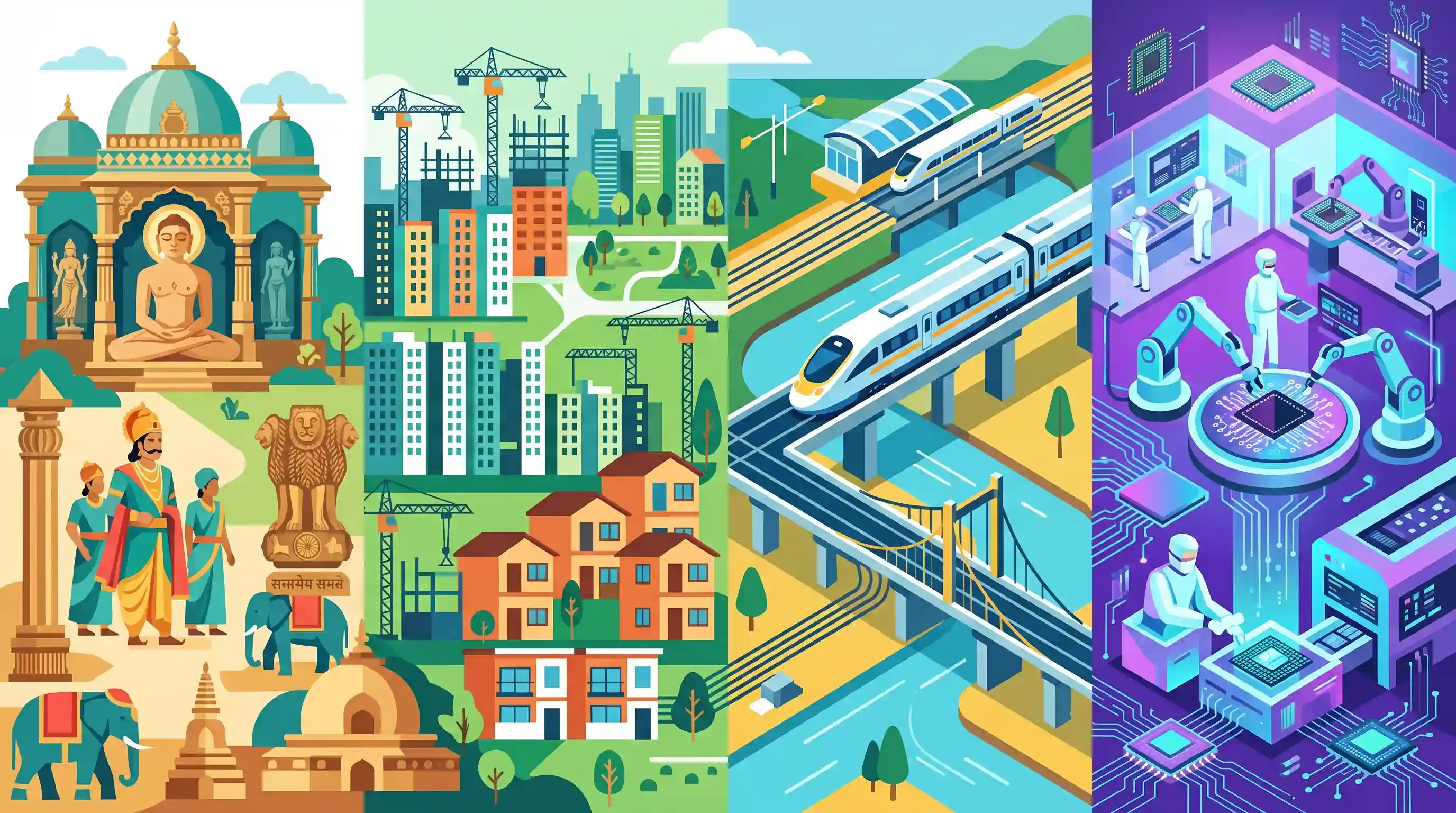
Prime Minister Narendra Modi is scheduled to visit Gujarat to inaugurate a blend of cultural, technological, and infrastructure projects. A key highlight is the launch of the Samrat Samprati Museum at the Shri Mahavir Jain Aradhana Kendra, which celebrates Jain heritage and the Mauryan emperor's legacy. On the technology front, an Outsourced Semiconductor Assembly and Test (OSAT) facility by Kaynes Semicon will be inaugurated in Sanand, providing a major push to the India Semiconductor Mission. Additionally, the PM will lay the foundation for urban and railway projects worth over ₹11,000 crore, encompassing PM Awas Yojana initiatives and regional rail connectivity.
Key Points
- Prime Minister Modi will inaugurate the Samrat Samprati Museum in Gandhinagar, dedicated to Jain heritage and the principles of non-violence.
- An Outsourced Semiconductor Assembly and Test (OSAT) facility by Kaynes Semicon, costing ₹3,300 crore, will be launched in Sanand to bolster the India Semiconductor Mission.
- The OSAT plant will have the capacity to package and test approximately 60 lakh chips per day.
- Infrastructure and urban development projects worth over ₹11,000 crore will be unveiled, including railway lines, PM Awas Yojana housing, and a heritage beautification project in Vadnagar.
- Samrat Samprati, a Mauryan emperor and grandson of Ashoka, is historically significant for his extensive patronage of Jainism.
Important Terms
India Semiconductor Mission (ISM)

A specialized business division under the Ministry of Electronics and IT (MeitY) launched in 2021 to establish a robust, sustainable semiconductor and display ecosystem in India.
UPSC context
GS3 (Economy/S&T); essential for topics on indigenization of technology, electronic manufacturing, and global supply chain resilience.
Samrat Samprati
A Mauryan Emperor and grandson of Ashoka, traditionally known as the 'Jain Ashoka' for his massive patronage of Jainism and construction of thousands of temples across India.
UPSC context
GS1 (Ancient History/Culture); tests knowledge of post-Ashokan Mauryan rulers and their religious patronage (Jainism vs. Buddhism).
Outsourced Semiconductor Assembly and Test (OSAT)
Third-party vendors providing packaging and testing services for semiconductor chips after fabrication; a critical 'back-end' stage in the global semiconductor manufacturing value chain.
UPSC context
GS3 (Science & Technology); relevant for understanding the electronics manufacturing process and India's 'Make in India' high-tech goals.
Pradhan Mantri Awas Yojana (PMAY)
A flagship housing scheme launched in 2015 aiming to provide 'Housing for All' through interest subsidies and financial assistance for the urban and rural poor.
UPSC context
GS2 (Social Justice/Governance) and GS3 (Infrastructure); tests awareness of central welfare schemes and urban/rural development strategies.
Shri Mahavir Jain Aradhana Kendra
A prominent Jain pilgrimage and research center in Koba, Gujarat, hosting the Samrat Samprati Museum and housing India’s largest collection of ancient Jain manuscripts.
UPSC context
GS1 (Indian Heritage & Culture); concerns the preservation of ancient literature, manuscripts, and philosophical traditions.
Prelims Trap
"Samprati, continuing the legacy of his grandfather Ashoka, was a prominent patron of Buddhism."
Samprati is renowned as the "Jain Ashoka." While Ashoka patronized Buddhism, his grandson Samprati heavily patronized Shvetambara Jainism, institutionalizing it in Western/Southern India.
Static Concepts Connected
How did religious patronage shift among major Mauryan Emperors?
- Chandragupta Maurya: Embraced Jainism late in life, migrating to Shravanabelagola with the Jain monk Bhadrabahu.
- Bindusara: Known to have actively patronized the Ajivika sect, a prominent ascetic movement parallel to early Buddhism and Jainism.
- Ashoka and Samprati: Ashoka popularized Buddhism globally, whereas his grandson Samprati became a massive patron of Jainism, constructing thousands of Jain derasars.
What is the difference between a Semiconductor Fab and an OSAT facility?
- Semiconductor Fab: The highly complex front-end process where actual integrated circuits (chips) are printed onto raw silicon wafers.
- OSAT: Outsourced Semiconductor Assembly and Test. The back-end process that cuts, packages, and tests the fabricated chips for final use.
Cross-Topic Patterns
Vadnagar vs. Post-Harappan Dark Age
Excavations at Vadnagar (continuous settlement since 800 BCE) are routinely highlighted by the ASI to challenge the thesis of a post-Harappan "Dark Age" before the Mahajanapadas emerged.
ISM's Pari-Passu Funding Model
Under the India Semiconductor Mission, the 50% central capex subsidy is released on a 'pari-passu' basis, meaning government funds are disbursed proportionally as the private entity deploys its own capital.

Expect a 'pairs matching' question linking Mauryan kings to their patronized sects (Ashoka-Buddhism, Samprati-Jainism) in Prelims 2026.
Linked PYQs · 3
Linked PYQs · 3
- 2025MainsGS3
India aims to become a semiconductor manufacturing hub. What are the challenges faced by the semiconductor industry in India? Mention the salient features of the India Semiconductor Mission.
- 2023PrelimsGS1
"Souls are not only the property of animal and plant life, but also of rocks, running water and many other natural objects not looked on as living by other religious sects." The above statement reflects one of the core beliefs of which one of the following religious sects of ancient India?
- 2011PrelimsGS1
The Jain philosophy holds that the world is created and maintained by
