Navi Mumbai Airport and Metro-3 Project Phase for Urban Transit
Source:Indian Express ↗
Why It Matters
These projects demonstrate the use of the Public-Private Partnership (PPP) model in developing large-scale greenfield infrastructure (airports) and mass rapid transit systems, both critical for sustainable urbanization and economic growth in major metropolitan areas.
Summary
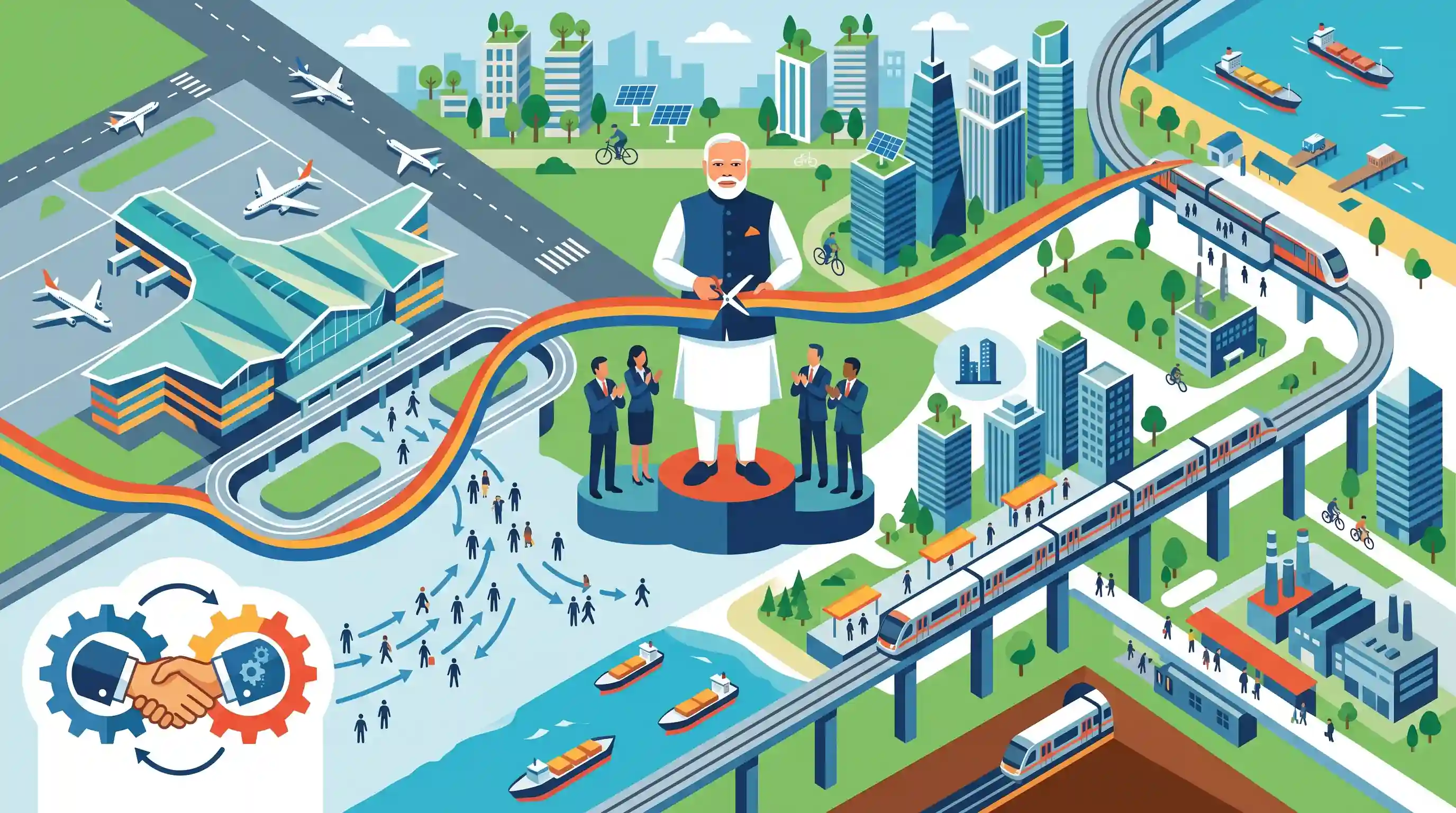
Prime Minister Narendra Modi is scheduled to inaugurate the Navi Mumbai International Airport and the final phase of the Colaba–Bandra–SEEPZ Metro-3 corridor. The events mark a major upgrade to Mumbai's infrastructure, enhancing both urban mass transit and aviation capacity. The greenfield airport, developed under a public-private partnership (PPP) model involving Adani Airport Holdings and CIDCO, will eventually handle up to 90 million passengers annually. Additionally, new metro segments will significantly improve east-west connectivity in India's financial capital.
Key Points
- PM Modi will inaugurate the Navi Mumbai International Airport and the final phase of Mumbai's Metro-3 (Colaba–Bandra–SEEPZ) line, making the 33.5 km corridor fully operational.
- The first phase of Metro Line-2B (Mandale to Chembur) will also be launched to boost east-west urban connectivity.
- Navi Mumbai International Airport is a greenfield project developed via a Public-Private Partnership (PPP) between Adani Airport Holdings Ltd. (74%) and CIDCO (26%).
- The new airport will initially handle 20 million passengers and 0.5 million metric tonnes of cargo, with scalable capacity up to 90 million passengers.
- The state has proposed transferring 58 acres of underutilised Airports Authority of India land in Dahisar to the BMC for urban development.
Important Terms
Airports Authority of India (AAI)

A statutory body under the Ministry of Civil Aviation responsible for creating, maintaining, and managing civil aviation infrastructure and air traffic management services across Indian airspace.
UPSC context
GS Paper 3: Infrastructure (Aviation); crucial for understanding state-led versus private-led aviation development.
CIDCO
The Maharashtra government's nodal agency and premier town planning authority established in 1970 to develop Navi Mumbai and decongest the main city; it holds a 26% stake in NMIAL.
UPSC context
GS Paper 3: Urbanization/Infrastructure; tests knowledge of regional planning authorities and state-level infrastructure agencies.
Public-Private Partnership (PPP)
A collaboration between a government agency and the private sector to finance, build, and operate projects such as airports, sharing risks and rewards while leveraging private efficiency.
UPSC context
GS Paper 3: Investment Models; a core topic for infrastructure financing and economic reforms.
Greenfield Airport
An infrastructure project built from scratch on previously undeveloped land, lacking constraints from prior infrastructure, such as the Navi Mumbai International Airport.
UPSC context
GS Paper 3: Infrastructure; tests the distinction between new developments (Greenfield) and upgrades (Brownfield).
Navi Mumbai International Airport Ltd. (NMIAL)
A Special Purpose Vehicle (SPV) established to develop and operate the Navi Mumbai airport; a joint venture between Adani Airport Holdings (74%) and CIDCO (26%).
UPSC context
GS Paper 3: Infrastructure; specifically related to large-scale multimodal connectivity projects and major domestic aviation hubs.
Special Purpose Vehicle (SPV)
A legal entity created for a specific, narrow objective (like an infrastructure project) to isolate financial risk and ensure focused management, such as NMIAL for airport development.
UPSC context
GS Paper 3: Economy/Infrastructure; relevant for project financing and organizational structures in large-scale public works.
Prelims Trap
"Under the Greenfield Airports Policy, new greenfield airports can only be developed by the Airports Authority of India (AAI)."
The policy allows private entities, state governments, or PPP joint ventures to propose and develop greenfield airports; it is not restricted to the Union government.
Static Concepts Connected
What distinguishes Greenfield from Brownfield infrastructure projects?
- Greenfield: Built entirely from scratch on undeveloped land, offering maximum design flexibility and the integration of modern environmental standards.
- Brownfield: Modifying, upgrading, or expanding existing facilities. Constrained by prior structures but typically involves lower land-acquisition hurdles and faster implementation.
What are the core provisions of India's Greenfield Airports Policy (2008)?
- Two-stage approval: Project proponents must secure a mandatory two-stage clearance: 'Site Clearance' followed by 'In-Principle' approval from the Ministry of Civil Aviation.
- Investment flexibility: 100% FDI is allowed under the automatic route. Projects can be proposed by state governments, private developers, or joint ventures.
- 150 km rule: Generally prohibits the construction of a new greenfield airport within a 150 km radius of an existing civilian airport, unless specifically exempted.
Cross-Topic Patterns
Asset monetization meets urban planning
Transferring underutilized AAI land to local civic bodies mirrors the broader National Monetisation Pipeline strategy, aiming to unlock dormant asset value to fund core infrastructure.
Divergent PPP viability in infrastructure
While airports increasingly rely on PPP joint ventures (like CIDCO-Adani), urban metro rail systems often fall back on state-center EPC models due to immense capital intensity and longer gestation.

Expect a 2026 prelims statement testing the Greenfield Airports Policy's 150 km rule alongside FDI limits in aviation.
Linked PYQs · 4
Linked PYQs · 4
- 2017MainsGS3
Examine the development of Airports in India through joint ventures under Public-Private Partnership (PPP) model. What are the challenges faced by the authorities in this regard?
- 2022MainsGS3
Why is Public Private Partnership (PPP) required in infrastructural projects ? Examine the role of PPP model in the redevelopment of Railway Stations in India.
- 2024MainsGS3
What is the need for expanding the regional air connectivity in India? In this context, discuss the government's UDAN Scheme and its achievements.
- 2021MainsGS3
“Investment in infrastructure is essential for more rapid and inclusive economic growth.” Discuss in the light of India's experience.
