AI Impact Summit in New Delhi Promotes Human-Centric Tech Governance
Source:The Hindu ↗
Why It Matters
This event highlights India's strategic push to lead the Global South in the critical domain of emerging technologies. It underscores India's foreign policy objective to democratize digital access and shape international rule-making around AI governance, diverging from the regulation-heavy approaches of Western nations.
Summary
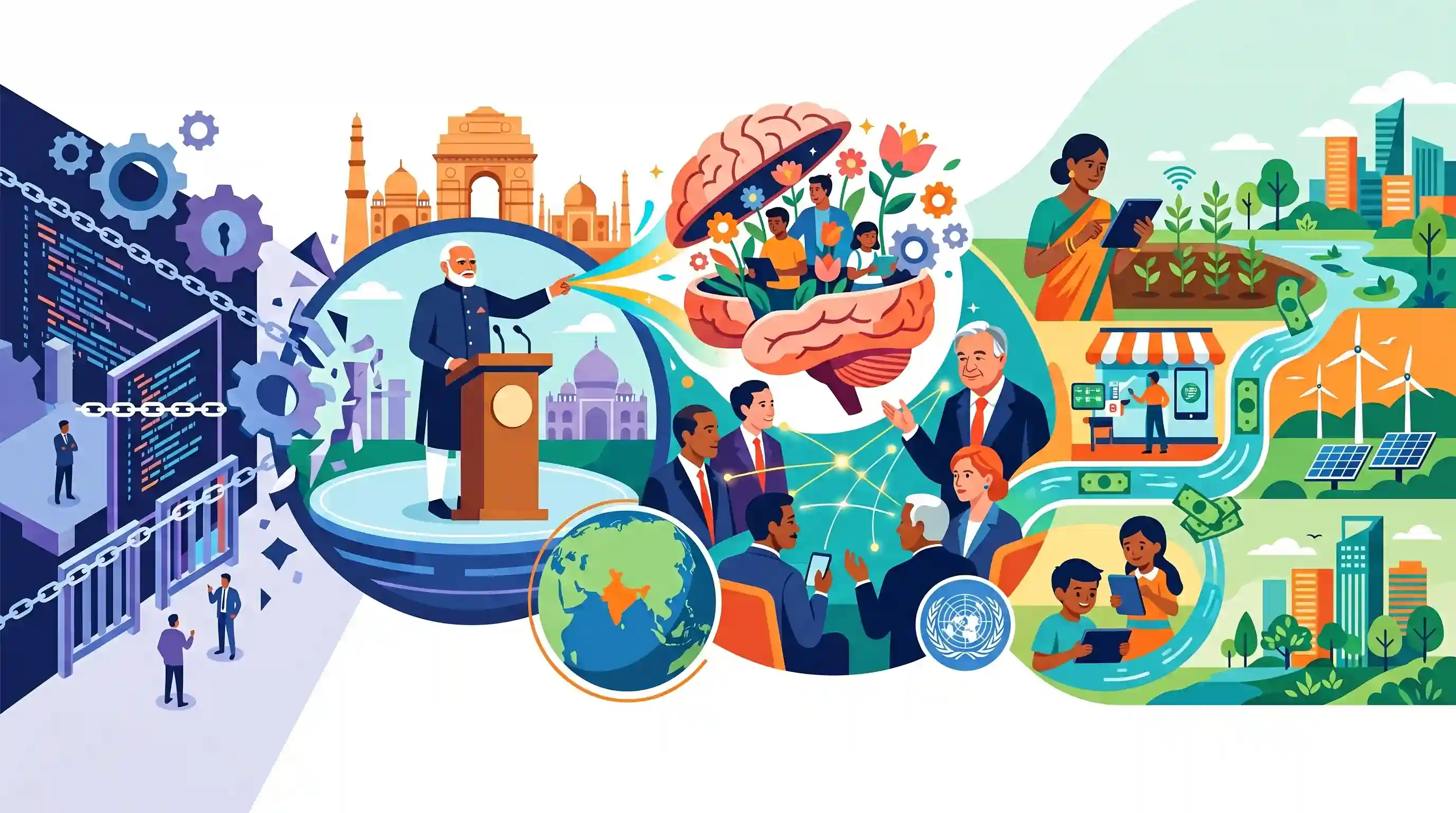
India is hosting the Artificial Intelligence Impact Summit 2026 in New Delhi, becoming the first Global South country to do so. Inaugurated by PM Modi, the summit seeks to reframe the global AI debate from strict regulatory frameworks toward a 'human-centric' approach that prioritizes equitable access to technology and economic good for developing economies. The event has attracted global tech leaders, the UN Secretary-General, and heads of state from 20 countries.
Key Points
- India is hosting the 4th AI Impact Summit 2026 at Bharat Mandapam in New Delhi, the first time the summit is hosted by a Global South nation.
- PM Narendra Modi will inaugurate the 'India AI Impact Expo 2026', with the summit structured across three thematic chakras: People, Planet, and Progress.
- Unlike developed nations focusing primarily on regulatory frameworks, India is pushing for a 'human-centric' approach, equitable access to AI resources, and fair rule-making for economic good.
- The event features top global tech CEOs like Sundar Pichai and Sam Altman, UN Secretary-General Antonio Guterres, and leaders from around 20 nations.
- PM Modi will hold concurrent bilateral talks with French President Emmanuel Macron and Brazilian President Lula during the summit.
Important Terms
Global South

A collective term for developing and least-developed nations, primarily in the Southern Hemisphere, prioritizing economic equity, technology access, and developmental sovereignty.
UPSC context
GS II: International Relations. Essential for India’s "Voice of Global South" diplomacy and leadership in multilateral forums.
IndiaAI Mission
A comprehensive national initiative to build India's AI ecosystem through 10,000+ GPUs, indigenous large language models (LMMs), and safe, trusted datasets.
UPSC context
GS III: Science & Technology. Focuses on indigenization, digital sovereignty, and the socio-economic impact of emerging technologies.
United Nations
The primary international body coordinating global AI governance through mechanisms like the High-Level Advisory Body on AI and the Global Digital Compact.
UPSC context
GS II: International Institutions. Relevant for global standards, ethical frameworks, and the democratization of technology.
External Affairs Ministry
The government ministry responsible for "AI Diplomacy," utilizing technology summits to build strategic partnerships and export India's digital governance models globally.
UPSC context
GS II: India’s Foreign Policy. Tests India's role as a "bridge power" in global technology governance.
OpenAI
An American AI research lab and developer of ChatGPT, often used in policy debates as a representative of "Big Tech" and generative AI.
UPSC context
GS III: Science & Technology. Relevant for awareness of cutting-edge AI developments, ethical concerns, and regulatory challenges.
Digital Public Infrastructure (DPI)
Open-source digital blocks (like UPI and Bhashini) that enable large-scale public service delivery, now being integrated with AI for human-centric governance.
UPSC context
GS III: Governance & Economy. Core for digital transformation, financial inclusion, and India's soft power.
Prelims Trap
India is hosting the first AI Impact Summit to establish strict globally binding AI regulatory frameworks.
India is hosting the 4th edition (UK hosted the 1st). Crucially, India champions a development-focused approach, actively contrasting with Western pushes for strict AI regulation.
Static Concepts Connected
What role do Sovereign Digital Public Infrastructures (DPIs) play in governance?
- Open Standards: Built on open standards and APIs, preventing vendor lock-in and allowing interoperability across government departments and private innovators.
- Data Sovereignty: Ensures citizen data remains localized and governed by national legal frameworks rather than foreign tech monopolies.
- Equitable Access: Tools like Bhashini (AI translation) or UPI democratize access, ensuring tech benefits reach the grassroots regardless of literacy or language.
How does the Global South differ from the West in technology diplomacy?
- Regulatory vs Developmental: Western nations often prioritize strict security guardrails, risk mitigation, and copyright protections in emerging tech like AI.
- Focus on Access: Developing nations prioritize technology transfer, capacity building, open-source models, and leveraging tech for poverty alleviation and economic growth.
Cross-Topic Patterns
Tech Diplomacy as Soft Power
India uses digital public goods (UPI, Bhashini) and summit leadership to champion Global South interests, countering Western 'digital colonization' and cementing its role as a tech-diplomacy leader.
AI, Bhashini, and Linguistic Inclusion
Deploying sovereign AI platforms like Bhashini for grassroots governance connects digital inclusion to 8th Schedule languages, ensuring equitable access to welfare schemes for non-English speakers.

Expect a 2026 multi-statement Prelims question contrasting India’s 'M.A.N.A.V' AI vision with the EU AI Act or the UK Bletchley model.
Linked PYQs · 3
Linked PYQs · 3
- 2023MainsGS3
Introduce the concept of Artificial Intelligence (AI). How does Al help clinical diagnosis? Do you perceive any threat to privacy of the individual in the use of Al in healthcare?
- 2024MainsGS4
The application of Artificial Intelligence as a dependable source of input for administrative rational decision-making is a debatable issue. Critically examine the statement from the ethical point of view.
- 2025MainsGS2
India-Africa digital partnership is achieving mutual respect, co-development and long-term institutional partnerships. Elaborate.
