India AI Impact Expo Champions Global South Interests
Source:The Hindu ↗
Why It Matters
The article highlights India's evolving stance on global technology governance, contrasting with the West's regulation-heavy approach by prioritizing developmental impact and equitable access. This is highly relevant for questions on India's role in the Global South, the ethics and governance of emerging technologies, and digital diplomacy.
Summary
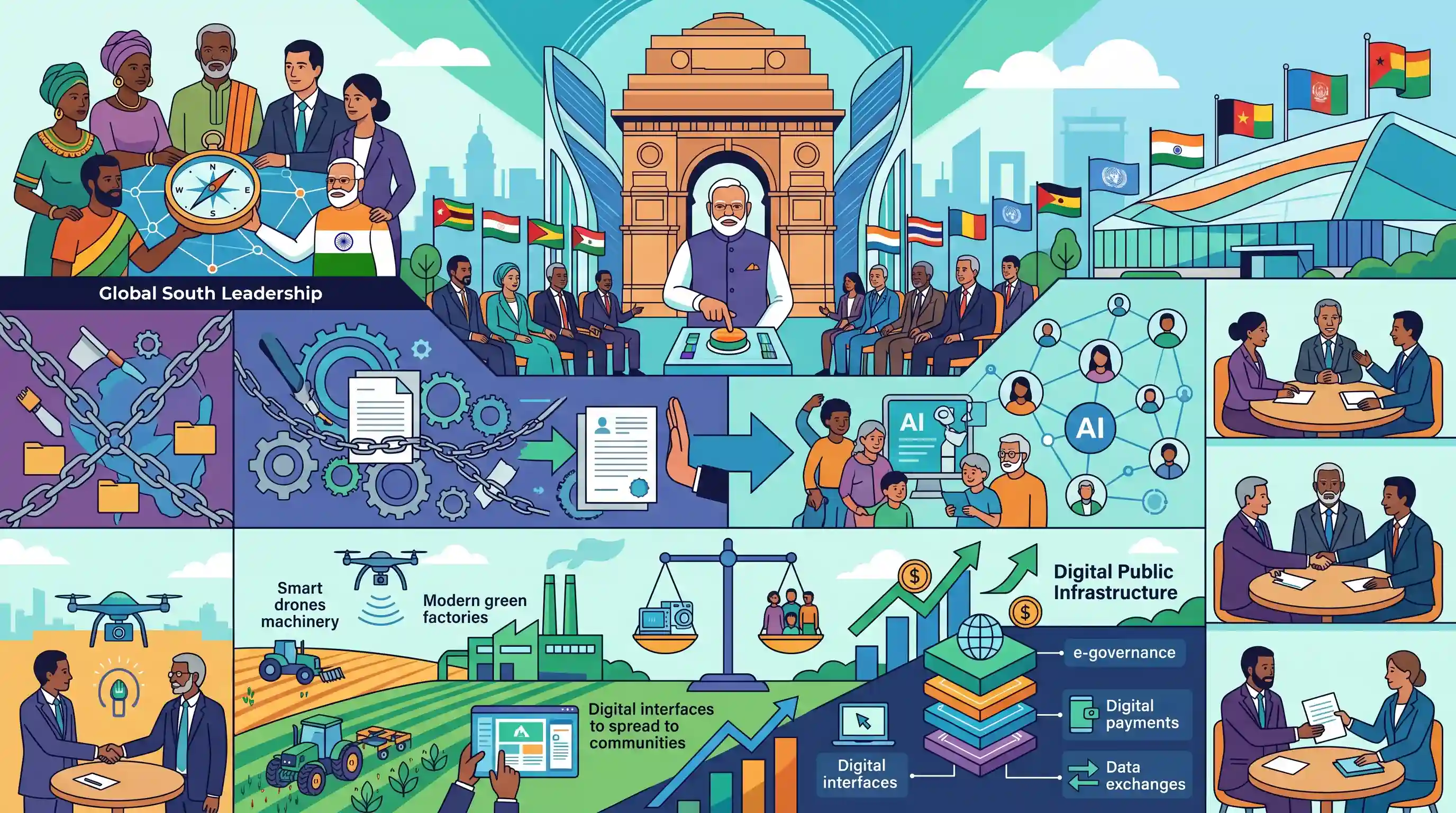
Prime Minister Narendra Modi is inaugurating the 'India AI Impact Expo 2026' as part of the 4th AI Impact Summit held in New Delhi, featuring vast international participation including state heads, the UN Secretary-General, and leading tech CEOs. Marking the first time the summit is hosted by a Global South country, India aims to steer the global discourse away from rigid regulatory frameworks toward a 'human-centric' AI approach focused on widespread economic benefits and equitable resource access for developing nations. The event will also facilitate significant bilateral diplomatic meetings.
Key Points
- The India AI Impact Expo 2026, inaugurated by PM Modi, is part of the 4th AI Impact Summit being held at Bharat Mandapam in New Delhi.
- India is utilizing the summit to champion the voice of the Global South, pushing for equitable access to AI resources and fair rule-making in digital policy.
- Unlike developed nations focusing on strict regulatory frameworks, India is advocating a 'human-centric' approach to AI aimed at 'economic good.'
- The summit is drawing massive global participation, including over 100 countries, top tech CEOs like Sundar Pichai and Sam Altman, UN Secretary-General Antonio Guterres, and leaders like French President Macron.
- The presence of Bill Gates at the summit has drawn criticism from the Opposition due to his past association with convicted sex offender Jeffrey Epstein.
Important Terms
Global South

A group of developing, less-developed, or under-developed nations, primarily in Asia, Africa, and Latin America, advocating for equitable global resource access.
UPSC context
GS Paper 2: International Relations; central to India’s strategic leadership and bridge-building in global governance forums.
Digital Public Infrastructure (DPI)
A shared digital framework (e.g., Aadhaar, UPI) built on open standards and APIs to enable secure, large-scale public and private service delivery.
UPSC context
GS Paper 3: Science & Technology/Economy; tests India's "India Stack" model and its role as a global public good.
Human-centric AI
India's policy framework (e.g., M.A.N.A.V. vision) that prioritizes ethical safeguards, accountability, and inclusivity over purely commercial or state-centric technological advancement.
UPSC context
GS Paper 3/4: S&T and Ethics; tests India's regulatory philosophy and its contrast with Western/Chinese models.
External Affairs Ministry (MEA)
The Indian government body responsible for managing foreign relations and coordinating international summits like the AI Impact Summit 2026.
UPSC context
GS Paper 2: International Relations; tests institutional roles in bilateral and multilateral technological diplomacy.
United Nations
An international organization fostering global cooperation; in AI, it facilitates norms for security, development, and Sustainable Development Goals (SDGs).
UPSC context
GS Paper 2: International Institutions; relevant for global governance frameworks and international technology standards.
Nvidia
The world's leading semiconductor company producing high-performance GPUs, essential for the "compute" capacity required to train and deploy advanced AI.
UPSC context
GS Paper 3: Science & Technology; relevant to India's "AI Mission" and goals for compute sovereignty and hardware self-reliance.
OpenAI
A prominent American AI research organization responsible for "frontier" models like ChatGPT, representing the commercial leadership in generative AI.
UPSC context
GS Paper 3: Science & Technology; tests understanding of the generative AI landscape and private-sector influence on global regulation.
Prelims Trap
"India is using the AI Impact Summit to advocate for rigid, legally binding global regulations similar to the EU AI Act."
India opposes rigid, EU-style frameworks, instead championing a 'human-centric', pro-innovation approach that prioritizes socio-economic development and equitable access for the Global South.
Static Concepts Connected
What are the core pillars of India's Digital Public Infrastructure (DPI) model?
- Interoperable layers: Built on open, interoperable standards and APIs that prevent vendor lock-in and promote broad digital inclusion across diverse linguistic and economic demographics.
- Public-private synergy: The government builds the foundational digital rails, while private sector startups and enterprises build scalable, innovative solutions on top of them.
- Data empowerment: Employs a consent-based data sharing architecture (like the Data Empowerment and Protection Architecture) to prioritize user privacy over corporate data monopolies.
How has the global institutional framework for AI governance evolved?
- Bletchley Declaration: Signed at the UK AI Safety Summit (2023), establishing the first major multilateral consensus recognizing the safety risks of frontier AI models.
- EU AI Act: The world's first comprehensive legal framework adopting a strict, risk-based categorization that bans unacceptable AI uses and heavily regulates high-risk systems.
- GPAI Framework: A multi-stakeholder initiative bridging the gap between theory and practice, focusing on responsible, human-centric development of AI across member nations.
Cross-Topic Patterns
Tech Diplomacy + Global South Voice
India's use of AI as a soft power tool mirrors its vaccine diplomacy, positioning it as the voice of developing nations against 'techno-nationalism' by the Global North.
Sovereign AI + Data Governance
The demand for equitable AI compute connects directly to India's push for Sovereign AI (IndiaAI Mission) and data localization to counter monopolistic control by Western Big Tech.

GS3 Mains 2026 will likely ask to contrast India's developmental 'AI for All' approach with the Global North's strict regulatory models.
Linked PYQs · 4
Linked PYQs · 4
- 2023MainsGS3
Introduce the concept of Artificial Intelligence (AI). How does Al help clinical diagnosis? Do you perceive any threat to privacy of the individual in the use of Al in healthcare?
- 2025MainsGS2
India-Africa digital partnership is achieving mutual respect, co-development and long-term institutional partnerships. Elaborate.
- 2020PrelimsGS1
With the present state of development, Artificial Intelligence can effectively do which of the following? 1. Bring down electricity consumption in industrial units 2. Create meaningful short stories and songs 3. Disease diagnosis 4. Text-to-Speech Conversion 5. Wireless transmission of electrical energy Select the correct answer using the code given below:
- 2021MainsGS2
Has digital illiteracy, particularly in rural areas, coupled with lack of Information and Communication Technology (ICT) accessibility hindered socio-economic development? Examine with justification.
