Prime Minister inaugurates new metro rail stretches in Kolkata
Source:The Hindu ↗
Why It Matters
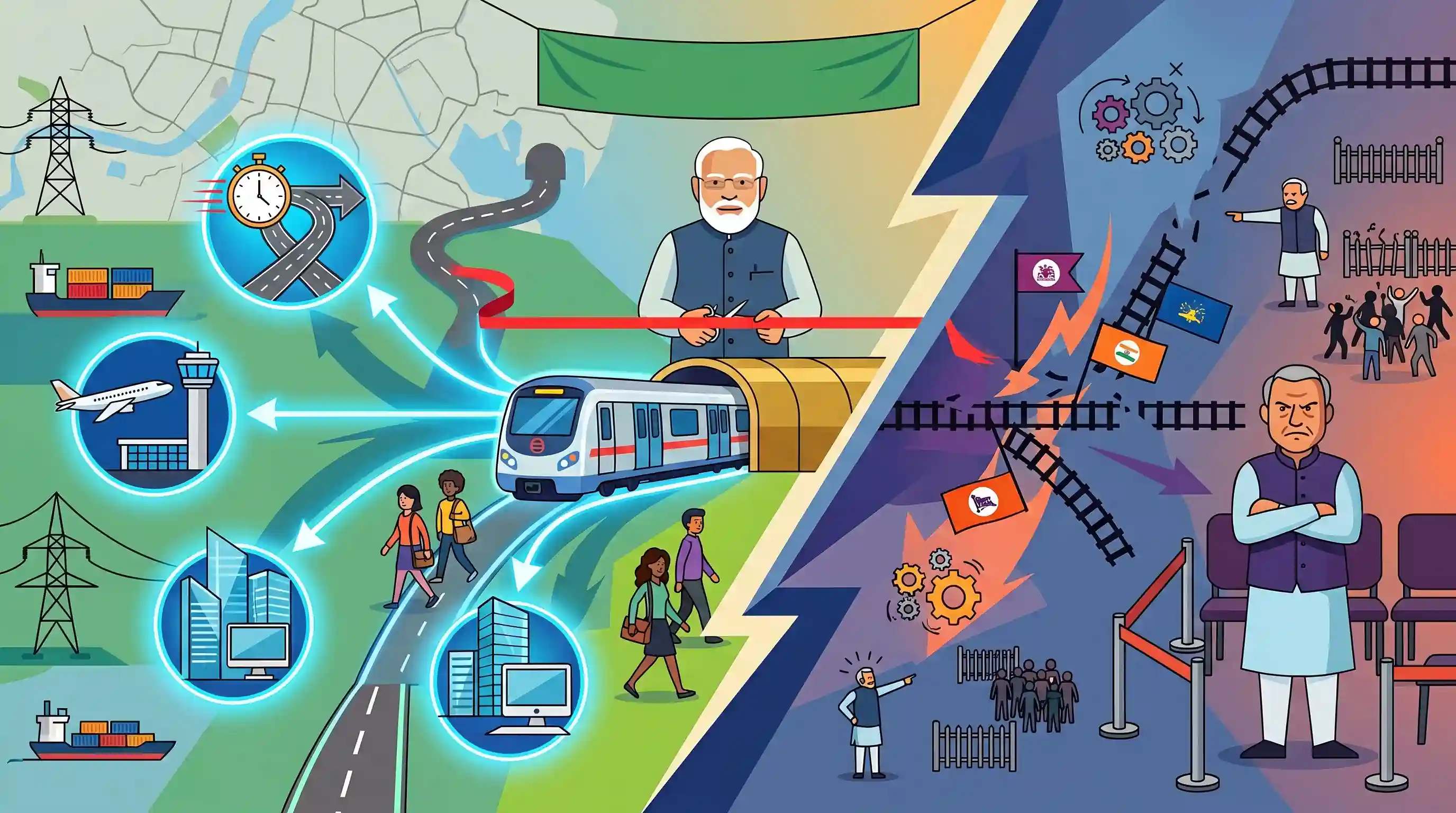
Demonstrates the critical role of urban mass transit in improving economic efficiency and city life, while also serving as a practical case study of how Centre-State political dynamics and credit-seeking can impact the narrative around major infrastructure projects.
Summary
Prime Minister Narendra Modi inaugurated three key Metro Railway extensions in Kolkata, significantly boosting urban mobility by connecting major transit points, the airport, and the IT hub while drastically reducing travel times. The infrastructure push, however, was overshadowed by ongoing Centre-State political friction. The ruling TMC boycotted the event and claimed historical credit for the projects, while PM Modi leveraged the occasion to critique the state government on governance and security issues, underscoring the complexities of cooperative federalism in India where developmental milestones often become political battlegrounds.
Key Points
- PM Narendra Modi flagged off three new Metro Railway stretches in Kolkata, adding 13.61 km to the city's urban transit network.
- The expansion drastically cuts commute times, linking major hubs like Howrah, Sealdah, the international airport, and Kolkata's IT sector.
- The inauguration highlighted Centre-State political friction, with the ruling TMC leadership missing the event and claiming credit for approving the projects during Mamata Banerjee's tenure as Railway Minister.
- PM Modi used the platform to critique the State government on governance issues, infiltration, and atrocities against women, contrasting it with the Centre's focus on infrastructural development.
Important Terms
Metro Railway (Kolkata)

A high-capacity, high-frequency urban rail transit system. The Kolkata Metro, inaugurated in 1984, was India's first such system and includes the country's first underwater transportation tunnel.
UPSC context
GS3 (Infrastructure/Railways). Tests knowledge of India's oldest metro, its unique underwater tunnel, and role in decongesting major urban centers.
Ministry of Railways
A Union-level ministry that governs rail transport. It is uniquely the direct owner and operator of the Kolkata Metro, which functions as a separate railway zone (Zone 17).
UPSC context
GS2 (Government Policies). Evaluates understanding of administrative jurisdictional nuances and the Union's direct role in state-level transport infrastructure.
Cooperative Federalism
A constitutional concept where the Union and State governments work collaboratively. Frictions over project credit and inauguration boycotts highlight the challenges of 'Competitive Federalism' in India.
UPSC context
GS2 (Federal Structure). Crucial for questions on Centre-State relations, jurisdictional overlaps, and political friction in developmental milestones.
Urban Mobility
The movement of people within urban areas using public and private transport. Efficient mobility is critical for economic productivity and addressing problems like traffic congestion and air pollution.
UPSC context
GS1 (Urbanization) and GS3 (Infrastructure). Tests remedies for urbanization challenges, including transit-oriented development and sustainable city planning.
Mass Rapid Transit System (MRTS)
A technical term for high-capacity public transport systems, such as Metros and RRTS, designed to provide rapid, grade-separated transit within and between metropolitan regions.
UPSC context
GS3 (Infrastructure). Concerns the technical, economic, and environmental feasibility of large-scale public transport projects in India.
Prelims Trap
Metro Rail projects fall under the exclusive legislative domain of State Governments.
While urban planning is a State subject, Metro Railways are governed by Central Acts (Metro Railways Act 2009) and implemented as 50:50 Centre-State Special Purpose Vehicles (SPVs).
Static Concepts Connected
What are the core mandates of the Metro Rail Policy 2017?
- PPP Requirement: Private participation is mandatory for securing central financial assistance for new metro projects.
- Funding Models: Central support is provided via a 50:50 Equity Joint Venture or a lump sum grant up to 10% of the total project cost.
- Non-Fare Revenue: Mandates Transit-Oriented Development (TOD) and commercial exploitation of land to ensure long-term financial viability.
How do Metro SPVs impact the functioning of Urban Local Bodies (ULBs)?
- Parastatal Encroachment: SPVs operate as parastatals outside ULB jurisdiction, absorbing urban planning functions intended for municipalities under the 74th Constitutional Amendment Act.
- Democratic Deficit: The reliance on bureaucratic Special Purpose Vehicles rather than elected local governments creates a governance gap and lack of direct civic accountability.
Cross-Topic Patterns
Urban Mobility + Parastatal Bodies
Metro SPVs frequently bypass elected municipal corporations, showcasing the tension between rapid infrastructure deployment and local democratic decentralization envisioned in the 74th Constitutional Amendment Act.
Federalism + Infrastructure Financing
Joint-venture mega-projects increasingly trigger credit-claiming disputes, illustrating the practical challenges of cooperative federalism when shared funding meets partisan electoral politics.

Expect a Mains question evaluating how parastatal SPVs in urban transit (like Metro Rail) impact the 74th Amendment's devolution goals.
Linked PYQs · 3
Linked PYQs · 3
- 2019MainsGS1
How is efficient and affordable urban mass transport key to the rapid economic development of India?
- 2021MainsGS3
“Investment in infrastructure is essential for more rapid and inclusive economic growth.” Discuss in the light of India's experience.
- 2024MainsGS2
What changes has the Union Government recently introduced in the domain of Centre-State relations ? Suggest measures to be adopted to build the trust between the Centre and the States and for strengthening federalism.
