Indigenised Namo Bharat and Amrit Bharat Trains in Bihar
Source:The Hindu ↗
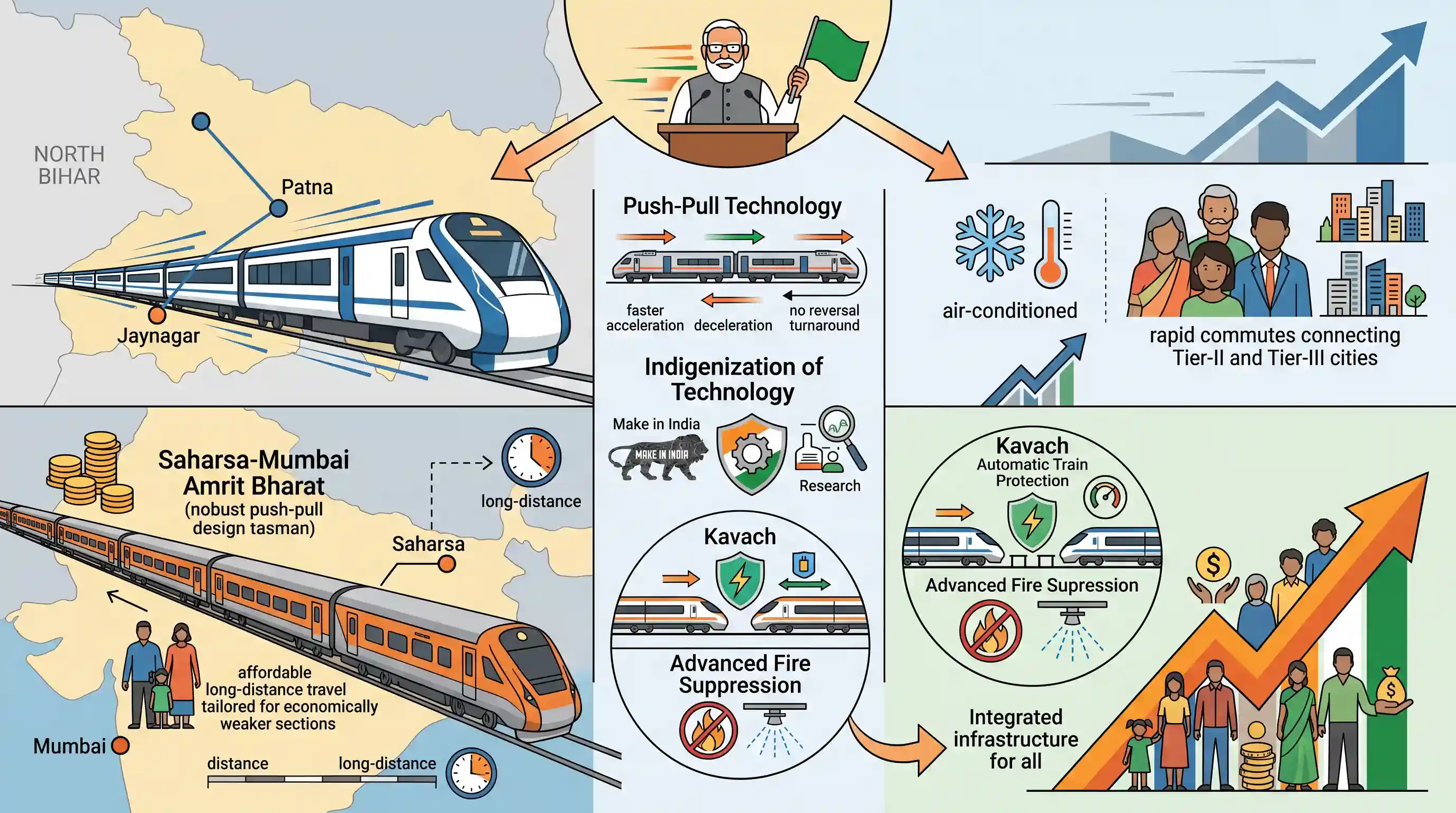
Why It Matters
The rollout of specialized trains like Amrit Bharat and Namo Bharat exemplifies India\'s strategy to democratize modern transport. For UPSC aspirants, these initiatives are prime examples of applying indigenous technology (like Kavach and push-pull systems) to upgrade critical infrastructure, ensuring that high-quality, safe connectivity reaches economically weaker sections and Tier-II/III cities.
Summary
Prime Minister Narendra Modi will inaugurate two new train services in Bihar, aimed at bolstering regional and national connectivity. The Saharsa-Mumbai Amrit Bharat train offers affordable, long-distance travel tailored for economically weaker sections, while the Jaynagar-Patna Namo Bharat provides rapid, air-conditioned commutes connecting key Tier-II and Tier-III cities. Both train types utilize advanced \'push-pull\' technology for faster turnarounds and integrate indigenous technologies like the \'Kavach\' collision protection system and advanced fire suppression, reflecting an ongoing push for modernized, inclusive railway infrastructure.
Key Points
- PM Narendra Modi is set to flag off two new train services in Bihar: the Saharsa-Mumbai Amrit Bharat and the Jaynagar-Patna Namo Bharat.
- Amrit Bharat trains provide low-cost, long-distance travel aimed at middle-class and economically weaker sections, operating at speeds up to 130 kmph.
- Namo Bharat services focus on rapid, air-conditioned intercity commutes, improving connectivity between urban centers and Tier-II/Tier-III cities.
- Both trains feature \'push-pull\' technology to minimize terminal turnaround time, and incorporate modern safety features like the indigenous \'Kavach\' system, aerosol-based fire suppression, and On-board Condition Monitoring Systems.
Important Terms
Amrit Bharat Express

A low-cost, non-AC superfast express service for long-distance travel. It utilizes push-pull technology and offers modern amenities like CCTV and bio-toilets to provide inclusive, affordable rail infrastructure.
UPSC context
GS Paper 3 (Infrastructure/Railways); tests knowledge of inclusive growth and affordable public transport initiatives.
Namo Bharat Rapid Rail
Formerly Vande Metro, this high-speed intercity service (110–130 km/h) is designed for rapid regional commutes. It connects urban hubs with Tier-II/III cities using air-conditioned coaches and advanced safety features.
UPSC context
GS Paper 3 (Infrastructure); tests understanding of regional connectivity and semi-high-speed transit systems.
Kavach (Automatic Train Protection)
An indigenously developed Automatic Train Protection (ATP) system. It prevents collisions by automatically applying brakes if a train overshoots signals or detects another train on the same track (SIL-4 certified).
UPSC context
GS Paper 3 (S&T/Infrastructure); tests knowledge of indigenization and safety technology in critical infrastructure.
Push-Pull Technology
A locomotive configuration placing engines at both the front and rear of a train. It enhances acceleration and eliminates engine reversal at terminals, significantly reducing turnaround times and improving efficiency.
UPSC context
GS Paper 3 (Infrastructure/Modernization); tests awareness of technical advancements in rail efficiency.
Integral Coach Factory (ICF)
The world’s largest coach-manufacturing unit of Indian Railways, located in Chennai. It is the lead facility for developing indigenous trainsets, including Vande Bharat, Amrit Bharat, and Namo Bharat.
UPSC context
GS Paper 3 (Economy); tests familiarity with 'Make in India' and domestic manufacturing hubs.
Prelims Trap
"Amrit Bharat trains are premium, air-conditioned rapid transit services designed to connect Tier-II and Tier-III cities."
Amrit Bharat is intentionally non-AC and low-cost to serve the unreserved migrant workforce. Namo Bharat handles rapid, air-conditioned commutes. Aspirants often confuse their specific use-cases.
Static Concepts Connected
What is the 'Kavach' Automatic Train Protection (ATP) system?
- RFID Tracking: It utilizes track-mounted Radio Frequency Identification (RFID) tags and ultra-high-frequency radio to continuously track train movement and positioning.
- Collision Prevention: It automatically overrides the loco pilot to apply brakes if a train passes a red signal (Signal Passed at Danger) or if another train is on the same line.
- Indigenous Design: Developed indigenously by the Research Designs and Standards Organisation (RDSO), it holds Safety Integrity Level 4 (SIL-4) certification.
What are the core objectives of the National Rail Plan (NRP) 2030?
- Freight Modal Share: To increase the modal share of Indian Railways in national freight traffic from the current ~27% to 45% by the year 2030.
- Future-Ready Capacity: To create infrastructure capacity ahead of demand by 2030, ensuring the railway network can seamlessly handle anticipated traffic growth up to 2050.
- Speed Corridors: Upgrading speeds on key passenger corridors (like Delhi-Howrah and Delhi-Mumbai) to 160 kmph to drastically reduce intercity travel time.
Cross-Topic Patterns
Internal Migration & Rail Infrastructure
Amrit Bharat trains directly support India's unorganized migrant workforce by providing affordable transport between labor-surplus states (Bihar) and economic hubs (Mumbai), mapping infrastructure to demographic realities.
Make in India & Safety Tech Indigenization
The transition to the RDSO-developed 'Kavach' system illustrates the 'Make in India' push within critical infrastructure, replacing expensive imported safety systems and reinforcing technological sovereignty.

Expect a Prelims matching question distinguishing the target demographics and core technologies of Vande, Amrit, and Namo Bharat trains.
Linked PYQs · 3
Linked PYQs · 3
- 2025PrelimsGS1
Consider the following statements : I. Indian Railways have prepared a National Rail Plan (NRP) to create a 'future ready' railway system by 2028. II. 'Kavach' is an Automatic Train Protection system developed in collaboration with Germany. III. 'Kavach' system consists of RFID tags fitted on track in station section. Which of the statements given above are not correct?
- 2022MainsGS3
Why is Public Private Partnership (PPP) required in infrastructural projects ? Examine the role of PPP model in the redevelopment of Railway Stations in India.
- 2021MainsGS3
“Investment in infrastructure is essential for more rapid and inclusive economic growth.” Discuss in the light of India's experience.
