India Multilateral Engagement and Major Power Geopolitics
Source:Indian Express ↗
Why It Matters
The interplay between major powers (US-China rivalry, Russia-Ukraine war, G7's influence) forms the core of contemporary international relations. Understanding these dynamics is essential for analyzing India's foreign policy maneuvering, strategic autonomy, and representation of the Global South.
Summary
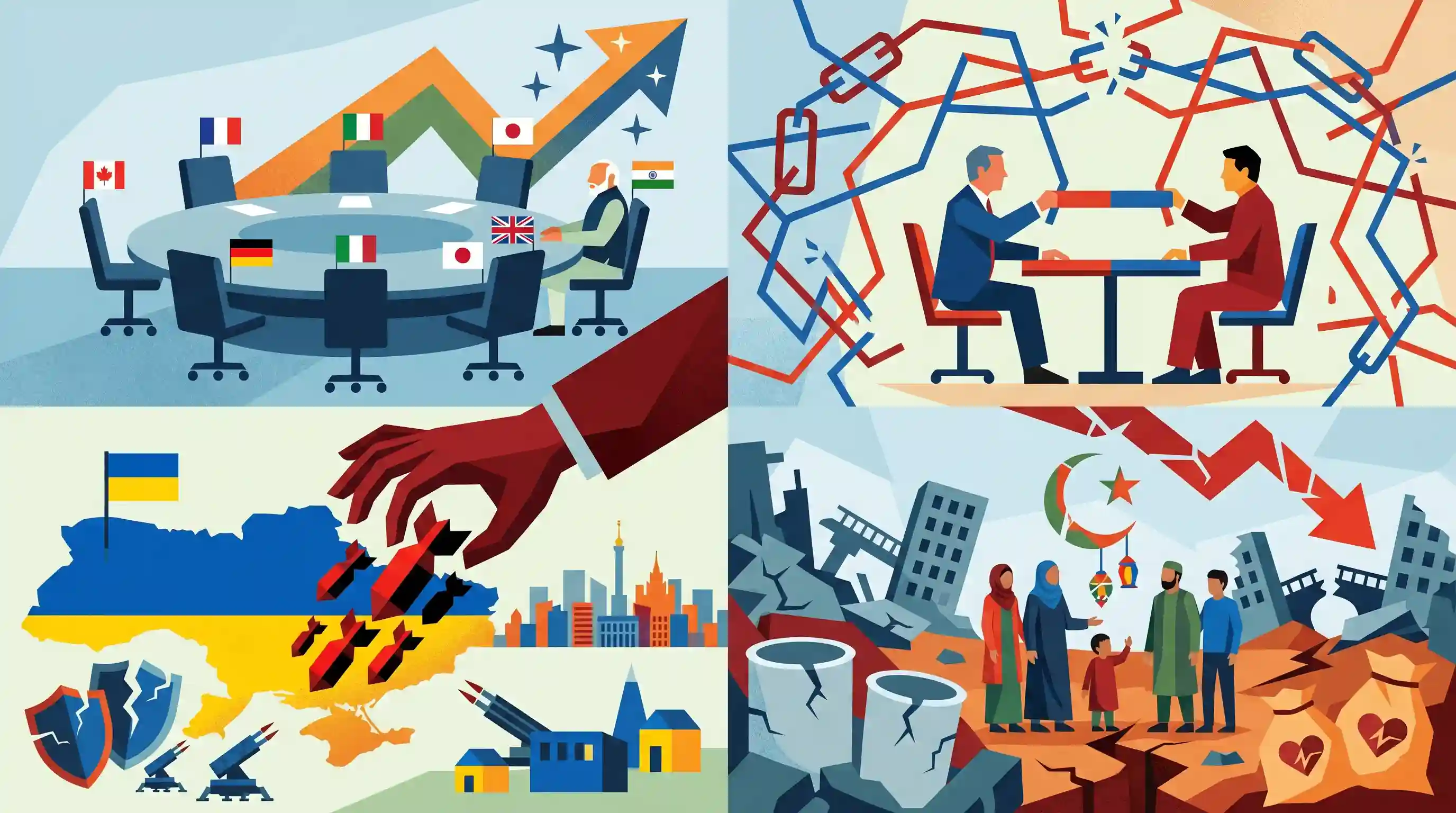
This weekly roundup highlights pivotal international developments: Prime Minister Narendra Modi's scheduled attendance at the G7 Summit, underscoring India's expanding role in global governance. Meanwhile, the US and China have resumed direct talks, an essential move to manage their complex geopolitical rivalry. In conflict zones, Russia continues its bombardment of Ukraine, while the population in Gaza observed Eid amidst severe humanitarian conditions and ongoing destruction.
Key Points
- Prime Minister Narendra Modi's participation in the upcoming G7 Summit underscores India's rising significance as a critical voice for the Global South in major international forums.
- The United States and China have resumed direct diplomatic dialogues, a necessary step in managing their strategic competition and stabilizing global geopolitics.
- The Russia-Ukraine conflict persists with ongoing bombardments, continuing to impact European security and global supply chains.
- The humanitarian crisis in Gaza continues unabated, casting a shadow over Eid observances amidst ongoing hostilities with Israel.
Important Terms
G7 (Group of Seven)

An informal forum of seven leading industrialized democracies (USA, UK, France, Germany, Italy, Japan, Canada) coordinating global economic, security, and energy policies; the EU also participates.
UPSC context
GS Paper-2: International Relations; tests knowledge of global groupings and India’s role as a recurring 'Outreach' partner.
Hamas
A Palestinian Sunni-Islamic militant and political organization that has governed the Gaza Strip since 2007; it is a primary party in the current conflict with Israel.
UPSC context
GS Paper-2: International Relations; critical for understanding West Asian geopolitics and the Israel-Palestine conflict’s impact on India.
Global South
Developing or emerging economies in Africa, Asia, and Latin America; India frequently positions itself as the 'Voice of the Global South' to advocate for equitable global governance.
UPSC context
GS Paper-2: International Relations; tests India’s leadership in representing developing nations and reforming international institutions.
Outreach Country
A non-member nation (like India at the G7) invited to participate in specific summit sessions to enhance the forum’s geographic representation and global legitimacy.
UPSC context
GS Paper-2: International Relations; examines India’s strategy of engaging elite global clubs to influence international agendas.
Bilateralism
The conduct of political or economic relations between two sovereign states; essential for managing high-stakes rivalries like US-China or deepening India’s strategic ties.
UPSC context
GS Paper-2: Bilateral Relations; focuses on the dynamics of major power interactions and India’s individual diplomatic partnerships.
Prelims Trap
The G7 is a treaty-based organization with a permanent secretariat, and India is an associate member.
The G7 is an informal, non-treaty forum without a founding charter or permanent secretariat. Furthermore, India is not a member, but a frequent guest invitee.
Static Concepts Connected
What distinguishes the G7 from the G20 in structure and membership?
- Membership profile: The G7 contains only advanced industrialized democracies; the G20 is broader, including developing economies (like BRICS), the EU, and the African Union.
- Institutional backing: Neither group has a permanent secretariat or founding treaty; both rely entirely on rotating presidencies to set their annual agendas and host summits.
- Core focus: While G7 historically drives global security and macroeconomic alignment among western allies, the G20 explicitly targets broader international financial stability.
What are the key geographical boundaries and access points of the Gaza Strip?
- Southwestern border: Shares its southwestern border with Egypt, controlled primarily through the Rafah crossing, which is highly restricted.
- Eastern/Northern border: Enclosed to the east and north by Israel, which heavily controls the movement of goods, utilities, and people (e.g., via Erez and Kerem Shalom crossings).
- Western coast: Bordered by the Mediterranean Sea to the west, though maritime access and fishing zones are strictly blockaded by Israel.
Cross-Topic Patterns
Global South & China+1 Strategy
India leverages its G7 guest status to champion Global South interests, actively positioning itself as the primary destination for advanced economies pursuing a 'China+1' supply chain diversification strategy.
Gaza Conflict & IMEC Viability
The prolonged Gaza crisis and broader Middle East instability directly threaten the operational viability of the India-Middle East-Europe Economic Corridor (IMEC), impacting global trade routes.

Expect a Prelims map question on Gaza's borders/crossings, or a GS-II Mains question on India leveraging G7 for Global South leadership.
Linked PYQs · 2
Linked PYQs · 2
- 2025MainsGS2
"The reform process in the United Nations remains unresolved, because of the delicate imbalance of East and West and entanglement of the USA vs. Russo-Chinese alliance.” Examine and critically evaluate the East-West policy confrontations in this regard.
- 2011MainsGS2
Is there still a role for the concept of balance of power in contemporary international politics? Discuss.
