NDA Parliamentary Strategy Meeting Amid Ongoing Legislative Deadlock
Source:The Hindu ↗
Why It Matters
The article intersects multiple core UPSC themes: the mechanics of the Vice-Presidential election, the credibility and functioning of constitutional bodies like the ECI, the impact of coalition politics on governance, and the challenges of parliamentary disruptions. It also touches upon national security responses to cross-border terrorism.
Summary
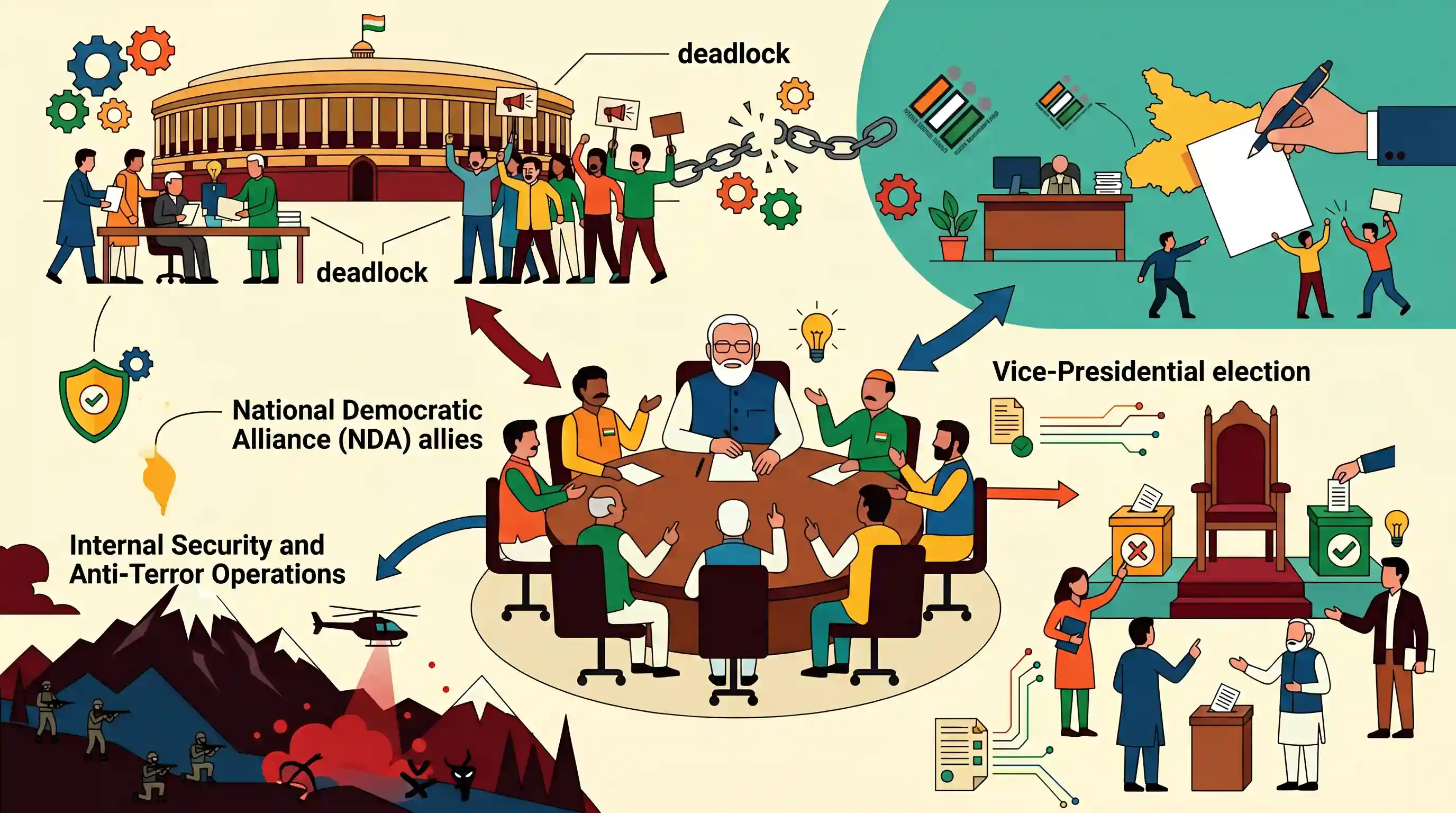
Prime Minister Narendra Modi is scheduled to address a meeting of National Democratic Alliance (NDA) MPs on August 5. The meeting holds significance as it reflects the BJP's renewed emphasis on coalition dynamics post the 2024 elections, actively involving allies like the TDP and JD(U). Key agenda items include strategizing for the upcoming Vice-Presidential election, addressing the ongoing parliamentary deadlock caused by Opposition protests against the Election Commission's revision of electoral rolls in Bihar, and discussing the government's internal security response, particularly 'Operation Sindoor' following the Pahalgam terror attack.
Key Points
- PM Narendra Modi will address a meeting of all NDA MPs, highlighting the reliance on coalition partners like TDP, JD(U), and LJP after the BJP lost its standalone majority in the 2024 Lok Sabha elections.
- The NDA aims to finalize its Vice-Presidential candidate before August 21. The VP electoral college comprises 782 MPs from both the Lok Sabha and Rajya Sabha.
- Recent parliamentary sessions have faced severe disruptions by the Opposition protesting the Election Commission of India's Special Intensive Revision (SIR) of electoral rolls in Bihar, citing alleged partisan conduct.
- The meeting is expected to cover a two-day discussion on the Pahalgam terror attack and the government's military response, Operation Sindoor, for which the PM is likely to be felicitated.
- Such Parliamentary meetings are utilized to brief MPs on governance issues and provide political talking points for their respective constituencies.
Important Terms
Special Intensive Revision (SIR) of electoral rolls

A comprehensive, house-to-house verification by the Election Commission of India (ECI) to update voter lists, remove duplicates, and ensure inclusion, conducted under Section 21(3) of the RPA, 1950.
UPSC context
GS Paper II: Polity/Elections. Tests knowledge of the Representation of the People Act and ECI's mandate for ensuring electoral integrity.
Operation Sindoor
A 2025 Indian military response involving precision strikes against terrorist infrastructure in Pakistan-occupied territories, launched following a deadly terror attack on tourists in Pahalgam.
UPSC context
GS Paper III: Internal Security. Tests understanding of counter-terror doctrines, cross-border security responses, and regional stability in Jammu and Kashmir.
National Democratic Alliance (NDA)
A center-right political coalition in India led by the BJP, currently emphasizing collective decision-making with key regional allies like the TDP and JD(U) to maintain a parliamentary majority.
UPSC context
GS Paper II: Indian Constitution/Polity. Relevant for topics on coalition politics, parliamentary functioning, and executive-legislative relations.
Election Commission of India (ECI)
An autonomous constitutional authority under Article 324 responsible for administering election processes in India for the Parliament, State Legislatures, and the offices of President and Vice-President.
UPSC context
GS Paper II: Constitutional Bodies. Core focus on institutional independence, powers, and the conduct of free and fair elections.
Telugu Desam Party (TDP)
A major regional party from Andhra Pradesh led by N. Chandrababu Naidu; a critical NDA ally whose support provides the ruling coalition strategic stability in the Lok Sabha.
UPSC context
GS Paper II: Polity. Illustrates the role of regional parties in national federal dynamics and coalition governance.
Janata Dal (United) (JD(U))
A regional party based in Bihar led by Nitish Kumar; it serves as a pivotal NDA partner, influencing national policy on social justice and state-specific issues.
UPSC context
GS Paper II: Polity. Relevant for understanding party systems, state politics, and coalition stability.
Prelims Trap
The Vice-President is elected by an electoral college consisting of elected members of Parliament and State Assemblies.
False. The VP electoral college includes BOTH elected and nominated MPs, but completely excludes all State Legislative Assembly members, unlike the Presidential election.
Static Concepts Connected
What are the key differences between Presidential and Vice-Presidential electoral colleges?
- State MLAs: Presidential college includes elected state MLAs; the Vice-Presidential college excludes all state legislators entirely.
- Nominated MPs: The Vice-Presidential college includes nominated members of both Houses of Parliament; the Presidential college excludes them.
What is the Special Intensive Revision (SIR) of electoral rolls by the ECI?
- Legal Basis: Invoked under Article 324 of the Constitution and Section 21(3) of the Representation of the People Act (RPA), 1950.
- Scope & Process: Involves comprehensive door-to-door verification to overhaul and correct severely flawed electoral lists, unlike routine annual summary revisions.
Cross-Topic Patterns
Coalition Politics & Parliamentary Output
A transition to coalition governance necessitates consensus-building but increases vulnerability to regional demands, directly impacting legislative productivity and policy continuity in GS2.
Security Ops & Executive Accountability
Briefing parliamentarians on proactive anti-terror responses (Operation Sindoor) bridges GS3 internal security doctrines with GS2 executive transparency and accountability norms.

Multi-statement question on ECI's discretionary powers under Article 324 vs statutory bounds under RPA 1950 is highly probable in 2026.
Linked PYQs · 4
Linked PYQs · 4
- 2004PrelimsGS1
The resolution for removing the Vice-president of India can be moved in the:
- 2022MainsGS2
Discuss the role of the Election Commission of India in the light of the evolution of the Model Code of Conduct.
- 2019MainsGS2
Individual Parliamentarian's role as the national law maker is on a decline, which in turn, has adversely impacted the quality of debates and their outcome. Discuss.
- 2023MainsGS3
The use of unmanned aerial vehicles (UAVs) by our adversaries across the borders to ferry arms/ammunitions, drugs, etc., is a serious threat to the internal security. Comment on the measures being taken to tackle this threat.
