Sixth BIMSTEC Summit and India Regional Connectivity Diplomacy
Source:The Hindu ↗
Why It Matters
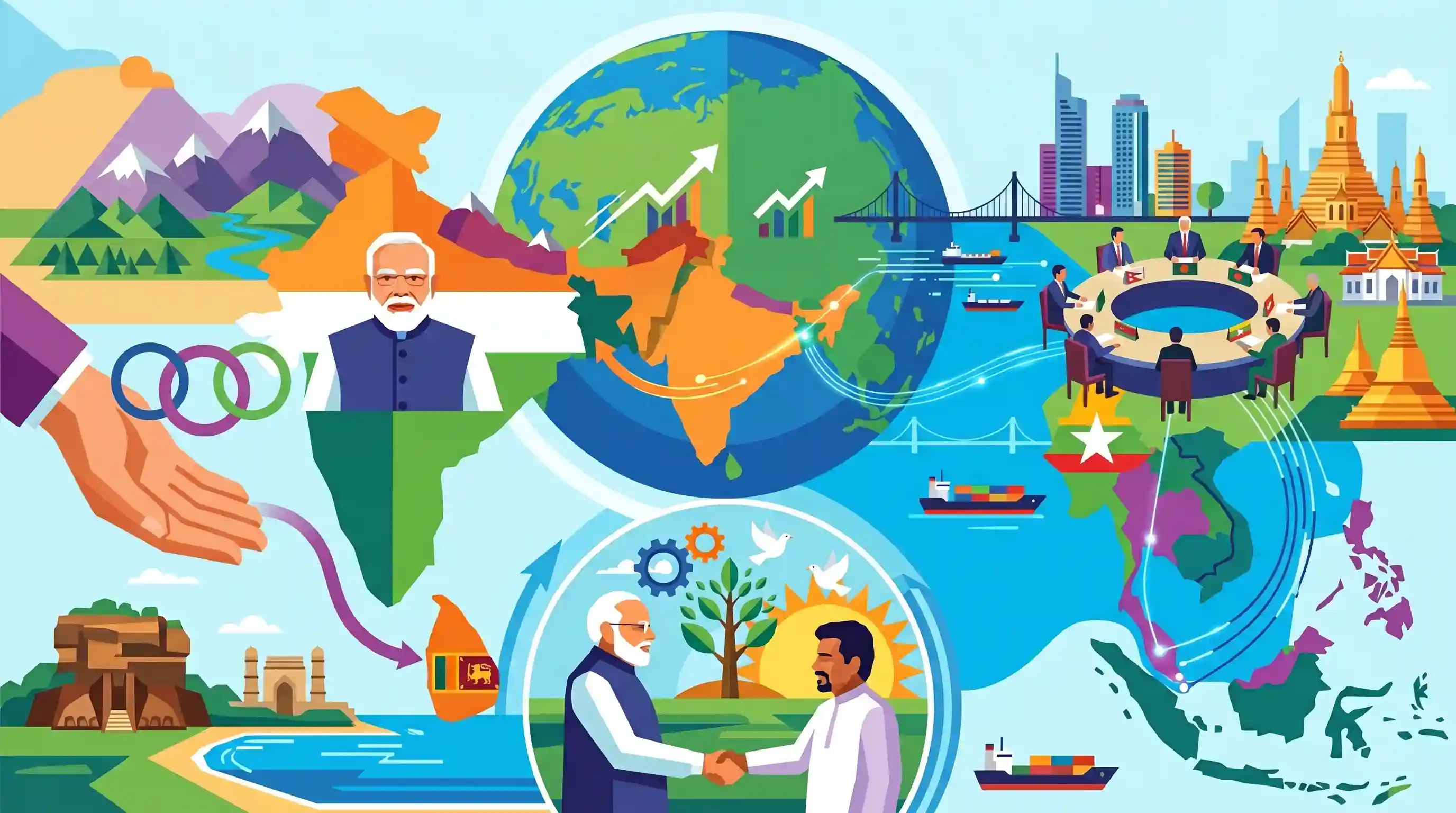
The 6th BIMSTEC Summit is central to India's 'Neighborhood First' and 'Act East' policies, especially given the recent political transitions in Bangladesh, Myanmar, and Sri Lanka. The focus on integrating the North Eastern states through cross-border connectivity initiatives forms a key part of the GS2 syllabus on regional cooperation.
Summary
Prime Minister Narendra Modi visited Thailand to attend the 6th BIMSTEC Summit, aiming to enhance regional connectivity, development, and economic cooperation in the Bay of Bengal. The summit provides a platform for crucial engagements with neighboring leaders from Nepal, Bangladesh, and Myanmar. Notably, PM Modi emphasized the central role of India's North Eastern region in the BIMSTEC framework, complementing India's Act East Policy. Following his engagements in Bangkok, the Prime Minister will travel to Sri Lanka to review bilateral progress under the 'Fostering Partnerships for a Shared Future' vision, marking his first visit since Anura Kumara Disanayake assumed the presidency. This diplomatic outreach highlights India's focus on its 'Neighborhood First' policy and regional stability.
Key Points
- PM Modi attended the 6th BIMSTEC Summit in Thailand to boost regional development, connectivity, and economic progress in the Bay of Bengal.
- The summit serves as a crucial platform for interactions with leaders from Nepal, Bangladesh, and Myanmar amid shifting political landscapes in India's neighborhood.
- Modi underscored that India's North Eastern region lies at the geographical heart of BIMSTEC, reinforcing its strategic importance for the Act East Policy.
- The visit extends to a bilateral trip to Sri Lanka, marking PM Modi's first visit since President Anura Kumara Disanayake's election, focusing on the joint vision of 'Fostering Partnerships for a Shared Future'.
Important Terms
BIMSTEC

A regional organization of seven South Asian and Southeast Asian nations bordering the Bay of Bengal, acting as a bridge between South Asia and ASEAN to promote economic and technical cooperation.
UPSC context
GS Paper II: International Groupings. Key for India's regional leadership and the "Bay of Bengal Community" concept.
Act East Policy
A diplomatic initiative launched in 2014 to strengthen economic, strategic, and cultural ties with the Asia-Pacific region, focusing on connectivity, commerce, culture, and capacity-building.
UPSC context
GS Paper II: India’s Foreign Policy. Tests understanding of strategic shifts from trade to active regional engagement.
Neighborhood First Policy
A core foreign policy approach prioritizing peaceful, stable, and consultative relations with immediate neighbors through economic assistance, connectivity projects, and non-reciprocal development support.
UPSC context
GS Paper II: India and its neighborhood-relations. Essential for analyzing regional stability and countering external influence.
Fostering Partnerships for a Shared Future
The 2024 India-Sri Lanka joint statement outlining a vision for investment-led partnerships, debt restructuring support, and enhanced maritime security cooperation under President Anura Kumara Dissanayake.
UPSC context
GS Paper II: Bilateral Relations. Relevant for current affairs concerning India-Sri Lanka strategic and economic ties.
6th BIMSTEC Summit
The 2025 meeting in Bangkok where member states adopted the "Bangkok Vision 2030" and the BIMSTEC Charter to transform the grouping into a more resilient and integrated regional bloc.
UPSC context
GS Paper II: Important International Institutions. Tests knowledge of recent multilateral outcomes and regional roadmaps.
Prelims Trap
BIMSTEC includes all SAARC member nations along with Myanmar and Thailand.
False. BIMSTEC excludes Pakistan, Afghanistan, and Maldives. It acts as a bridge between South Asia and Southeast Asia, not a SAARC extension.
Static Concepts Connected
What is the mandate and origin of the BIMSTEC grouping?
- Origin (1997): Formed via the 1997 Bangkok Declaration initially as BIST-EC; expanded to include Myanmar (1997), and Nepal and Bhutan (2004).
- Strategic Bridge: Connects South and Southeast Asia. It serves as a functional, Pakistan-free alternative to SAARC for regional integration.
- Sector-driven: Unlike SAARC, it operates on sector-driven cooperation. India currently leads the Security (including counter-terrorism and energy) sector.
What are the key physical connectivity projects linking India's NER to Southeast Asia?
- IMT Highway: A massive road network project connecting Moreh in Manipur, India, to Mae Sot in Thailand via Myanmar.
- Kaladan Project: A multi-modal transit project linking Kolkata port to Sittwe port in Myanmar, then via inland waterways and roads to Mizoram.
- Strategic Aim: These initiatives provide alternative supply routes to India's NER, reducing dependence on the highly vulnerable Siliguri Corridor (Chicken's Neck).
Cross-Topic Patterns
BIMSTEC as SAARC's pragmatic alternative
India's strategic shift to BIMSTEC bypasses Pakistan's obstructionism in SAARC. This pivots regional focus toward maritime security in the Bay of Bengal over continental South Asian disputes.
NER connectivity and Internal Security
Integrating the North East with ASEAN markets through BIMSTEC initiatives reduces economic isolation, serving as a core strategy to counter historical insurgencies and stabilize the border region.
Digital diplomacy in Sri Lanka
The 'Fostering Partnerships' vision highlights a shift from traditional infrastructure aid to digital integration (UPI/Aadhaar) and shared energy grids, effectively countering China's Belt and Road footprint.

Expect a multi-statement Prelims question contrasting BIMSTEC and SAARC memberships, paired with the Kaladan or IMT Highway projects.
Linked PYQs · 3
Linked PYQs · 3
- 2011MainsGS2
Compared to the South Asian Free Trade Area (SAFTA), the Bay of Bengal Initiative for Multisectoral Technical and Economic Cooperation Free Trade Area (BIMSTEC FTA) seems to be more promising." Critically evaluate.
- 2022MainsGS2
Do you think that BIMSTEC is a parallel organisation like the SAARC ? What are the similarities and dissimilarities between the two ? How are Indian foreign policy objectives realized by forming this new organisation?
- 2022MainsGS2
India is an age-old friend of Sri Lanka.’ Discuss India's role in the recent crisis in Sri Lanka in the light of the preceding statement.
