Prime Minister Modi Visit to Thailand for BIMSTEC Summit
Source:Indian Express ↗
Why It Matters
BIMSTEC is increasingly central to India's foreign policy given the stagnation of SAARC. The adoption of the Bangkok Vision 2030 and strengthening maritime cooperation with Thailand directly align with India's Act East and SAGAR initiatives, making it highly relevant for Mains GS-2 (International Relations).
Summary
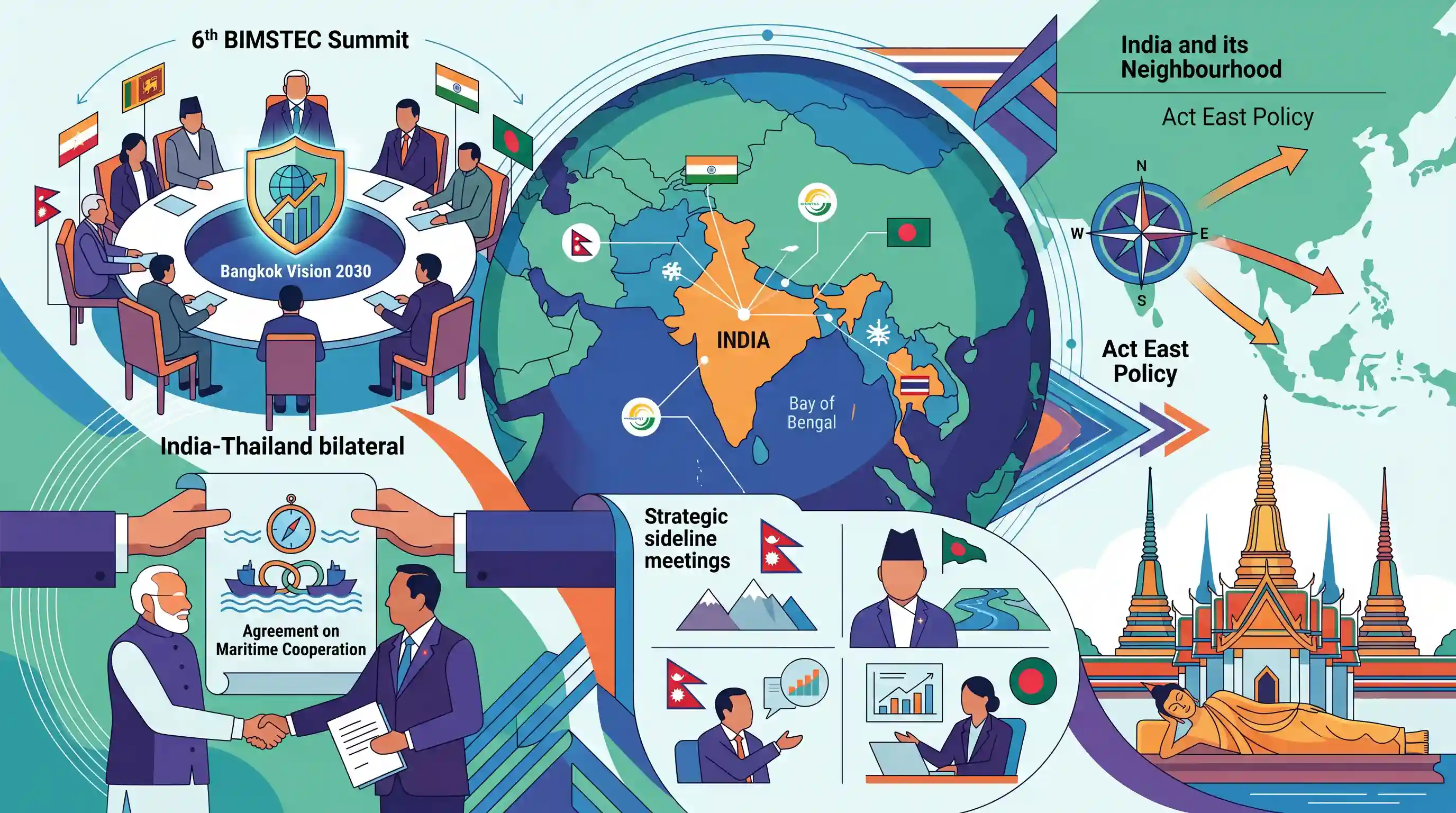
Prime Minister Narendra Modi's visit to Thailand encompasses both multilateral engagement at the 6th BIMSTEC Summit and crucial bilateral diplomacy. Key outcomes expected include the adoption of the Bangkok Vision 2030 by BIMSTEC leaders and the signing of an Agreement on Maritime Cooperation between India and Thailand. The trip also features strategic sideline meetings with leaders from Nepal and Bangladesh, alongside a cultural visit to the historic Wat Pho temple in Bangkok, reinforcing India's Act East policy and regional partnerships in the Bay of Bengal.
Key Points
- Prime Minister Narendra Modi is visiting Thailand to attend the 6th BIMSTEC Summit.
- The summit is expected to see the adoption of the Bangkok Vision 2030, a strategic roadmap for the regional grouping.
- India and Thailand are expected to sign a bilateral Agreement on Maritime Cooperation during talks with Thai PM Paetongtarn Shinawatra.
- Modi will hold sideline meetings with Nepal PM K P Sharma Oli and Bangladesh Chief Adviser Muhammad Yunus.
- The PM will visit Wat Pho, renowned for its Reclining Buddha statue, emphasizing the deep historical and Buddhist cultural ties between the two nations.
Important Terms
BIMSTEC

A regional organization of seven South and Southeast Asian nations focused on technical and economic cooperation to bridge ties across the Bay of Bengal.
UPSC context
GS Paper II (Regional Groupings); essential for topics on regional integration and India's 'Neighborhood First' policy.
Bangkok Vision 2030
A strategic roadmap adopted by BIMSTEC to build a 'Prosperous, Resilient, and Open' (PRO) region by 2030 through economic integration and climate resilience.
UPSC context
GS Paper II (Global Groupings & Agreements); tests knowledge of specific regional developmental milestones and agendas.
Act East Policy
India's proactive foreign policy initiative to strengthen economic, strategic, and cultural relations with Southeast Asia and the broader Indo-Pacific region.
UPSC context
GS Paper II (Foreign Policy); fundamental for analyzing India’s strategic pivot toward ASEAN and the Indo-Pacific.
Agreement on Maritime Cooperation
A framework to enhance naval coordination, improve port connectivity, and streamline logistics between India and Thailand to boost trade and maritime safety.
UPSC context
GS Paper II (Bilateral Relations); relevant for maritime security and the 'Blue Economy' under the SAGAR initiative.
India-Thailand Strategic Partnership
An elevated diplomatic tier between India and Thailand (formalized in 2025) emphasizing deeper collaboration in defense, security, and the digital economy.
UPSC context
GS Paper II (Bilateral Relations); tests understanding of diplomatic tiers and strategic alignment with key ASEAN partners.
Prelims Trap
"The Bangkok Vision 2030 is a strategic roadmap adopted by ASEAN for regional integration."
Bangkok Vision 2030 belongs to BIMSTEC, not ASEAN. Furthermore, both ASEAN (1967) and BIMSTEC (1997) were established via distinct "Bangkok Declarations," making this a prime confusion point for examiners to exploit.
Static Concepts Connected
How does BIMSTEC differ structurally and geographically from SAARC?
- Geographic scope: SAARC is strictly South Asian (includes Pakistan, Afghanistan). BIMSTEC connects South and Southeast Asia (includes Myanmar, Thailand).
- Origin declarations: SAARC operates via the 1985 Dhaka Declaration; BIMSTEC was formed by the 1997 Bangkok Declaration.
- Operational focus: SAARC is often paralyzed by bilateral disputes. BIMSTEC explicitly avoids bilateral tensions, focusing strictly on sector-driven economic and technical cooperation.
What is the significance of the Reclining Buddha posture in Buddhist iconography?
- Parinirvana depiction: It depicts the historical Buddha during his final illness, about to enter Parinirvana (the final nirvana achieved after death).
- Physical posture: The figure is typically shown lying on its right side, with the head resting on a cushion or the right elbow.
- Indian parallels: While prominent in Southeast Asia (like Wat Pho), India houses a famous rock-cut Reclining Buddha in Cave 26 at Ajanta.
Cross-Topic Patterns
Act East Policy + SAGAR Vision
The India-Thailand Agreement on Maritime Cooperation links India's Act East Policy with its SAGAR vision, extending coastal security and logistical integration deeper into the Bay of Bengal and Andaman Sea.
Buddhist Soft Power + Cultural Diplomacy
PM Modi's visit to Wat Pho highlights India's use of shared Buddhist heritage to cement diplomatic ties in Southeast Asia, acting as an external extension of India's domestic Buddhist Circuit tourism initiatives.

Expect a tricky 2026 Prelims multi-statement question confusing BIMSTEC's Bangkok Vision 2030 and 1997 origin with ASEAN's 1967 founding.
Linked PYQs · 4
Linked PYQs · 4
- 2011MainsGS2
Compared to the South Asian Free Trade Area (SAFTA), the Bay of Bengal Initiative for Multisectoral Technical and Economic Cooperation Free Trade Area (BIMSTEC FTA) seems to be more promising." Critically evaluate.
- 2022MainsGS2
Do you think that BIMSTEC is a parallel organisation like the SAARC ? What are the similarities and dissimilarities between the two ? How are Indian foreign policy objectives realized by forming this new organisation?
- 2016MainsGS2
Evaluate the economic and strategic dimensions of India's Look East Policy in the context of the post Cold War international scenario.
- 2023PrelimsGS1
With reference to India's projects on connectivity, consider the following statements: 1. East-West Corridor under Golden Quadrilateral Project connects Dibrugarh and Surat. 2. Trilateral Highway connects Moreh in Manipur and Chiang Mai in Thailand via Myanmar. 3. Bangladesh-China-India-Myanmar Economic Corridor connects Varanasi in Uttar Pradesh with Kunming in China. How many of the above statements are correct?
