Technological Self Reliance and Economic Growth Goals
Source:Indian Express ↗
Why It Matters
This reinforces the interconnectedness of technological sovereignty (Atmanirbharta in tech) and macroeconomic growth. For UPSC aspirants, it is a key framing narrative for answers in GS Paper 3 regarding how digital infrastructure and domestic tech innovation act as catalysts for India's GDP expansion and global economic standing.
Summary
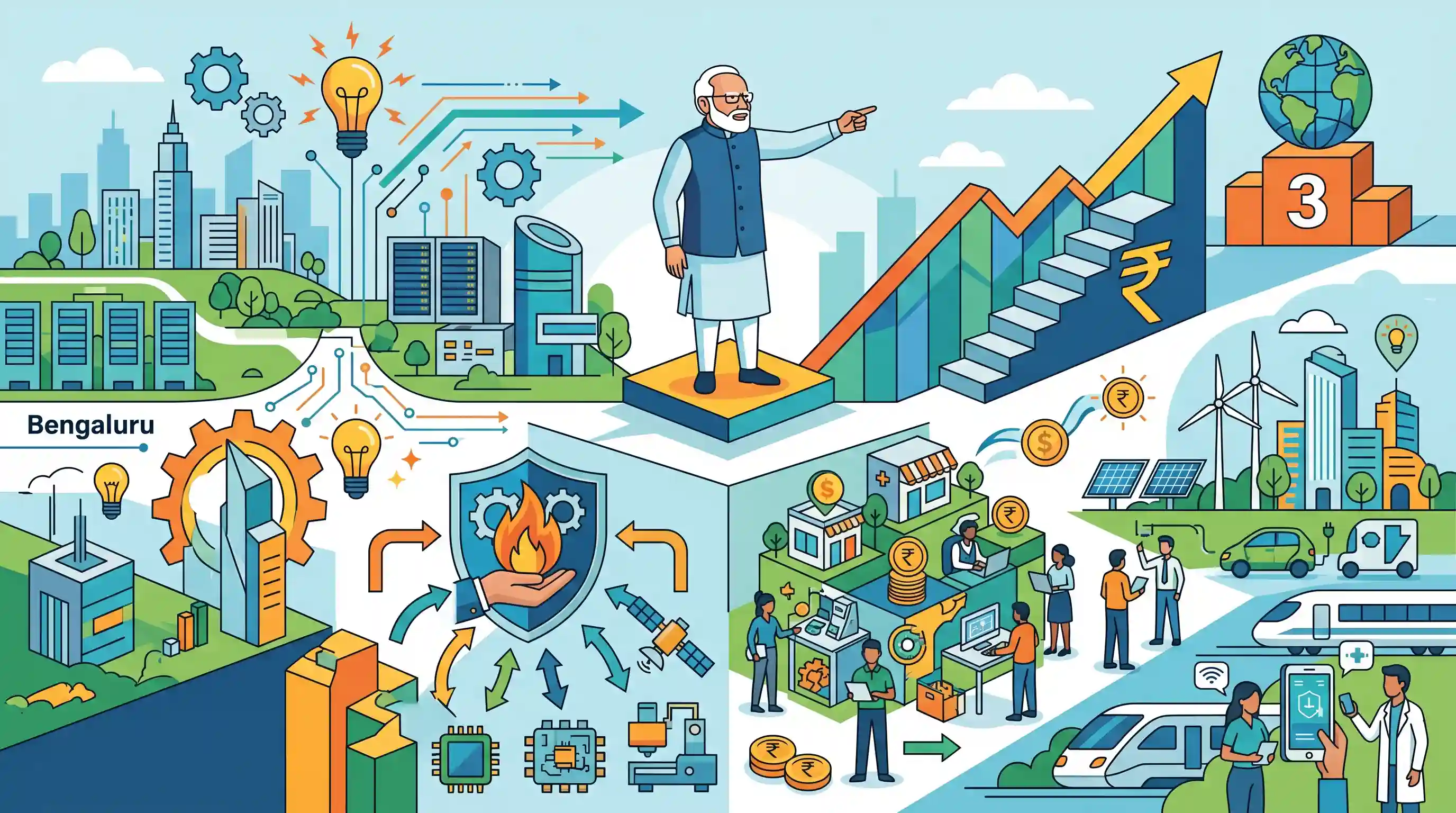
Addressing an event in Bengaluru, Prime Minister Narendra Modi stressed the imperative of technological self-reliance as a cornerstone of India's development strategy. He expressed confidence that the nation is firmly on course to becoming one of the world's top three economies, crediting the vibrant startup ecosystem, innovation hubs like Bengaluru, and a focus on indigenization of technology for fueling this rapid economic growth.
Key Points
- PM Modi emphasized the critical need for technological self-reliance to secure India's strategic and economic future.
- He projected confidence that India is on a steady trajectory to become one of the top three economies in the world globally.
- The speech highlighted Bengaluru's foundational role as a technology and innovation hub driving the nation's economic engine and startup ecosystem.
- The synergy between digital infrastructure, indigenization of critical technologies, and broad-based economic growth was presented as a core governance focus.
Important Terms
Atmanirbhar Bharat

A national vision to transform India into a self-reliant economy by bolstering domestic manufacturing, reducing import dependency, and strengthening five pillars: Economy, Infrastructure, Systems, Vibrant Demography, and Demand.
UPSC context
GS Paper III: Economic development; tests understanding of self-sufficiency strategies and their impact on global trade.
Indigenization of Technology
The process of developing and producing technology domestically using local R&D and materials. It aims to reduce foreign reliance and enhance strategic autonomy in sectors like defense and IT.
UPSC context
GS Paper III: Science and Technology; tests knowledge of domestic advancements and strategies to reduce import dependency.
Digital India Mission
A flagship mission launched in 2015 to transform India into a digitally empowered society. It focuses on digital infrastructure, electronic delivery of services, and digital literacy.
UPSC context
GS Paper III: S&T and Economy; tests knowledge of digital infrastructure and its role in e-governance.
Startup India
A government initiative launched in 2016 to foster a strong ecosystem for innovation. It aims to drive sustainable economic growth and large-scale employment by simplifying regulations and providing funding support.
UPSC context
GS Paper III: Indian Economy and employment; tests understanding of entrepreneurial policy and innovation-led growth.
Third Largest Economy Goal
India's strategic economic goal to surpass major global powers to become the world's third-largest economy by nominal GDP, currently projected for 2027–2030 through sustained reforms and growth.
UPSC context
GS Paper III: Planning and growth; tests awareness of India’s economic trajectory and global standing.
Prelims Trap
"The IMF projects India will become the third-largest economy in Purchasing Power Parity (PPP) terms by 2027."
India is already the 3rd largest economy in the world by PPP (behind China and the US). The 2027 projection refers strictly to Nominal GDP.
Static Concepts Connected
What are the current criteria for DPIIT Startup Recognition?
- Age Limit: Must not have completed 10 years from the date of incorporation/registration.
- Turnover Limit: Annual turnover must not have exceeded ₹100 crore in any preceding financial year.
- Innovation Focus: Must work towards innovation, development, or improvement of products/processes, or have a scalable business model.
What are the three core layers of India's Digital Public Infrastructure (India Stack)?
- Identity Layer: Provides unique digital identity to residents (Aadhaar, e-KYC, e-Sign).
- Payments Layer: Enables interoperable, high-volume, low-cost transactions (UPI, Aadhaar Enabled Payment System).
- Data Layer: Allows secure, consent-based data sharing (DigiLocker, Account Aggregator framework).
Cross-Topic Patterns
DPI as diplomatic soft power
Exporting India Stack (UPI, modular ID) to Global South nations bridges domestic technological self-reliance with foreign policy, establishing tech-diplomacy as a pillar of South-South cooperation.
Startups vs. Jobless Growth
With over 15.5 lakh jobs created, DPIIT-recognized startups act as a structural counter to the "jobless growth" critique, linking innovation hubs directly to the demographic dividend and formal employment.

Expect a multi-statement Prelims question testing the difference between India's Nominal vs. PPP GDP global rankings alongside DPIIT rules.
Linked PYQs · 4
Linked PYQs · 4
- 2023MainsGS3
What is the status of digitalization in the Indian economy? Examine the problems faced in this regard and suggest improvements.
- 2019MainsGS3
Do you agree with the view that steady GDP growth and low inflation have left the Indian economy in good shape? Give reasons in support of your arguments.
- 2011PrelimsGS1
In the context of Indian economy, consider the following statements: 1. The growth rate of GDP has steadily increased in the last five years. 2. The growth rate in per capita income has steadily increased in the last five years. Which of the statements given above is/are correct?
- 2018PrelimsGS1
Which of the following is/are the aim/aims of "Digital India" Plan of the Government of India? 1. Formation of India's own Internet companies like China did. 2. Establish a policy framework to encourage overseas multinational corporations that collect Big Data to build their large data centres within our national geographical boundaries. 3. Connect many of our villages to the Internet and bring Wi-Fi to many of our schools, public places and major tourist centres. Select the correct answer using the code given below:
