Pariksha Pe Charcha Emphasises Swadeshi Mindset and Skill Development
Source:Indian Express ↗
Why It Matters
The article highlights the national leadership's perspective on human resource development, emphasizing the transition from rote learning to skill-based education (aligned with NEP 2020 objectives). It also touches upon crucial socio-cultural themes like decolonisation, self-reliance (Atmanirbhar Bharat), and women's empowerment through indigenous industries, which are recurring themes in GS1 (Society/History) and GS2 (Social Justice/Governance).
Summary
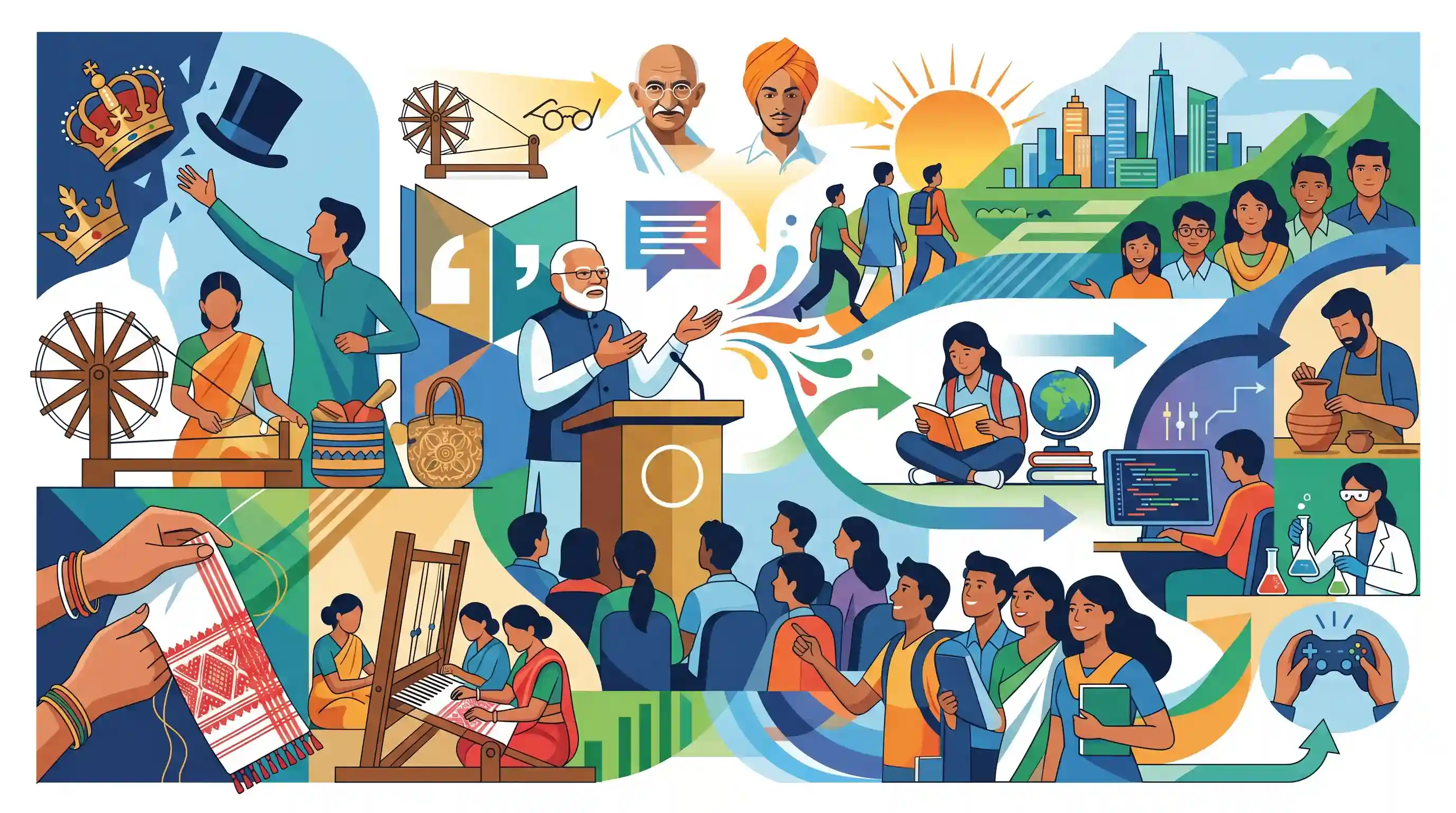
During the ninth 'Pariksha Pe Charcha', Prime Minister Narendra Modi addressed students across India, focusing on the adoption of a 'swadeshi' lifestyle, discarding colonial mindsets, and integrating skill development—including modern avenues like gaming—with formal education. He utilized the Assamese gamosa to underscore women's empowerment through traditional crafts and cited the sacrifices of Mahatma Gandhi and Bhagat Singh to inspire the youth toward the collective goal of a 'Viksit Bharat' (Developed India).
Key Points
- The PM urged students to shed "gulami ki mansikta" (slave mentality) and replace foreign goods with local products to foster a self-reliant India.
- Emphasized that education and skills are "twin siblings," advocating for a balance between formal academic learning and practical life and professional skills.
- Supported gaming as a legitimate skill that aids cognitive development, encouraging youth to develop and launch their own games rather than viewing it solely as a distraction.
- Highlighted the handwoven Assamese gamosa as a symbol of women's empowerment and the economic importance of indigenous handicrafts.
- Drew parallels between the long-term vision of freedom fighters like Mahatma Gandhi and Bhagat Singh and the current generational objective of achieving a "Viksit Bharat".
Important Terms
Pariksha Pe Charcha (PPC)

An annual interactive program where the Prime Minister engages with students to reduce exam stress and promote holistic development.
UPSC context
GS Paper 2 (Education); tests understanding of student welfare and mental health initiatives.
Viksit Bharat @2047
The government's vision to transform India into a fully developed nation by 2047, focusing on economic prosperity and social advancement.
UPSC context
GS Paper 3 (Economy); central to long-term development strategies and economic planning.
Swadeshi
A concept emphasizing indigenous production and self-reliance; historically an anti-colonial tool and currently linked to modern economic independence.
UPSC context
GS Paper 1 & 3; bridges historical national movements with modern economic self-reliance.
National Education Policy (NEP) 2020
The 21st-century framework for India's education system, emphasizing multi-disciplinary learning, vocational skills, and the elimination of rote learning.
UPSC context
GS Paper 2 (Education Policy); crucial for understanding reforms in human capital development.
Assamese Gamosa
A GI-tagged traditional handwoven cloth from Assam, symbolizing women's empowerment through craft and regional cultural identity.
UPSC context
GS Paper 1 (Art and Culture); relevant for GI tags and regional cultural heritage.
Aatmanirbhar Bharat
A flagship mission to make India a self-reliant global manufacturing hub, focusing on economy, infrastructure, and demography.
UPSC context
GS Paper 3 (Indian Economy); tests knowledge of industrial policy and import substitution.
Decolonisation of Mindset
A goal to discard colonial-era thinking, promoting indigenous languages, traditional knowledge, and national pride.
UPSC context
GS Paper 1 & 4; relates to post-independence identity and socio-cultural values.
Prelims Trap
"The 'Panch Pran' (Five Resolves) are recently added Fundamental Duties under Article 51A."
Panch Pran are ideological goals for India's Amrit Kaal announced by the Prime Minister in 2022, not constitutional amendments or enforceable legal duties.
Static Concepts Connected
What are the rules governing Geographical Indication (GI) tags in India?
- Legal Framework: Administered under the Geographical Indications of Goods (Registration and Protection) Act, 1999.
- WTO TRIPS: Complies with the World Trade Organization's Trade-Related Aspects of Intellectual Property Rights (TRIPS) agreement.
- Validity Period: Registration is valid for 10 years, but can be renewed indefinitely to protect indigenous producers.
What constituted Mahatma Gandhi's Constructive Programme?
- Swadeshi Economics: Promoting Khadi and village industries to build economic self-reliance among the rural masses.
- Social Reform: Grassroots work on Hindu-Muslim unity, removal of untouchability, and women's empowerment during non-active struggle phases.
- Nai Talim: The Wardha Scheme of Basic Education (Nai Talim), which integrated vocational skills with formal learning.
Cross-Topic Patterns
Decolonisation + New Criminal Laws
Shedding the colonial mindset (a Panch Pran resolve) directly parallels the recent replacement of the colonial-era Indian Penal Code (IPC) with the Bharatiya Nyaya Sanhita (BNS).
NEP 2020 + AVGC Sector Integration
Promoting gaming as a cognitive skill aligns with NEP 2020's mandate to blur lines between vocational and academic streams, leveraging the AVGC Task Force recommendations.
GI Tags + SHG Women's Empowerment
Highlighting the Assamese Gamosa connects cultural GI protections directly to rural female economic resilience, dovetailing with self-help group (SHG) initiatives like the Lakhpati Didi scheme.

Expect a hybrid 2026 question linking 'Panch Pran' decolonization themes with recent legislative changes or NEP vocational mandates.
Linked PYQs · 4
Linked PYQs · 4
- 2023MainsGS2
Skill development programmes have succeeded in increasing human resources supply to various sectors. In the context of the statement analyse the linkages between education, skill and employment.
- 2016MainsGS2
Demographic Dividend in India will remain only theoretical unless our manpower becomes more educated, aware, skilled and creative." What measures have been taken by the government to enhance the capacity of our population to be more productive and employable?
- 2021MainsGS1
Bring out the constructive programmes of Mahatma Gandhi during Non-Cooperation Movement and Civil Disobedience Movement.
- 2024MainsGS1
Distinguish between gender equality, gender equity and women's empowerment. Why is it important to take gender concerns into account in programme design and implementation?
