India Sri Lanka Bilateral Ties and Maritime Security Partnership
Source:Indian Express ↗
Why It Matters
Sri Lanka is a critical maritime neighbor for India. The multidimensional engagement spanning cultural, economic, and strategic sectors reflects India's broader diplomatic goals in the Indian Ocean. Understanding this relationship is essential for analyzing regional geopolitics and India's 'Neighbourhood First' policy in the Mains GS2 examination.
Summary
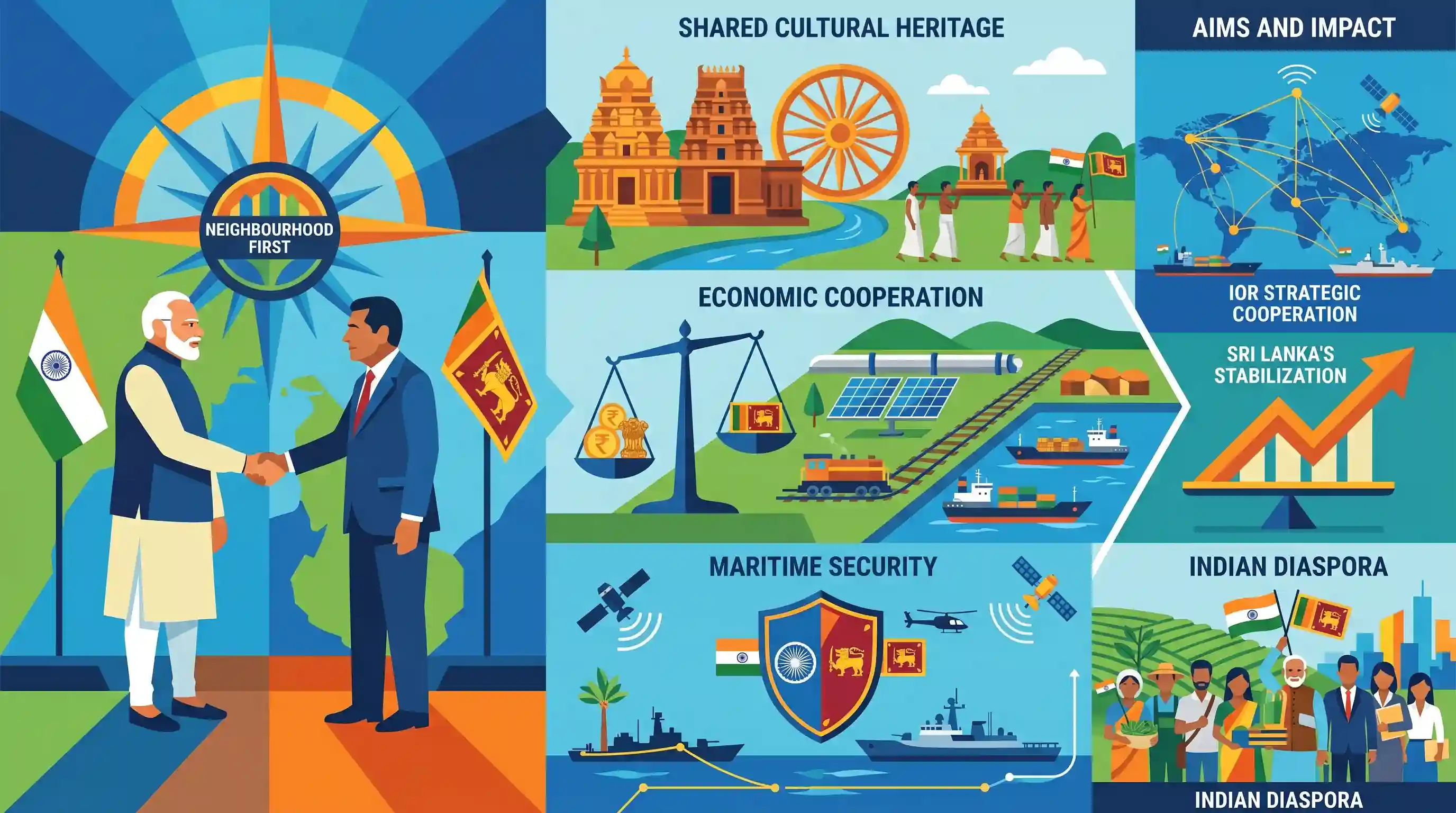
The article highlights Prime Minister Narendra Modi's visit to Sri Lanka, underscoring a renewed commitment to India-Sri Lanka bilateral ties across multiple dimensions. The diplomatic engagement focuses on shared cultural heritage (temples), economic cooperation (trade), and maritime security (defence). This multi-faceted approach reinforces India's 'Neighbourhood First' policy, aiming to strengthen strategic cooperation in the Indian Ocean Region, aid in Sri Lanka's economic stabilization, and enhance regional security architectures.
Key Points
- PM Modi's visit to Sri Lanka reinforces historical and cultural bonds, highlighted by engagements related to shared religious sites and temples.
- Economic cooperation is a major pillar, with a renewed focus on boosting bilateral trade, infrastructure development, and enhancing connectivity to support Sri Lanka's economic recovery.
- Defence and maritime security form a crucial aspect of the bilateral engagement, reflecting mutual concerns over stability in the Indian Ocean Region.
- The visit embodies India's 'Neighbourhood First' policy and the SAGAR vision, aimed at fostering deep-rooted partnerships and navigating regional geopolitical challenges.
Important Terms
Neighbourhood First Policy

Diplomatic strategy prioritizing immediate neighbors for regional stability and connectivity. It emphasizes consultative, non-reciprocal assistance and infrastructure development to foster integrated regional growth.
UPSC context
GS Paper II (International Relations). Tests India's regional diplomacy, connectivity projects, and strategies to counter external influences in South Asia.
SAGAR (Security and Growth for All in the Region)
India’s strategic framework for the Indian Ocean Region (IOR). It promotes maritime cooperation, security, and sustainable "Blue Economy" development, positioning India as a responsible regional leader.
UPSC context
GS Paper II/III. Tests maritime strategy, IOR geopolitics, and India's role in ensuring regional safety.
13th Amendment (Sri Lanka)
A constitutional provision from the 1987 Indo-Sri Lanka Accord. It mandates the devolution of power to provincial councils, aimed at addressing the political aspirations of the Tamil minority.
UPSC context
GS Paper II. Tests understanding of ethnic issues, bilateral accords, and India's interest in Tamil political rights.
Indian Ocean Region (IOR)
A strategic maritime zone vital for global trade and energy security. It is central to India's maritime security, resource exploration, and countering external geopolitical influence.
UPSC context
GS Paper I/II. Tests geo-strategic importance, maritime chokepoints, and trade route security essential for India’s stability.
Net Security Provider
A role where India provides maritime security and stability beyond its borders through capacity building, patrols, and humanitarian assistance (HADR) in the Indian Ocean.
UPSC context
GS Paper II/III. Tests defense diplomacy, maritime domain awareness, and leadership in regional security architectures.
Prelims Trap
"India-Sri Lanka bilateral trade has consistently increased year-on-year over the last decade."
Despite strong economic ties and India's crisis assistance, trade volumes fluctuate. UPSC frequently sets "consistently increased/decreased" traps in bilateral trade questions.
Static Concepts Connected
What is the Colombo Security Conclave (CSC)?
- Origin: Began in 2011 as a trilateral maritime security grouping of India, Sri Lanka, and the Maldives.
- Members: Currently includes India, Sri Lanka, Maldives, Mauritius, and Bangladesh. Seychelles acts as an observer state.
- Mandate: Focuses on maritime safety, countering terrorism, combating transnational crime, and cyber security in the Indian Ocean Region.
What are the key India-Sri Lanka joint defence exercises?
- Mitra Shakti: A bilateral joint military (Army) exercise focusing on counter-insurgency and counter-terrorism operations.
- SLINEX: A bilateral maritime (Navy) exercise aimed at enhancing interoperability and mutual understanding.
- DOSTI: A trilateral Coast Guard exercise involving India, Sri Lanka, and the Maldives to enhance regional maritime security and disaster relief.
Cross-Topic Patterns
SAGAR + Maritime Minilateralism
India's SAGAR vision is increasingly being operationalized through sub-regional minilaterals like the Colombo Security Conclave to counter Chinese presence and secure sea lines in the Indian Ocean.
Cultural Heritage + Soft Power Diplomacy
Shared civilizational heritage (promoting the Buddhist Circuit in India and Ramayana Trail in Sri Lanka) links directly to India's soft power diplomacy and tourism schemes like Swadesh Darshan.

Expect a multi-statement question interlinking the Colombo Security Conclave's exact membership, the SAGAR doctrine, and maritime exercises.
Linked PYQs · 2
Linked PYQs · 2
- 2022MainsGS2
India is an age-old friend of Sri Lanka.’ Discuss India's role in the recent crisis in Sri Lanka in the light of the preceding statement.
- 2020PrelimsGS1
Consider the following statements: 1. The value of Indo-Sri Lanka trade has consistently increased in the last decade. 2. "Textile and textile articles" constitute an important item of trade between India and Bangladesh. 3. In the last five years, Nepal has been the largest trading partner of India in South Asia. Which of the statements given above is/are correct?
