Constitutional Amendment Requirements and Women Reservation Impasse
Source:Indian Express ↗
Why It Matters
The article is relevant for GS Paper 2 as it touches upon issues of women's political representation, the procedural mechanics of Constitutional Amendment Bills (Article 368), and the sensitive political dynamics surrounding the upcoming delimitation exercise and federal relations.
Summary
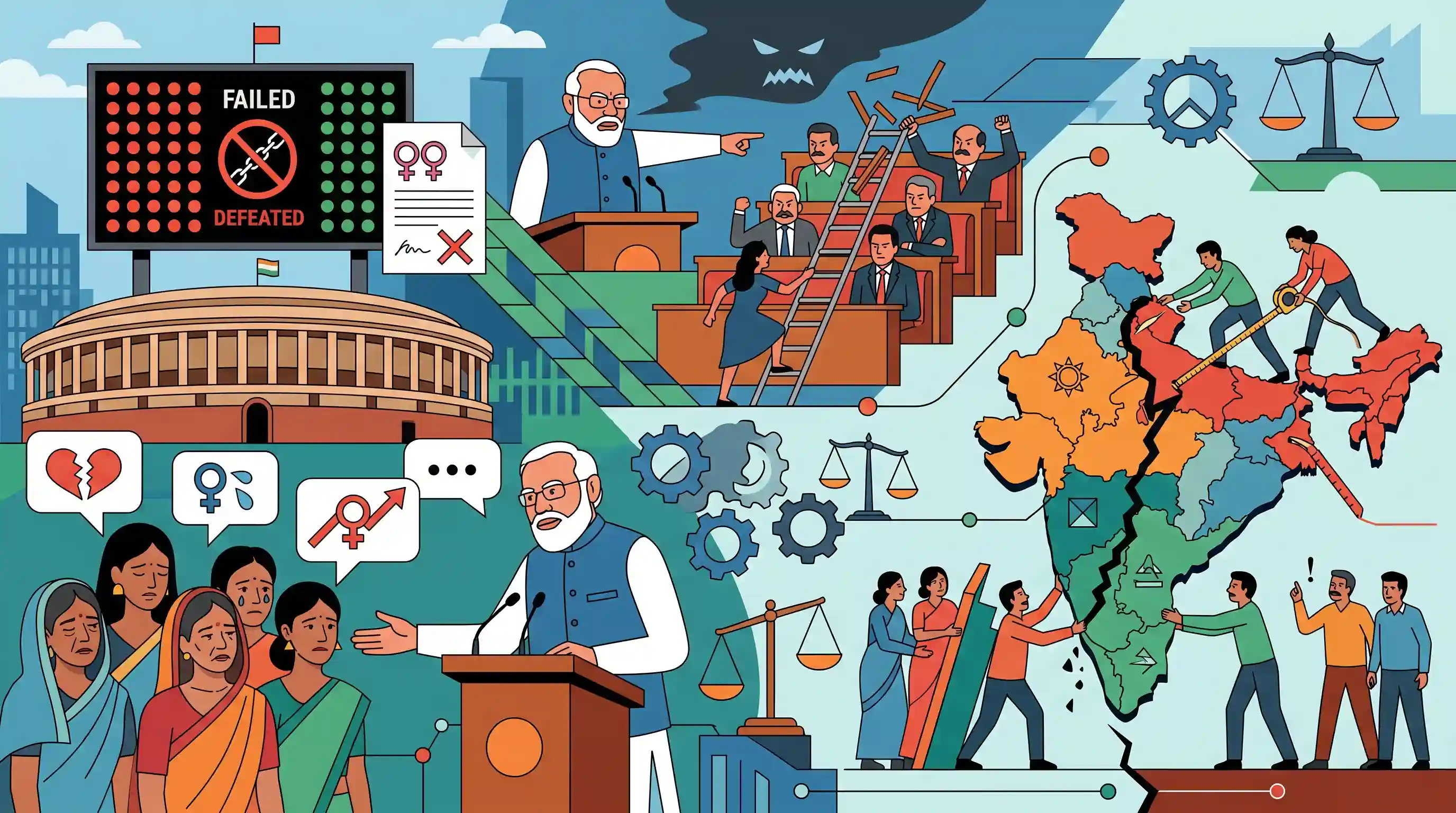
Following the defeat of the Nari Shakti Vandan Adhiniyam (Women's Reservation Bill) in Parliament, Prime Minister Narendra Modi launched a scathing attack on the Opposition, accusing them of political 'female foeticide'. He apologized to the women of India for the bill failing to secure the requisite two-thirds special majority. Modi also criticized the Congress for allegedly stoking a North-South divide by spreading falsehoods about the future delimitation of parliamentary constituencies. The event underscores the ongoing political and procedural challenges in achieving equitable political representation for women in India.
Key Points
- Prime Minister Narendra Modi apologized for the defeat of the Nari Shakti Vandan Adhiniyam in Parliament, attributing its failure to the Opposition's lack of support.
- He strongly condemned the Opposition, equating the bill's defeat to political 'female foeticide' (bhroon hatya) and a betrayal of women's aspirations.
- The PM accused the Congress party of spreading misinformation regarding the impending delimitation exercise to create a North-South divide and justify their opposition to the bill.
- The failure of the bill highlights the stringent requirements of Article 368 for passing Constitutional Amendment Bills, which need a special two-thirds majority in Parliament.
Important Terms
Nari Shakti Vandan Adhiniyam

Formally the 106th Constitutional Amendment Act (2023), it mandates 33% reservation for women in the Lok Sabha, State Legislative Assemblies, and the Delhi Assembly. Its implementation is linked to post-2026 census delimitation.
UPSC context
GS Paper 2: Governance and Social Justice. Crucial for topics on women's political empowerment and legislative representation.
Special Majority
A procedural requirement under Article 368 where a bill must be passed by a majority of the total membership of the House and two-thirds of those present and voting.
UPSC context
GS Paper 2: Indian Polity. Essential for understanding the checks and balances in the constitutional amendment process.
Delimitation
The process of redrawing the boundaries of territorial constituencies for Lok Sabha and State Assemblies based on the latest census data to ensure uniform representation (Article 82).
UPSC context
GS Paper 2: Elections and Representation of People Act. Tests knowledge on federal representation and demographic impacts on politics.
Constitutional Amendment Bill
A legislative proposal to alter India's fundamental law under Article 368. It requires passing in both Houses separately with no provision for a joint sitting to resolve deadlocks.
UPSC context
GS Paper 2: Indian Constitution. Core topic for Prelims and Mains regarding legislative procedures and Article 368.
Federalism
A constitutional system of power-sharing between the Union and States. In the delimitation context, it involves disputes over regional representation based on population growth disparities between North and South.
UPSC context
GS Paper 2: Federal Structure. Relevant for analyzing Centre-State relations and interstate political balance.
Lok Sabha
The Lower House of the Indian Parliament, composed of directly elected representatives. It serves as the primary chamber for introducing and voting on critical government legislation.
UPSC context
GS Paper 2: Parliament and State Legislatures. Fundamental to understanding the structure and function of the Indian legislative system.
Prelims Trap
Orders of the Delimitation Commission are subject to judicial review by the Supreme Court.
Under Article 329(a) of the Constitution, orders issued by the Delimitation Commission have the force of law and cannot be questioned in any court.
Static Concepts Connected
What are the conditions for a Special Majority under Article 368?
- Total Membership Majority: The bill must be supported by more than 50% of the total sanctioned strength of the House.
- Present and Voting: The bill must also be supported by at least two-thirds of the members who are present and voting in the House.
- State Ratification: If the amendment affects federal provisions (e.g., state representation in Parliament), ratification by a simple majority of half the state legislatures is also required.
What is the constitutional basis of the delimitation freeze?
- 84th Amendment Act: Passed in 2001, it froze the state-wise allocation of Lok Sabha seats based on the 1971 Census until the first Census published after 2026.
- Article 82: This Article empowers Parliament to enact a Delimitation Act after every census to readjust constituency boundaries and allocate seats.
- Federal Anxieties: The freeze was introduced to avoid penalizing Southern states that successfully implemented family planning, preserving their relative political weight against Northern states.
Cross-Topic Patterns
Women's Quota + Delimitation + Federalism
Implementing the women's quota is legally contingent on the post-2026 delimitation exercise, tightly entangling gender representation with federal anxieties over shifting North-South political power bases.
Constitutional checks on absolute power
The failure to secure a special majority underscores Article 368's structural design to prevent unilateral constitutional amendments, enforcing the need for bipartisan consensus in parliament.

Expect a multi-statement Prelims question linking Women's Quota (Art 330A), Delimitation (Art 82), and judicial review bars (Art 329).
Linked PYQs · 3
Linked PYQs · 3
- 2023MainsGS2
Discuss the contribution of civil society groups for women's effective and meaningful participation and representation in state legislatures in India.
- 2024PrelimsGS1
As per Article 368 of the Constitution of India, the Parliament may amend any provision of the Constitution by way of : 1. Addition 2. Variation 3. Repeal Select the correct answer using the code given below:
- 2022PrelimsGS1
Consider the following statements: 1. A bill amending the Constitution requires a prior recommendation of the President of India. 2. When a Constitution Amendment Bill is presented to the President of India, it is obligatory for the President of India to give his/her assent. 3. A Constitution Amendment Bill must be passed by both the Lok Sabha and the Rajya Sabha by a special majority and there is no provision for joint sitting. Which of the statements given above are correct?
