India Stance on Peaceful Resolution of Russia-Ukraine Conflict
Source:Indian Express ↗
Why It Matters
Highlights India's evolving diplomatic role in global crises and its strategy of multi-alignment. This is highly relevant for GS-2 International Relations, particularly concerning questions on India's stance on the Russia-Ukraine war, strategic autonomy, and global peacebuilding efforts.
Summary
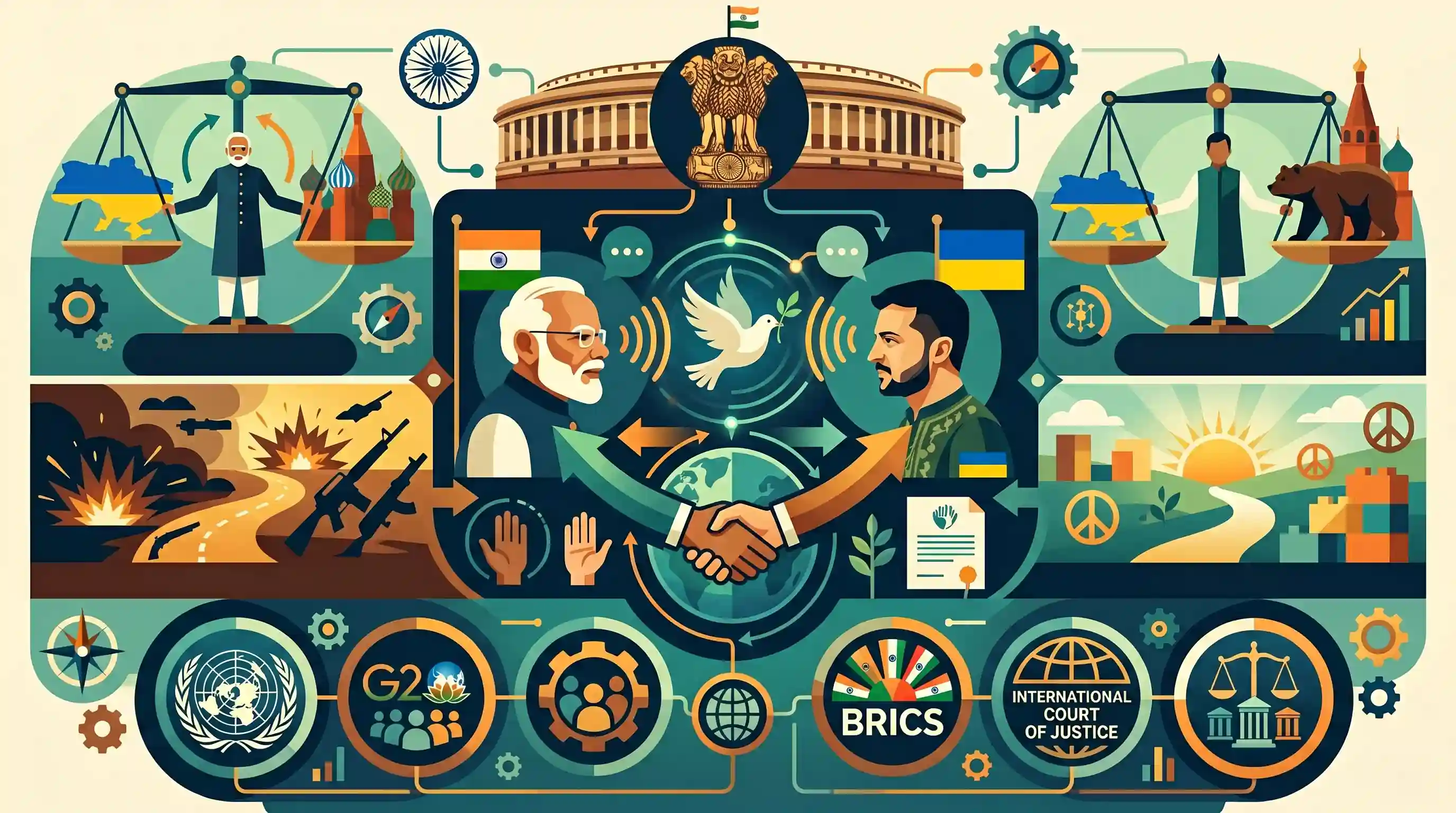
Prime Minister Narendra Modi spoke to Ukraine's President Volodymyr Zelenskyy, conveying India’s consistent position favoring an early and peaceful resolution to the ongoing Russia-Ukraine conflict. PM Modi emphasized India's readiness to contribute to peace efforts and end the hostilities. The interaction highlights India's approach of prioritizing dialogue and diplomacy, maintaining its strategic autonomy, and actively engaging with both sides of the conflict to foster a diplomatic solution.
Key Points
- PM Modi assured Ukrainian President Zelenskyy of India's commitment to assist in achieving an early and peaceful end to the conflict.
- India reiterated its consistent stance prioritizing dialogue and diplomacy over military escalation in resolving the crisis.
- The engagement reflects India's continuous dialogue with both Russian and Ukrainian leadership, highlighting its potential role as a peacebuilder or mediator.
- The interaction underscores India's broader foreign policy principle of strategic autonomy, maintaining relationships across geopolitical divides without aligning with any bloc.
Important Terms
Strategic Autonomy

A foreign policy doctrine where a nation makes independent decisions based on its own national interests, without being compelled by alliances or external pressures from major powers.
UPSC context
GS Paper II: International Relations. Tests understanding of India's balancing act between the West and Russia amidst global polarization.
Dialogue and Diplomacy
India's preferred approach to conflict resolution, advocating for peaceful negotiations and official communication channels rather than military solutions to settle international disputes.
UPSC context
GS Paper II: Foreign Policy. Tests India's stance on peaceful settlement of disputes and its 'Era of Not War' philosophy.
Russia-Ukraine Conflict
The ongoing geopolitical crisis and armed conflict between Russia and Ukraine, which has significant implications for global energy security, food supply, and international law.
UPSC context
GS Paper II: Global Events. Analyzes the conflict's impact on India's strategic interests, defense dependencies, and diplomatic positioning.
Bilateral Relations
The conduct of political, economic, and cultural relations between two sovereign states, such as India's separate and evolving engagements with both Kyiv and Moscow.
UPSC context
GS Paper II: Bilateral Groupings. Evaluates India's specific engagements and treaties with individual nations in a multipolar world.
Sovereignty and Territorial Integrity
The principle that a state has exclusive authority over its territory and that its borders should not be altered by force, as per the UN Charter.
UPSC context
GS Paper II: International Institutions. Relates to India's adherence to international law and its nuanced stance on territorial violations.
Global South
A term used to describe developing and less-developed nations; India often positions itself as a 'bridge' or 'voice' for these countries in global forums.
UPSC context
GS Paper II: International Relations. Tests India's leadership role and its efforts to address concerns of developing nations in conflicts.
Prelims Trap
India voted in favor of UN resolutions explicitly condemning Russia's military actions in Ukraine.
India has consistently abstained from UN resolutions directly condemning Russia. Instead, it maintains a nuanced stance advocating broadly for the UN Charter, territorial integrity, and dialogue.
Static Concepts Connected
How does 'Strategic Autonomy' differ from traditional 'Non-Alignment'?
- Non-Alignment: Historically focused on passive distancing from Cold War military blocs and maintaining ideological neutrality.
- Strategic Autonomy: Involves active, issue-based multi-alignments to maximize national interests, such as purchasing Russian oil while expanding US partnerships.
How does the UNSC veto power paralyze institutional action?
- Article 27: Under the UN Charter, grants the P5 (US, UK, France, Russia, China) the power to unilaterally block any substantive resolution.
- Structural Paralysis: When a P5 member is party to a conflict, they can veto disciplinary actions against themselves, highlighting the urgent need for structural UN reform.
Cross-Topic Patterns
Geopolitics + Energy Security
Western sanctions forced India to dramatically increase discounted Russian crude imports, directly linking foreign policy autonomy to domestic macro-economic inflation management.
G20 + The Global South
India leveraged the Ukraine crisis during its G20 presidency to champion the Global South, highlighting how the conflict triggered a severe crisis in the '3 Fs'—Food, Fuel, and Fertilizers.

Expect a 2026 Mains question analyzing how India used 'multi-alignment' to secure domestic energy while championing Global South issues.
Linked PYQs · 3
Linked PYQs · 3
- 2025MainsGS2
"The reform process in the United Nations remains unresolved, because of the delicate imbalance of East and West and entanglement of the USA vs. Russo-Chinese alliance.” Examine and critically evaluate the East-West policy confrontations in this regard.
- 2012MainsGS2
Does Putin's return as President of Russia mark a shift to a confrontationist stance in international diplomacy towards the West?
- 2023MainsGS2
‘Virus of Conflict is affecting the functioning of the SCO’ In the light of the above statement point out the role of India in mitigating the problems.
