Modi and Putin Reaffirm Strategic Partnership Amid Tariff Pressures
Source:The Hindu ↗
Why It Matters
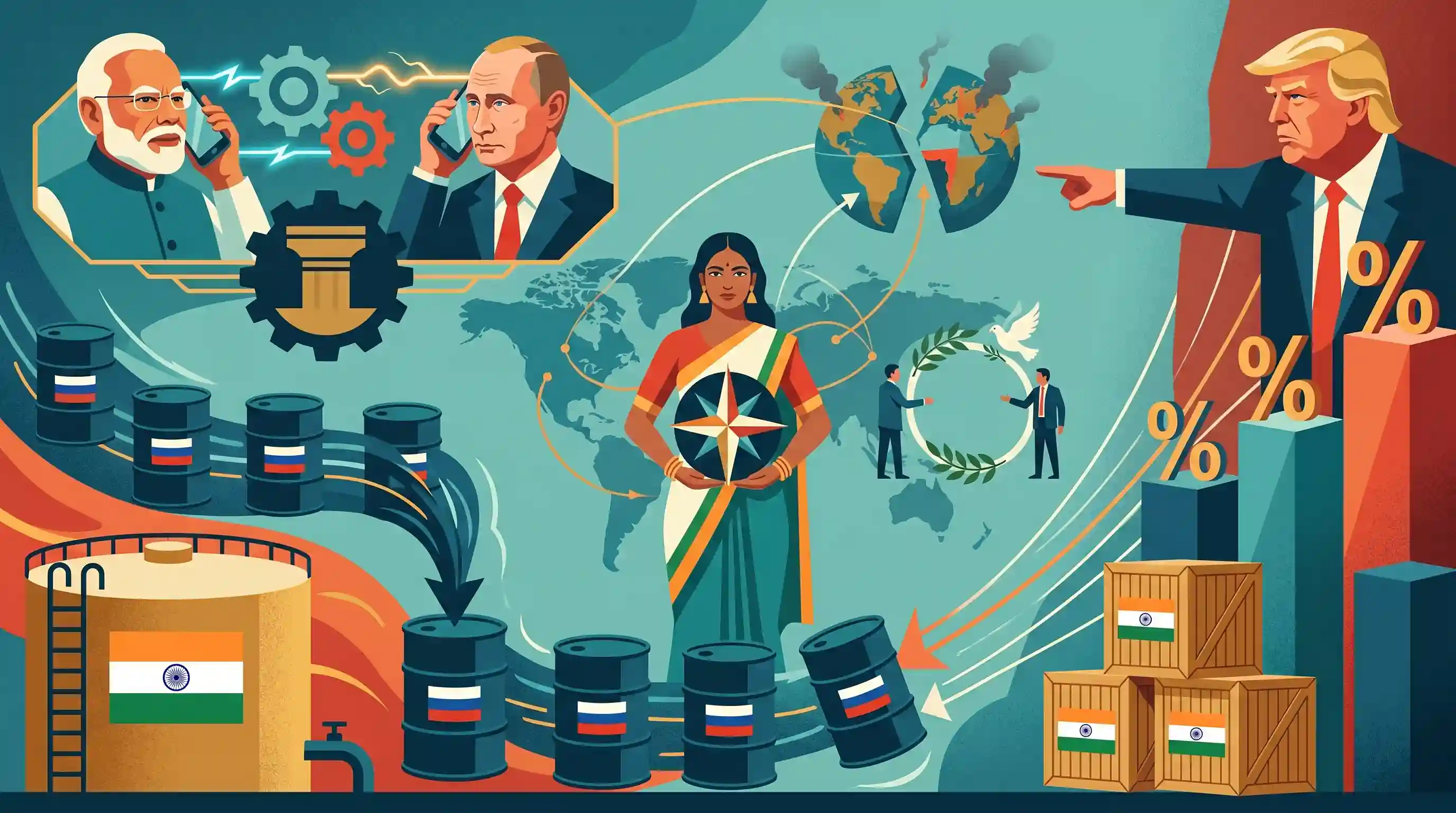
The development demonstrates the practical challenges of India's 'strategic autonomy' doctrine. It illustrates how India balances its energy security needs (via Russian oil) against economic and diplomatic pressure from the United States, offering a prime case study for GS2 International Relations.
Summary
Prime Minister Narendra Modi and Russian President Vladimir Putin held a strategic phone conversation reaffirming the "Special and Privileged Strategic Partnership" between the two nations. The dialogue closely followed US President Donald Trump's announcement of 50% tariffs on Indian imports, a move perceived as pressure on New Delhi to curb its crude oil imports from Russia. The two leaders discussed bilateral trade, energy security, and the Ukraine conflict, with Modi emphasizing diplomacy for peace. The interaction underscores India's commitment to maintaining strategic autonomy and securing its energy interests amidst mounting geopolitical complexities and US pressure.
Key Points
- Prime Minister Narendra Modi and Russian President Vladimir Putin held a telephone conversation to reaffirm the India-Russia "Special and Privileged Strategic Partnership."
- The discussion took place days after US President Donald Trump imposed 50% tariffs on Indian imports, aimed at pressuring India over its Russian crude oil purchases.
- Both leaders focused on global energy security, logistics, and bilateral trade, emphasizing the continued importance of Russian energy supplies to India.
- The phone call precedes an expected meeting between Putin and Trump, highlighting India's pursuit of strategic autonomy despite coercive US trade policies.
- PM Modi reiterated India's steadfast commitment to seeking a peaceful, diplomatic resolution to the ongoing Russia-Ukraine conflict.
Important Terms
Special and Privileged Strategic Partnership

The highest level of strategic partnership India maintains with any country (elevated in 2010), encompassing deep cooperation in defense, civil nuclear energy, space, and counter-terrorism.
UPSC context
GS II: International Relations. Tests understanding of India’s unique, long-term bilateral frameworks and historical alliances.
Strategic Autonomy
The ability of a nation to make sovereign foreign policy and defense decisions based on national interest, without being constrained by external powers or military alliances.
UPSC context
GS II: International Relations. Central to India’s independent stance in a polarized world and its transition from Non-Alignment.
Energy Security
The uninterrupted availability of energy sources at an affordable price, ensuring that a nation's economic growth and stability are not compromised by supply disruptions.
UPSC context
GS III: Economic Development. Relevant for India’s import dependency, inflation management, and strategic oil reserves.
Tariffs
Taxes imposed by a government on imported goods, frequently used as a tool of economic statecraft or geopolitical pressure to influence another nation's trade behavior.
UPSC context
GS III: Economy / GS II: IR. Important for trade wars, protectionism, and bilateral trade tensions with major partners like the US.
Rupee-Ruble Mechanism
An alternative payment arrangement allowing India and Russia to settle trade in their national currencies, thereby bypassing the US-dollar-dominated global financial systems and sanctions.
UPSC context
GS III: Economy. Vital for understanding sanctions-evasion, trade settlement issues, and the internationalization of the Indian Rupee.
Multipolarity
A global order characterized by the distribution of power among multiple major states, rather than being dominated by one (unipolar) or two (bipolar) superpowers.
UPSC context
GS II: International Relations. Key to India’s vision for global governance and its leadership in groups like BRICS and SCO.
Prelims Trap
India's 'Special and Privileged Strategic Partnership' with Russia includes a mutual defense assistance clause.
India-Russia relations are a strategic partnership, not a formal military alliance. India actively avoids binding mutual defense treaties to maintain its Strategic Autonomy.
Static Concepts Connected
What distinguishes 'Strategic Autonomy' from traditional 'Non-Alignment'?
- Non-Alignment: Rooted in the Cold War; focused primarily on maintaining equidistance and staying out of formal military blocs.
- Strategic Autonomy: Proactive multi-alignment. It involves issue-based partnerships to secure national interests (like cheap energy) without compromising independent sovereign decision-making.
- Modern Application: Balancing Russian oil procurement for domestic inflation control while simultaneously deepening defense and tech ties with the US via the Quad.
How do WTO Trade Remedies differ from Unilateral Tariffs?
- WTO Remedies: Include Anti-Dumping, Countervailing, and Safeguard duties, strictly governed by WTO agreements requiring proof of unfair trade practices or import surges.
- Unilateral Tariffs: Imposed by a single nation (like US 50% tariffs) often for geopolitical leverage, bypassing multilateral consensus.
- Legality & MFN: Unilateral tariffs usually violate the WTO's Most-Favored-Nation (MFN) principle, though countries often controversially cite GATT Article XXI (national security exception).
Cross-Topic Patterns
US Tariffs & the Push for Rupee Trade
Coercive US trade policies and sanctions accelerate India's push for Rupee-Rouble settlement mechanisms and the broader internationalization of the Rupee to insulate domestic energy security.
Energy Security vs. Geopolitical Vulnerability
India's heavy reliance on securing discounted Russian crude highlights the immediate tension between macroeconomic stability (inflation control) and long-term geopolitical vulnerability in energy supply chains.

Weaponization of trade vs Strategic Autonomy is a prime 2026 GS2 question; expect Prelims MCQs on WTO rules and security exceptions.
Linked PYQs · 2
Linked PYQs · 2
- 2020MainsGS2
What is the significance of Indo-US defence deals over Indo-Russian defence deals? Discuss with reference to stability in the Indo-Pacific region.
- 2012MainsGS2
How have the US sanctions against Iran affected India's bilateral relations with Iran?
