India Iran Diplomatic Engagement on Regional Stability
Source:The Hindu ↗
Why It Matters
This ongoing West Asian crisis perfectly illustrates the interconnectedness of geopolitics with India's core national interests, specifically energy security and the safety of its massive diaspora. It is highly relevant for GS-2 (International Relations) and GS-3 (Economy/Energy), presenting a real-world case study of India balancing strategic autonomy, multilateral leadership (via BRICS), and crisis management.
Summary
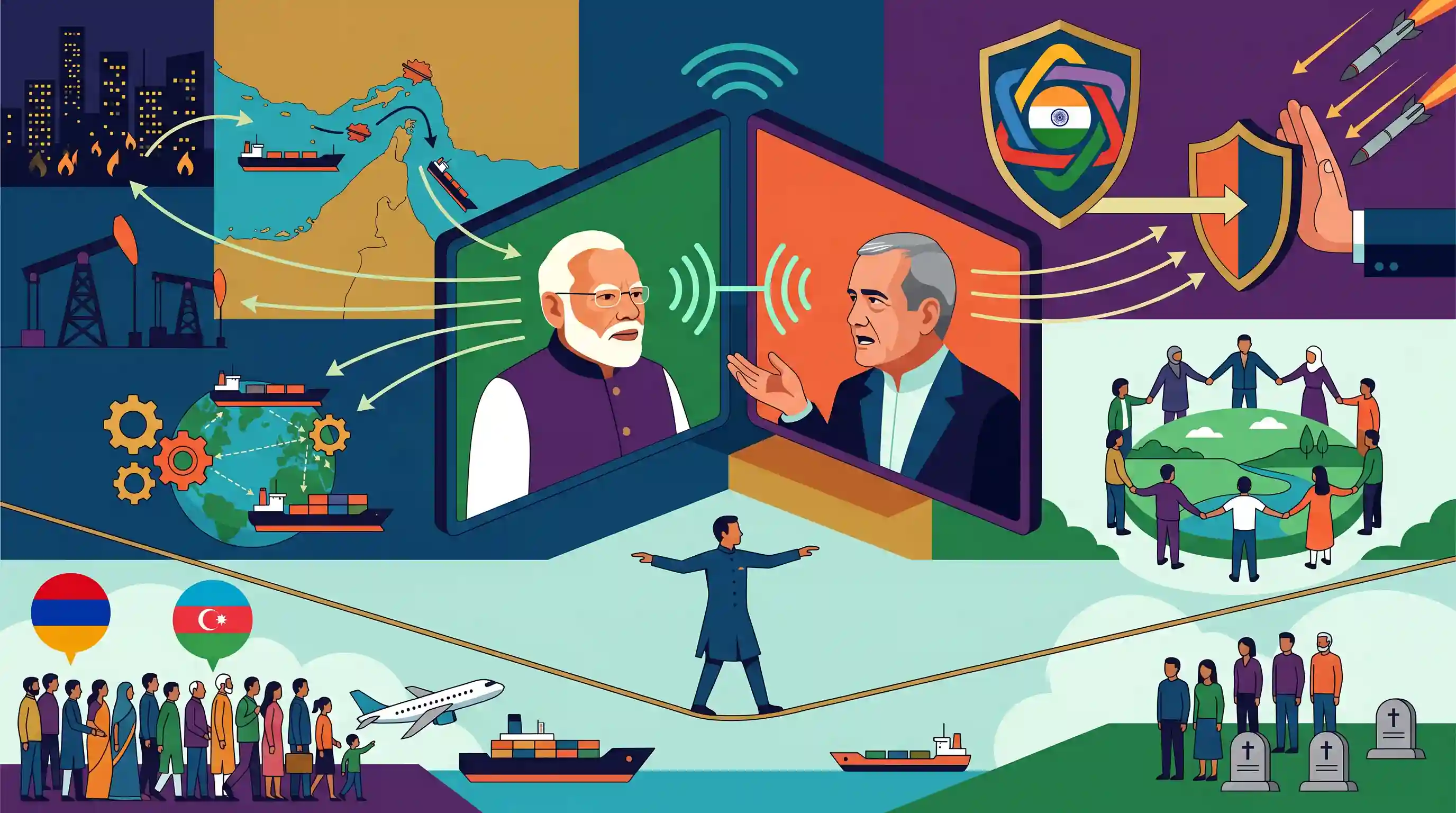
In a significant diplomatic engagement, Prime Minister Narendra Modi spoke with Iranian President Masoud Pezeshkian against the backdrop of the escalating conflict in West Asia, triggered by the US-Israel strikes on Tehran that killed Supreme Leader Ayatollah Ali Khamenei. The discussion focused heavily on India's strategic concerns: the freedom of navigation in the Strait of Hormuz, maintaining global supply chains, and mitigating severe energy insecurity. Iran requested that India, as the current chair of BRICS, leverage its position to halt foreign aggressions and support an indigenous regional security framework free from external interference. Concurrently, the crisis highlights the vulnerability of the Indian diaspora, as India reported evacuating 882 citizens through Armenia and Azerbaijan while grappling with the death of six nationals, underscoring the tightrope walk of India's foreign policy in the Middle East.
Key Points
- PM Narendra Modi and Iranian President Masoud Pezeshkian held a telephone conversation addressing the disruption of global supply chains and freedom of navigation in the Strait of Hormuz amid the escalating US-Israel-Iran conflict.
- Highlighting India's current presidency of the BRICS grouping, Iran urged New Delhi to take an independent, multilateral role in halting aggressions and ensuring regional stability.
- Iran proposed an indigenous "regional security framework" for West Asia, insisting on the immediate cessation of US and Israeli attacks and the removal of foreign interference.
- The ongoing conflict poses direct challenges to India through energy insecurity caused by a chokehold on the Strait of Hormuz and threats to its diaspora, necessitating the evacuation of 882 Indians via Armenia and Azerbaijan following multiple casualties, including a recent death in Riyadh.
Important Terms
BRICS

An intergovernmental organization comprising Brazil, Russia, India, China, and South Africa, recently expanded to include Iran, Egypt, Ethiopia, and the UAE to promote a multipolar world order.
UPSC context
GS-II International Relations; tests knowledge of multilateral groupings, South-South cooperation, and India's role in global governance.
Strait of Hormuz
A critical maritime chokepoint between the Persian Gulf and the Gulf of Oman through which approximately 20% of the world's oil and a third of its LNG pass daily.
UPSC context
GS-I World Geography/GS-II Strategic Security; vital for understanding energy transit risks and India’s maritime security concerns.
Energy Security
The uninterrupted availability of energy sources at an affordable price, ensuring that a nation's economic growth and basic needs are not compromised by supply disruptions.
UPSC context
GS-III Economy & Infrastructure; significant due to India's high (80%+) dependence on imported crude oil and natural gas.
Indian Diaspora
The global community of Non-Resident Indians (NRIs) and Persons of Indian Origin (PIOs), representing the world's largest overseas population and a major source of remittances.
UPSC context
GS-II International Relations; focuses on the protection of citizens abroad and the diaspora's role as a strategic asset for soft power.
West Asia
A geopolitically volatile region (Middle East) critical to India for its energy supplies, trade routes, and as a major destination for the Indian labor force.
UPSC context
GS-II International Relations; central to India's 'Link West' policy and regional stability's direct impact on national interests.
Prelims Trap
"The Strait of Hormuz connects the Persian Gulf directly to the Red Sea, making it a critical choke point."
It connects the Persian Gulf to the Gulf of Oman and the Arabian Sea. The Bab-el-Mandeb strait is what connects the Red Sea to the Gulf of Aden.
Static Concepts Connected
What makes the Strait of Hormuz geopolitically vital and which nations border it?
- Bordering Nations: Iran lies to the north, and the Omani exclave of Musandam lies to the south, making it a narrow but highly contested maritime chokepoint.
- Trade Dependency: It facilitates the transit of roughly 20% of global petroleum consumption, serving as the sole sea passage connecting the resource-rich Persian Gulf to the open ocean.
What defines India's 'Strategic Multi-Alignment' policy in West Asia?
- De-hyphenation: India maintains parallel, independent ties with mutually hostile nations, simultaneously deepening technological and defense ties with Israel while pursuing transit and energy ties with Iran.
- Diaspora & Energy: A primary driver of this delicate balancing act is the protection of the 9 million-strong Indian diaspora in the Gulf, alongside securing critical energy supplies.
Cross-Topic Patterns
Oil chokepoints & Imported Inflation
Disruptions in Hormuz spike crude prices, widening India's Current Account Deficit and triggering imported inflation, heavily impacting the RBI's monetary policy and macroeconomic stability.
BRICS geopolitical expansion
Iran's call for an indigenous security framework signals BRICS shifting from pure economic cooperation to geopolitical balancing against Western hegemony, testing India's non-aligned stance.

Expect map-based Prelims Qs linking West Asian chokepoints (Hormuz) to regional conflicts and India's INSTC connectivity routes.
Linked PYQs · 5
Linked PYQs · 5
- 2017MainsGS2
The question of India's Energy Security constitutes the most important part of India's economic progress. Analyze India's energy policy cooperation with West Asian countries.
- 2025MainsGS2
"Energy security constitutes the dominant kingpin of India's foreign policy, and is linked with India's overarching influence in Middle Eastern countries.” How would you integrate energy security with India's foreign policy trajectories in the coming years?
- 2023MainsGS2
Indian diaspora has scaled new heights in the West. Describe its economic and political benefits for India.
- 2012MainsGS2
Compare the significance of IBSA and BRICS in the context of India's multilateral diplomacy.
- 2024PrelimsGS1
Consider the following statements : Statement-I : Sumed pipeline is a strategic route for Persian Gulf oil and natural gas shipments to Europe. Statement-II : Sumed pipeline connects the Red Sea with the Mediterranean Sea. Which one of the following is correct in respect of the above statements?
