PM Modi Addresses Namibian Parliament on Africa Partnership
Source:The Hindu ↗
Why It Matters
The article showcases India's contemporary diplomatic strategy in Africa, transitioning from historical anti-colonial solidarity to modern partnerships based on technology sharing (UPI) and global environmental leadership (CDRI, GBA). It provides a concrete example of India's 'cooperate, not compete' alternative to traditional resource-extractive diplomacy in the Global South.
Summary
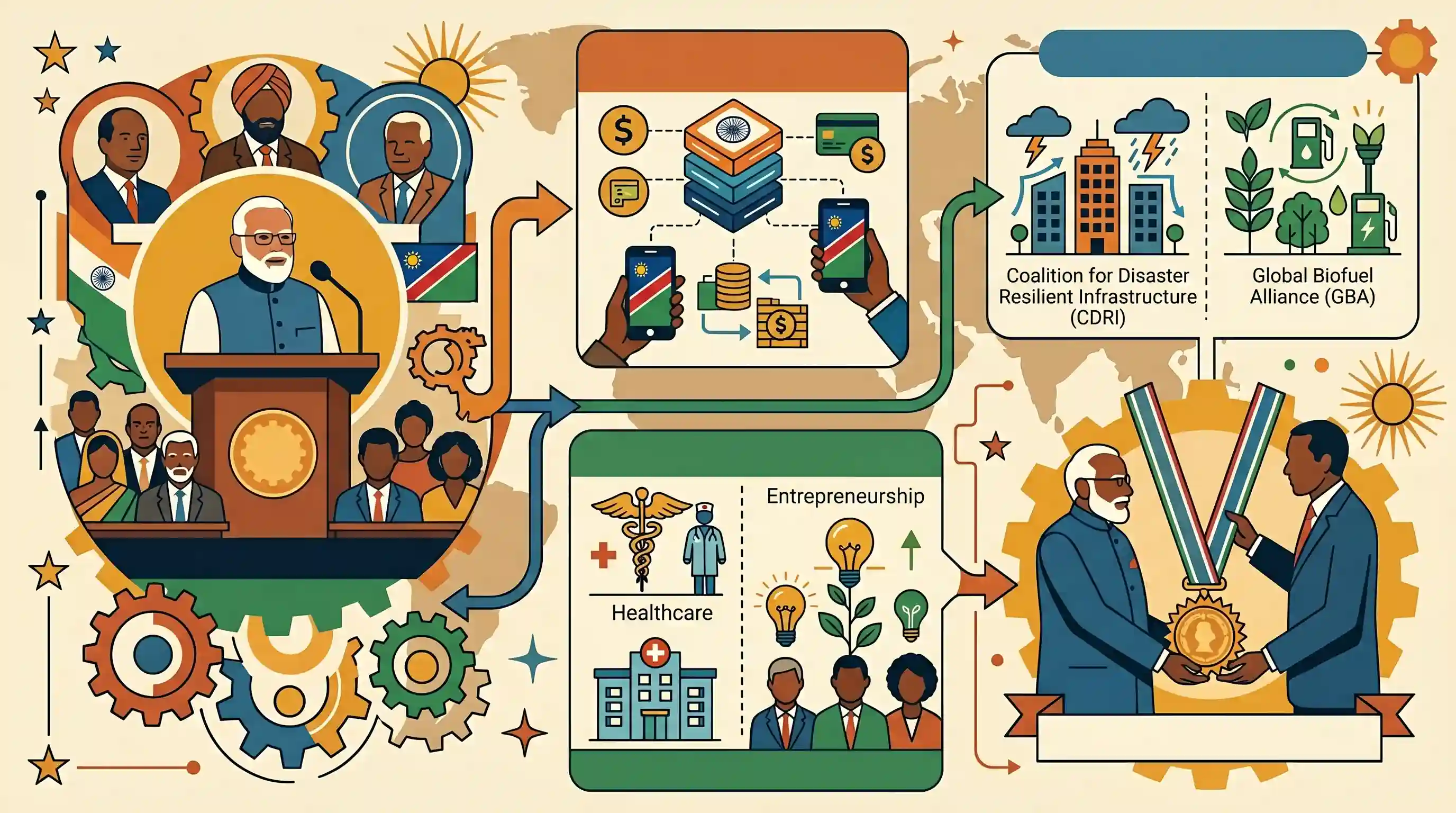
During a historic visit to Namibia, Prime Minister Narendra Modi addressed the Namibian Parliament, highlighting the deep-rooted ties between the two nations dating back to India's support for Namibia's independence. Expanding on India's Africa policy, PM Modi emphasized a partnership model based on cooperation and value creation rather than resource exploitation. The visit marked significant diplomatic milestones, including Namibia's adoption of India's UPI system, its entry into the Coalition of Disaster Resilient Infrastructure (CDRI) and the Global Biofuel Alliance (GBA), and the signing of MoUs in health and entrepreneurship. Recognizing these strengthening ties, Namibia conferred its highest civilian honor on the Indian Prime Minister.
Key Points
- Prime Minister Narendra Modi addressed a joint session of the Namibian Parliament, emphasizing India's historical support for Namibia's decolonisation and the SWAPO liberation movement since the 1940s.
- India's broader Africa policy was outlined as focusing on mutual cooperation ('build together') and capacity building, rejecting models that treat the continent merely as a source of raw materials.
- Namibia has formally adopted India's UPI digital payment system, with a launch expected later this year following an agreement between NPCI and the Bank of Namibia.
- Namibia completed formalities to join key India-led global initiatives: the Coalition of Disaster Resilient Infrastructure (CDRI) and the Global Biofuel Alliance (GBA).
- PM Modi was conferred with Namibia's highest civilian honour, the Order of the Most Ancient Welwitschia Mirabilis, by Namibian President Netumbo Nandi-Ndaitwah.
Important Terms
Order of the Most Ancient Welwitschia Mirabilis

Namibia's highest civilian honor, named after a resilient desert plant endemic to the Namib Desert; conferred upon Prime Minister Modi in 2025 to recognize India's developmental support and leadership.
UPSC context
GS Paper II: Bilateral relations and international honors; tests understanding of India's soft power and diplomatic recognition in Africa.
South West Africa People’s Organisation (SWAPO)
The liberation movement that led Namibia to independence; India was a key supporter, hosting its first-ever foreign diplomatic mission in New Delhi in 1986.
UPSC context
GS Paper II: Historical foundations of India's Africa policy; tests knowledge of anti-colonial solidarity and South-South cooperation.
Coalition for Disaster Resilient Infrastructure (CDRI)
An India-led global partnership of national governments and UN agencies launched in 2019 to promote resilient infrastructure against climate and disaster risks; Namibia joined in 2025.
UPSC context
GS Paper III: Disaster management and environment; tests awareness of India's leadership in global climate action and infrastructure resilience.
Global Biofuel Alliance (GBA)
An international initiative launched by India at the 2023 G20 Summit to accelerate the adoption of sustainable biofuels; Namibia became a member during PM Modi’s 2025 visit.
UPSC context
GS Paper III: Energy and Environment; tests understanding of clean energy transitions and India's role in global fuel standards.
UPI Technology Licensing Agreement
A historic deal between the Bank of Namibia and NPCI to deploy India's real-time payment technology, making Namibia the first African nation to adopt the full UPI stack.
UPSC context
GS Paper III: Digital Public Infrastructure (DPI); tests knowledge of India's fintech exports and digital diplomacy in the Global South.
NPCI International Payments Limited (NIPL)
The wholly-owned subsidiary of the National Payments Corporation of India (NPCI) responsible for deploying indigenous payment systems like UPI and RuPay in international markets.
UPSC context
GS Paper III: Indian Economy; tests understanding of institutional mechanisms for globalizing India's financial technology.
Prelims Trap
"The Coalition for Disaster Resilient Infrastructure (CDRI) is a specialized agency of the United Nations."
CDRI is an international multi-stakeholder partnership launched by India at the 2019 UN Climate Action Summit. It is an independent coalition, not a UN specialized agency.
Static Concepts Connected
What is the core mandate and structure of the CDRI?
- Origin: Launched by India at the 2019 UN Climate Action Summit in New York.
- Core Mandate: Promotes the resilience of new and existing infrastructure systems to climate and disaster risks to ensure sustainable development.
- Structure: A multi-stakeholder global partnership of national governments, UN agencies, multilateral development banks, and the private sector.
How does Digital Public Infrastructure (DPI) act as a foreign policy tool?
- Soft Power: Exporting homegrown, cost-effective tech like UPI builds immense diplomatic capital and goodwill in developing nations.
- Strategic Alternative: Offers an alternative to Western tech monopolies and Chinese telecom dominance, fostering financial inclusion.
- Economic Diplomacy: Facilitates seamless cross-border remittances and trade, directly benefiting the Indian diaspora and domestic businesses globally.
Cross-Topic Patterns
DPI replacing traditional aid diplomacy
India is pivoting from traditional grant-based aid to exporting Digital Public Infrastructure (UPI, Aadhaar-like models), establishing itself as the digital governance champion of the Global South.
'Build Together' vs Resource Extraction
Modi's emphasis on value creation directly contrasts with China's infrastructure-for-minerals model, highlighting India’s strategy of human capacity building and localized empowerment across the African continent.
Namibia's uranium and energy security
Beyond soft power, deep ties with Namibia are strategically vital for India's nuclear energy ambitions, as Namibia remains one of the world's top producers of uranium.

Expect a multi-statement question mapping India's DPI exports (UPI) and environmental coalitions (CDRI/GBA) as Global South soft power.
Linked PYQs · 2
Linked PYQs · 2
- 2025MainsGS2
India-Africa digital partnership is achieving mutual respect, co-development and long-term institutional partnerships. Elaborate.
- 2021MainsGS2
If the last few decades were of Asia's growth story, the next few are expected to be of Africa's.” In the light of this statement, examine India's influence in Africa in recent years.
