Seva Teerth and Central Secretariat infrastructure modernization
Source:The Hindu ↗
Why It Matters
The inauguration represents a symbolic and functional shift in India's administrative setup, marrying the decolonization of public institutions with indigenous cultural aesthetics. Additionally, the scaling up of key welfare and agriculture schemes provides crucial data points for answers regarding rural empowerment, agricultural financing, and health infrastructure.
Summary
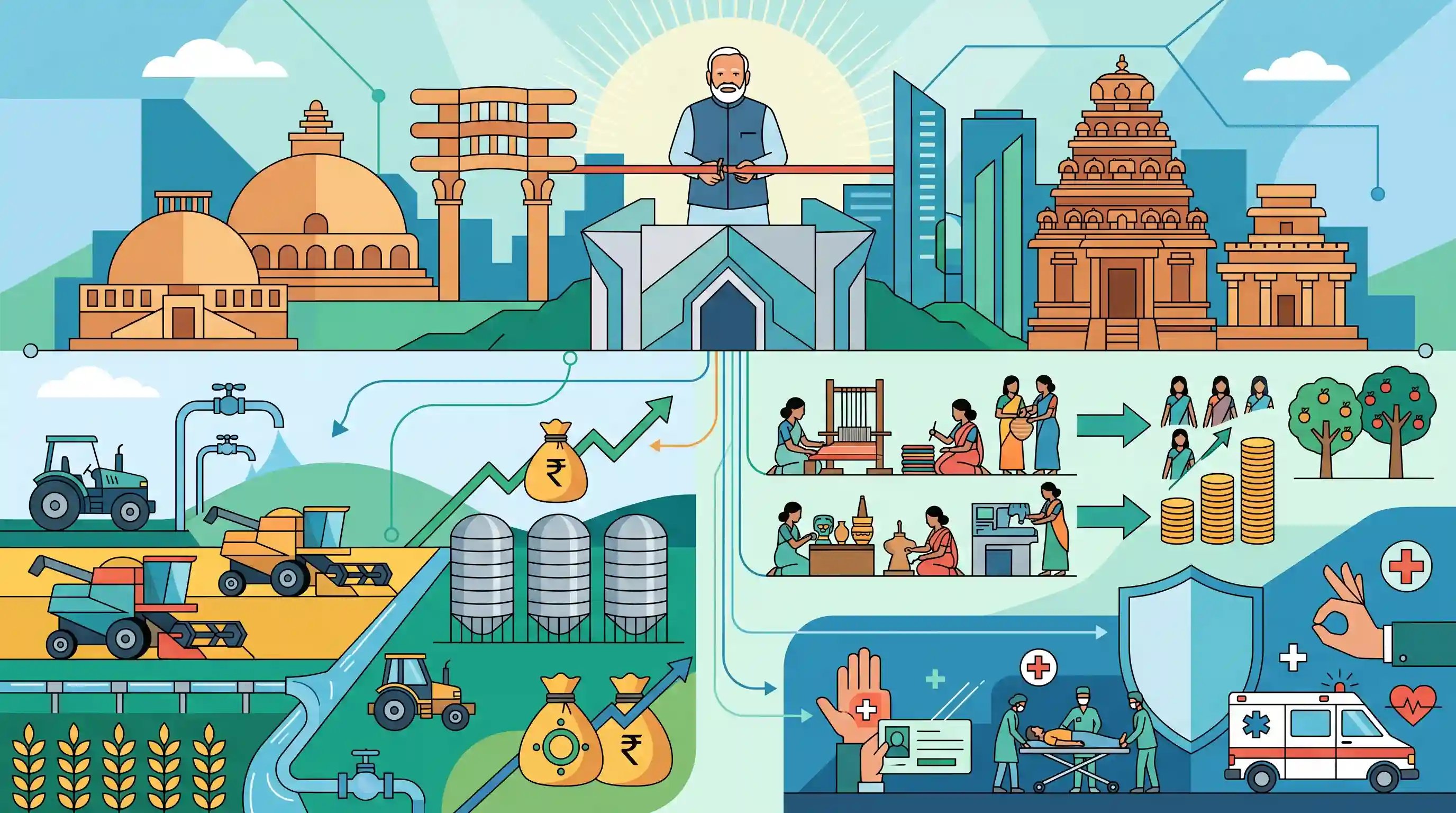
Prime Minister Narendra Modi inaugurated the new PMO and Central Secretariat buildings ('Seva Teerth' and 'Kartavya Bhavans') as part of the Central Vista redevelopment. Emphasizing a shift away from a "colonial mindset," he noted that the buildings draw inspiration from India's rich architectural heritage, including Buddhist stupas and Chalukyan temples, rather than the imperial design of the old North and South Blocks. Concurrently, the PM signed key decisions to expand the Agriculture Infrastructure Fund to ₹2 lakh crore, increase the target for 'Lakhpati Didis' to 6 crores, and introduce the PM RAHAT Scheme for cashless treatment of accident victims, tying the modernization of administrative infrastructure to grassroots welfarism and rural empowerment.
Key Points
- The new PMO complex ('Seva Teerth') and Central Secretariat ('Kartavya Bhavans') were inaugurated to provide modern, tech-enabled administrative spaces, replacing the colonial-era North and South Blocks.
- The architectural design of the new buildings features indigenous elements like red and white sandstone, drawing inspiration from Buddhist Stupas and Chalukyan temples, including the Chennakeshava Temple.
- The Prime Minister framed the new infrastructure as a step towards decolonizing Indian governance, shifting the institutional ethos from imperial authority to 'Seva' (service) and fulfilling people's aspirations.
- To boost rural women's economic empowerment, the target for the 'Lakhpati Didi' scheme (which works through SHGs) was doubled to 6 crore women.
- The Agriculture Infrastructure Fund was doubled to ₹2 lakh crore to enhance post-harvest management and support farming assets.
- The PM RAHAT Scheme was launched to provide cashless emergency medical treatment up to ₹1.5 lakh for road accident victims.
Important Terms
PM RAHAT Scheme

A national scheme providing cashless medical treatment up to ₹1.5 lakh for road accident victims during the "Golden Hour." It covers any road category and is funded by the Motor Vehicle Accident Fund.
UPSC context
GS Paper 2 & 3: Government policies, health infrastructure, and emergency response systems. Tests knowledge of welfare schemes and safety.
Lakhpati Didi scheme
An initiative under DAY-NRLM aiming to empower Self Help Group (SHG) members to earn a sustainable annual income of ₹1 lakh or more. The target was recently increased to 6 crore women.
UPSC context
GS Paper 2 & 3: Women empowerment, rural development, and poverty alleviation through financial inclusion. Relevant for social justice.
Agriculture Infrastructure Fund
A Central Sector Scheme providing medium-to-long term debt financing for post-harvest management infrastructure and community farming assets. It offers 3% interest subvention and credit guarantee for loans up to ₹2 crore.
UPSC context
GS Paper 3: Agriculture, supply chain management, and rural economy. Focuses on doubling farmer incomes and post-harvest technology.
Central Vista Project
A comprehensive plan to modernize New Delhi's administrative area, including a new Parliament, the Common Central Secretariat (Kartavya Bhavans), and a new PMO (Seva Teerth), replacing colonial-era infrastructure.
UPSC context
GS Paper 1 & 2: Architecture, heritage conservation, and governance. Tests understanding of national symbols and administrative modernization.
Seva Teerth
The newly inaugurated Prime Minister’s Office (PMO) complex under the Central Vista project. It houses the PMO, Cabinet Secretariat, and National Security Council, symbolizing a shift toward service-oriented governance.
UPSC context
GS Paper 2: Governance and administrative efficiency. Highlighted as a move away from colonial legacy in government architecture.
Self Help Groups (SHGs)
Informal, voluntary associations of 15–20 people (mainly rural women) from similar socio-economic backgrounds who pool savings for collective credit and socio-economic empowerment.
UPSC context
GS Paper 2: Role of civil society and community organizations in rural development. Tests grassroots governance and microfinance models.
Prelims Trap
"The Lakhpati Didi scheme is a flagship initiative implemented by the Ministry of Women and Child Development."
Because it targets women, aspirants assume it falls under MoWCD. It actually operates under the Ministry of Rural Development via DAY-NRLM.
Static Concepts Connected
What defines Hoysala temple architecture (like the Chennakeshava Temple)?
- Stellate Plan: Temples are built on a star-shaped, raised platform called a 'jagati', which also serves as an open circumambulatory path (pradakshinapatha).
- Vesara Hybrid: It exemplifies the Vesara style, seamlessly blending Nagara (northern) and Dravidian (southern) architectural elements into a distinct regional aesthetic.
- Soapstone Usage: Builders used chloritic schist (soapstone), which is soft when quarried but hardens over time, enabling incredibly intricate carvings like 'Madanika' bracket figures.
What are the core mechanisms of the Agriculture Infrastructure Fund (AIF)?
- Scheme Type: It is a Central Sector Scheme, meaning it is 100% funded by the Union Government with no state-level financial matching required.
- Interest Subvention: It provides an interest subvention of 3% per annum for loans up to ₹2 crore, specifically for building post-harvest management infrastructure.
- Target Assets: Loans are directed toward PACS, FPOs, SHGs, and agri-entrepreneurs to build community farming assets like cold storage, assaying units, and silos.
Cross-Topic Patterns
Decolonization of Public Administration
The architectural shift in the Central Vista links Post-Independence consolidation directly to Art & Culture, mirroring the recent overhaul of colonial-era penal codes to indigenous systems.
SHGs as Apex Welfare Delivery
Expanding the 'Lakhpati Didi' target cements SHGs' evolution from simple microfinance pooling mechanisms into primary nodal agencies for rural economic empowerment and poverty eradication.

Expect a 2026 Prelims question mixing Hoysala architectural features (jagati, stellate plan) with the expanded Lakhpati Didi parameters.
Linked PYQs · 4
Linked PYQs · 4
- 2020MainsGS2
Micro-Finance as an anti-poverty vaccine, is aimed at asset creation and income security of the rural poor in India". Evaluate the role of the Self Help Groups in achieving the twin objectives along with empowering women in rural India.
- 2014MainsGS3
In the villages itself no form of credit organization will be suitable except the cooperative society. -All India Rural Credit Survey. Discuss this statement in the background of agricultural finance in India. What constraints and challenges do financial institutions supplying agricultural finance face? How can technology be used to better reach and serve rural clients?
- 2020MainsGS1
Indian philosophy and tradition played a significant role in conceiving and shaping the monuments and their art in India. Discuss.
- 2016MainsGS1
Early Buddhist Stupa-art, while depicting folk motifs and narratives successfully expounds Buddhist ideals. Elucidate.
