India Stance on Cross Border Terrorism at SCO Summit
Source:Indian Express ↗
Why It Matters
The SCO is a major Eurasian political and security bloc. India's strategy to address cross-border terrorism directly at such multilateral summits, particularly in the presence of China and Pakistan, is directly relevant to GS2 (International Relations and Institutions) and GS3 (Internal Security). Understanding this helps aspirants analyze India's diplomatic posturing and its fight against state-sponsored terrorism.
Summary
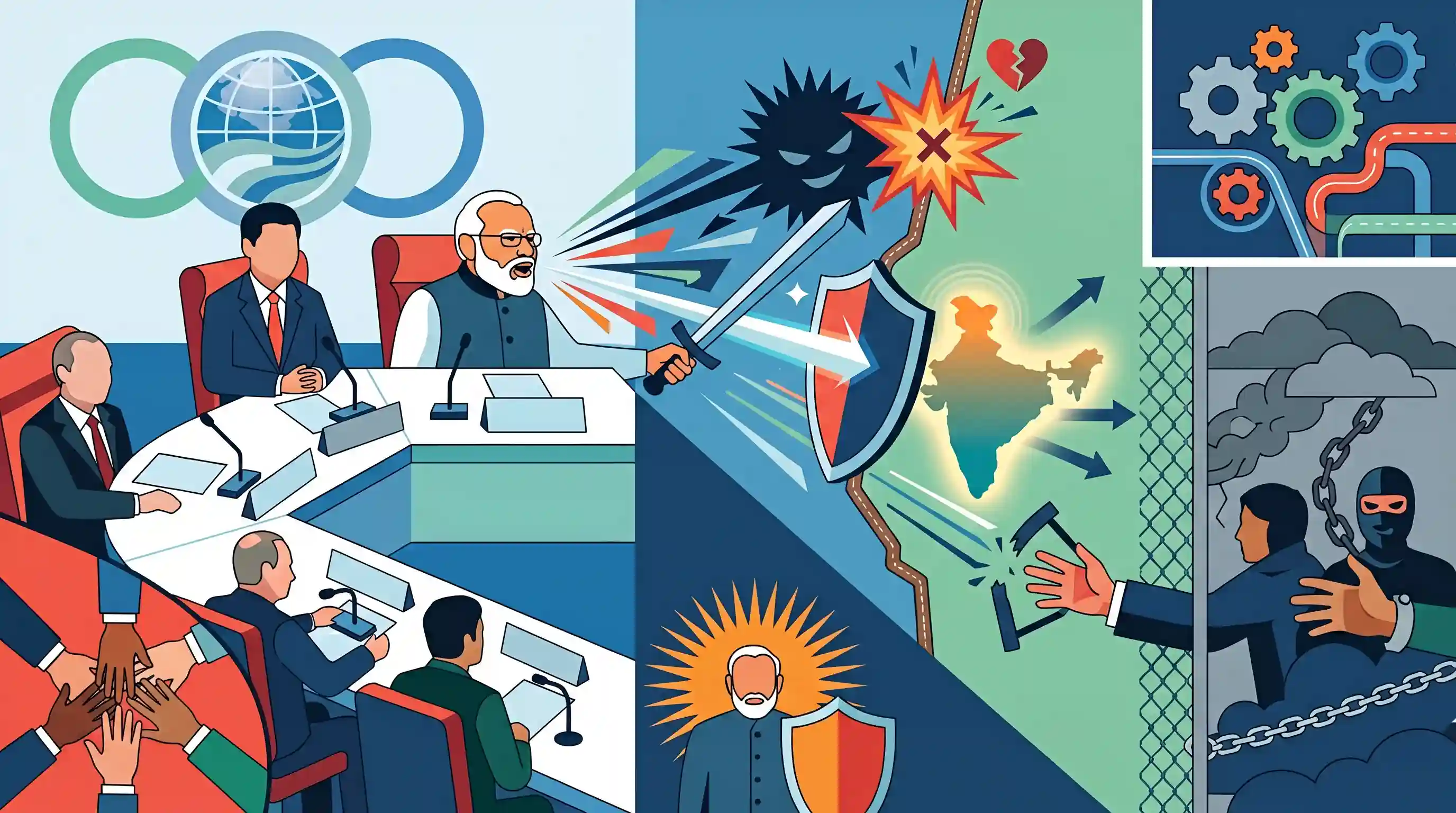
At the Shanghai Cooperation Organisation (SCO) summit—attended by regional leaders including Chinese President Xi Jinping, Russian President Vladimir Putin, and Pakistan's Prime Minister—PM Narendra Modi delivered a strong message against cross-border terrorism. Referencing the recent Pahalgam terror attack, Modi condemned it as an "assault on India’s soul" and a challenge to humanity. The address underscores India's strategic approach to multilateral diplomacy: utilizing forums like the SCO to assert national security priorities, isolate state sponsors of terror, and navigate complex geopolitical dynamics involving neighboring adversaries.
Key Points
- PM Modi raised the issue of the Pahalgam terror attack at the SCO summit, calling it an "assault on India's soul."
- The SCO summit saw the attendance of key regional leaders, including China's Xi Jinping, Russia's Vladimir Putin, and the Prime Minister of Pakistan.
- India effectively utilized the multilateral SCO platform to spotlight the issue of cross-border terrorism and challenge states that harbour or support terrorist elements.
- The address highlights India's diplomatic strategy of engaging in Eurasian multilateral forums while firmly asserting its red lines on national security and terrorism in the presence of adversaries.
Important Terms
Shanghai Cooperation Organisation (SCO)

A Eurasian intergovernmental organization founded in 2001 by China, Russia, and Central Asian states. It focuses on regional security, economic cooperation, and countering terrorism (the "three evils").
UPSC context
GS Paper 2 (International Relations); tests knowledge of regional groupings and India's balancing act between Eurasian and Western powers.
Cross-border Terrorism
A form of grey-zone warfare where a state’s territory is used to execute terror attacks in a neighboring country, aiming to destabilize it through proxy violence.
UPSC context
GS Paper 3 (Internal Security); tests understanding of external security threats and the role of state-sponsored non-state actors.
State-sponsored Terrorism
Intentional support—including funding, training, and sanctuary—provided by a national government to violent non-state actors to achieve foreign policy goals against rival states.
UPSC context
GS Paper 3; critical for discussing proxy warfare and India's diplomatic strategy to isolate regimes that harbor terrorists.
Regional Anti-Terrorist Structure (RATS)
A Tashkent-based permanent organ of the SCO tasked with coordinating member states' efforts to combat the "three evils" of terrorism, separatism, and extremism.
UPSC context
GS Paper 2; tests knowledge of institutional mechanisms within the SCO that assist India's regional security objectives.
Multilateral Diplomacy
Diplomacy involving three or more nations within formal frameworks to build consensus, solve global problems, and manage collective security and trade.
UPSC context
GS Paper 2 (International Relations); tests the ability to analyze India’s strategic engagement in complex global forums.
Comprehensive Convention on International Terrorism (CCIT)
A legal framework proposed by India to the UN in 1996 to establish a universal definition of terrorism and criminalize its international support.
UPSC context
GS Paper 2; relevant to India’s long-standing global advocacy for a robust international counter-terrorism law.
Prelims Trap
"The SCO's Regional Anti-Terrorist Structure (RATS) is headquartered in Shanghai, alongside the main Secretariat."
RATS is actually headquartered in Tashkent, Uzbekistan. Furthermore, the main SCO Secretariat is located in Beijing, not Shanghai, despite the organization's name.
Static Concepts Connected
What is the mandate of the SCO's Regional Anti-Terrorist Structure (RATS)?
- Core mandate: Combating the "three evils" of terrorism, separatism, and extremism across the Eurasian region.
- Headquarters: Located in Tashkent, Uzbekistan (distinct from the main SCO Secretariat in Beijing).
- Key functions: Facilitates intelligence sharing, joint counter-terrorism military exercises, and extradition of terrorists among member states.
What constitutes 'Grey Zone' warfare in India's internal security?
- Definition: Aggressive, coercive actions by a state that intentionally fall below the threshold of conventional, declared war.
- Tactics: Use of non-state actors, cross-border terrorism, cyber attacks, and targeted disinformation campaigns.
- Indian context: State-sponsored terrorism in Jammu & Kashmir, aimed at bleeding India through a "thousand cuts" without triggering full-scale military retaliation.
Cross-Topic Patterns
SCO RATS + FATF Global Mandate
While SCO RATS focuses on regional intelligence and tactical counter-terrorism, India heavily leverages the Financial Action Task Force (FATF) globally to systematically choke terror financing networks of the same adversaries.
Multilateral terror + UNSC 1267 Committee
India's push against cross-border terror at SCO highlights frustration with the UN's 1267 sanctions committee, where China frequently places 'technical holds' on designating Pakistan-based terrorists.

Expect a 2026 multi-statement question on SCO structure, contrasting RATS (Tashkent) with the Secretariat, plus new members Iran/Belarus.
Linked PYQs · 5
Linked PYQs · 5
- 2021MainsGS2
Critically examine the aims and objectives of SCO. What importance does it hold for India?
- 2024MainsGS2
‘Terrorism has become a significant threat to global peace and security.’ Evaluate the effectiveness of the United Nations Security Council's Counter Terrorism Committee (CTC) and its associated bodies in addressing and mitigating this threat at the international level.
- 2016MainsGS2
Increasing cross-border terrorist attacks in India and growing interference in the internal affairs of several member-states by Pakistan are not conducive for the future of SAARC (South Asian Association for Regional Cooperation)." Explain with suitable examples.
- 2022PrelimsGS1
Consider the following: 1. Asian Infrastructure Investment Bank 2. Missile Technology Control Regime 3. Shanghai Cooperation Organisation India is a member of which of the above?
- 2007PrelimsGS1
Consider the following statements: 1. China has the observer’s status at the South Asian Association for Regional Cooperation. 2. India has the observer’s status at the Shanghai Cooperation Organisation. Which of the statements given above is/are correct?
