Rhetorical Stagnation Undermines Parliamentary Debate and Opposition
Source:Indian Express ↗
Why It Matters
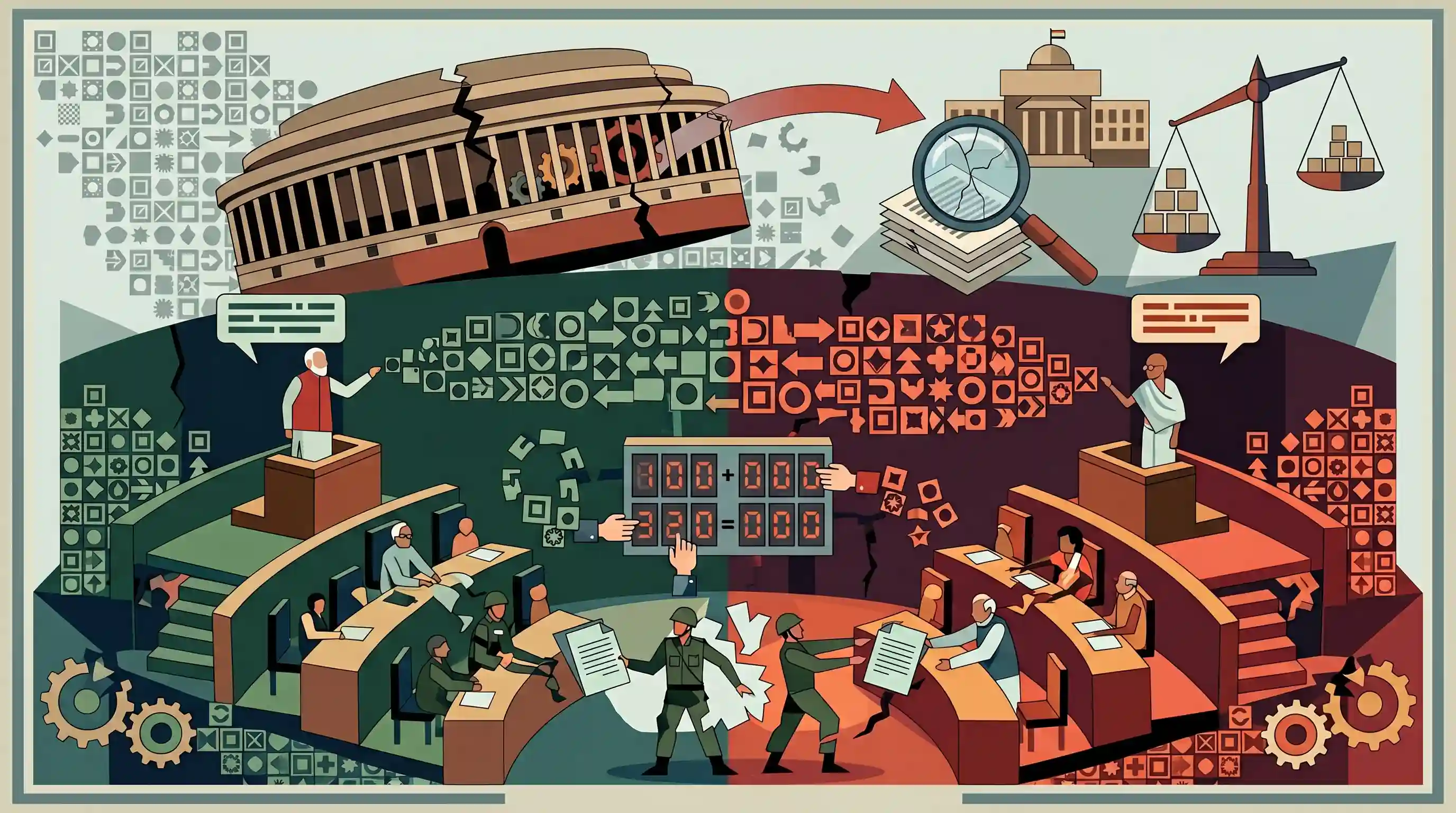
The quality of parliamentary debates and the effectiveness of the Opposition are fundamental to the health of a parliamentary democracy. This article provides critical insights into how rhetorical stagnation undermines legislative accountability, directly addressing GS Paper 2 topics on the functioning of the Indian Parliament and democratic institutions.
Summary
The article critiques the current state of parliamentary debates in India, observing a lack of substantive discourse as both the government and the Opposition resort to repeating predictable political rhetoric. It argues that this 'sameness' disproportionately harms the Opposition, which requires fresh, constructive narratives to effectively hold the executive accountable. Highlighting the exchanges between key figures like PM Modi and Rahul Gandhi, as well as debates on issues like the Agnipath scheme (linked to former Army Chief Gen. M.M. Naravane's remarks), the author points out that mechanical point-scoring has largely replaced meaningful legislative scrutiny. This trend ultimately diminishes the Parliament's role as a robust forum for democracy and executive accountability.
Key Points
- Parliamentary debates are increasingly characterized by mechanical repetition of political rhetoric by both the ruling party and the Opposition.
- This predictable 'sameness' in political narratives is more detrimental to the Opposition, as it fails to articulate a fresh alternative vision or effectively scrutinize the government.
- High-profile exchanges between leaders like PM Modi and Rahul Gandhi often prioritize political point-scoring over substantive policy discussions.
- Issues of national importance, such as controversies surrounding the Agnipath scheme and military recruitment (highlighted by former Army Chief Gen. M.M. Naravane's remarks), are often reduced to partisan talking points rather than constructive legislative debate.
- The decline in the quality of discourse undermines the Parliament's core democratic function of holding the executive accountable.
Important Terms
Agnipath Scheme

A recruitment model for the Indian Armed Forces where youth (Agniveers) serve for four years, with a provision for 25% retention in permanent service.
UPSC context
GS-II (Government Policies) and GS-III (Security). Tests understanding of defense reforms and their socio-political implications.
Executive Accountability
The constitutional principle (Article 75) ensuring the Council of Ministers remains answerable to the Lok Sabha for all government policies, actions, and administration.
UPSC context
GS-II (Indian Polity). Central to understanding checks and balances and the functioning of a parliamentary democracy.
Leader of the Opposition (LoP)
A statutory post held by the leader of the largest opposition party having at least one-tenth of the total seats in the House.
UPSC context
GS-II (Parliamentary Structure). Tests knowledge of statutory roles and the importance of a 'Shadow Cabinet' in democracy.
Motion of Thanks
A parliamentary procedure (Article 87) to debate the President’s Address; its passage is vital for the government to maintain confidence in the Lok Sabha.
UPSC context
GS-II (Parliamentary Procedures). Tests understanding of legislative devices and indicators of government stability.
Parliamentary Scrutiny
The legislature's process of monitoring and challenging executive actions through questions, debates, and Department-related Standing Committees (DRSCs).
UPSC context
GS-II (Governance). Tests ability to evaluate the effectiveness and potential decline of legislative oversight mechanisms.
Prelims Trap
"The office of the Leader of Opposition is explicitly defined in the Constitution of India."
The LoP is a statutory position governed by the Salary and Allowances of Leaders of Opposition in Parliament Act, 1977, not a constitutional one.
Static Concepts Connected
How does the Parliament procedurally ensure daily executive accountability?
- Question Hour: The first hour of a sitting where MPs ask questions and Ministers must provide oral or written answers, ensuring daily administrative accountability.
- Zero Hour: An informal Indian parliamentary innovation allowing MPs to raise matters of urgent public importance immediately after Question Hour, without prior formal notice.
- No-Confidence Motion: Introduced only in the Lok Sabha; if passed, it forces the entire Council of Ministers to resign, enforcing ultimate collective responsibility.
Which statutory selection committees require the Leader of the Opposition's presence?
- Anti-Corruption Bodies: The LoP is a mandatory member in the selection panels for the CBI Director, Central Vigilance Commissioner (CVC), and the Lokpal.
- Rights Commissions: Selection panels for the National Human Rights Commission (NHRC) and Central Information Commission (CIC) also require the LoP's participation.
Cross-Topic Patterns
Anti-Defection Law's impact on debate
The 10th Schedule forces MPs to toe party lines under threat of disqualification, suppressing independent legislative thought and contributing to the repetitive, partisan rhetoric seen in Parliament.
Bypassing Parliamentary Standing Committees
Major policies like Agnipath often bypass pre-legislative scrutiny by Parliamentary Standing Committees, which reduces floor debates to mere political point-scoring rather than substantive, technical review.

Expect a GS2 Mains question linking the anti-defection law, bypassed standing committees, and the structural decline of debate.
Linked PYQs · 2
Linked PYQs · 2
- 2019MainsGS2
Individual Parliamentarian's role as the national law maker is on a decline, which in turn, has adversely impacted the quality of debates and their outcome. Discuss.
- 2021MainsGS2
To what extent, in your view, the Parliament is able to ensure accountability of the executive in India?
