PM Modi Initiatives at G20 Targeting Drug Terror Nexus
Source:The Hindu ↗
Why It Matters
The article is crucial for understanding India\'s expanding footprint in global diplomacy, particularly its leadership role for the Global South, its new technology partnerships (like ACITI), and its stance on pressing security issues like the drug-terror nexus (fentanyl). It also integrates political philosophy (integral humanism) into foreign policy discourse.
Summary
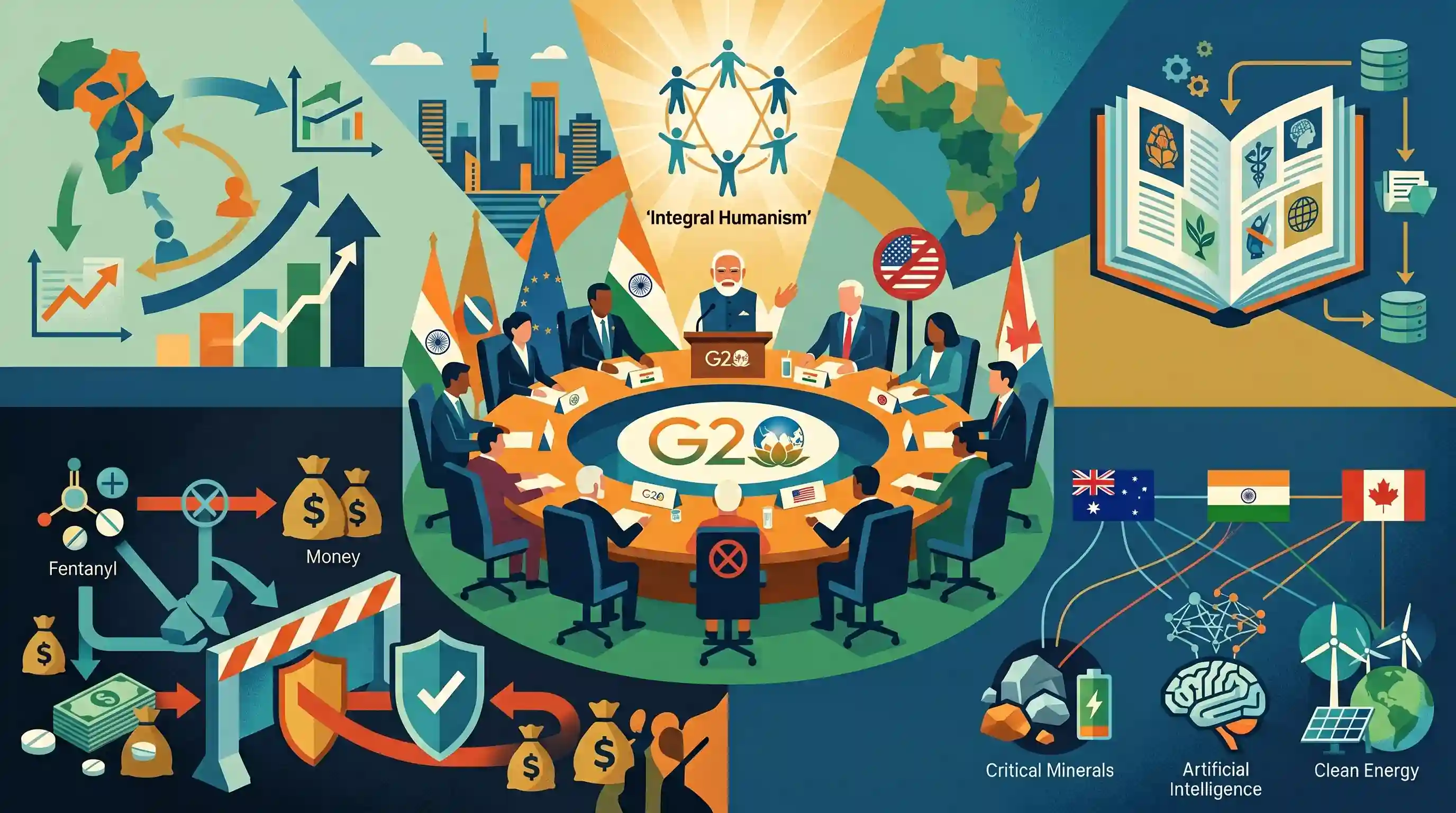
At the G-20 Summit in Johannesburg, South Africa, Prime Minister Narendra Modi proposed several initiatives targeting health, skills, and technology, while championing the philosophy of \'integral humanism\'. Key proposals included the G-20-Africa Skills Multiplier Initiative, a global traditional knowledge repository, and an initiative countering the drug-terror nexus, specifically highlighting fentanyl\'s role in terror financing. He also announced the Australia-Canada-India Technology and Innovation (ACITI) Partnership for collaboration on critical minerals, AI, and clean energy. The summit, notable for being the first in Africa, was marred by a U.S. boycott.
Key Points
- PM Modi addressed the G-20 Summit in South Africa, proposing initiatives like the Global Traditional Knowledge Repository and the G-20-Africa Skills Multiplier Initiative to train one million Africans.
- He highlighted the drug-terror nexus, pointing to lethal substances like fentanyl as major sources of terror financing and threats to global security.
- Modi announced the Australia-Canada-India Technology and Innovation (ACITI) Partnership focusing on critical technologies, resilient supply chains, clean energy, and AI.
- The PM promoted Deen Dayal Upadhyay\'s philosophy of \'integral humanism\' as a pathway for future development, criticizing current growth models for resource deprivation and nature exploitation.
- The U.S. boycotted the historic summit, which was the first held in an African nation, due to strained ties with South Africa.
Important Terms
G-20 Initiative on Countering the Drug-Terror Nexus

A proposed framework to unify financial, governance, and security tools among G20 nations to disrupt trafficking networks and choke illicit funding sources for terrorism, specifically targeting synthetic drugs like fentanyl.
UPSC context
GS Paper III: Internal Security; tests understanding of the links between organized crime (narcotics) and terrorism financing.
G-20-Africa Skills Multiplier Initiative
A skills-development program based on a "train-the-trainers" model, aiming to create one million certified trainers in Africa within a decade to empower the continent's youth and foster local capacity.
UPSC context
GS Paper II: International Relations; tests knowledge of India-Africa cooperation and South-South developmental partnerships.
Global Traditional Knowledge Repository
An initiative based on India's Indian Knowledge Systems (IKS) to document and share global traditional wisdom and sustainable, eco-balanced lifestyles for future generations and global wellbeing.
UPSC context
GS Paper I & III: Culture and Environment; relevant for protecting traditional knowledge and promoting sustainable development goals (SDGs).
Australia-Canada-India Technology and Innovation (ACITI) Partnership
A trilateral framework between Australia, Canada, and India focusing on critical minerals, resilient supply chains, clean energy innovation, and the safe, mass adoption of artificial intelligence.
UPSC context
GS Paper II & III: Bilateral/Trilateral groupings; tests awareness of strategic technology alliances and supply chain resilience.
G-20 Global Healthcare Response Team
A proposed specialized squad of medical experts from G20 countries designed for rapid deployment to manage global health emergencies and natural disasters collectively.
UPSC context
GS Paper II: Social Justice/Health; tests understanding of global health governance and disaster management cooperation.
G-20 Open Satellite Data Partnership
An initiative to share satellite data from G20 space agencies with the Global South to assist in agriculture, fisheries, and disaster management activities.
UPSC context
GS Paper III: Science and Technology; relevant for space diplomacy and technology transfer to developing nations.
G-20 Critical Minerals Circularity Initiative
A proposal to enhance the recycling and sustainable mining of critical minerals to strengthen supply chain security and promote cleaner development pathways.
UPSC context
GS Paper III: Environment and Economy; tests knowledge of energy transition and resource security strategies.
Prelims Trap
"The ACITI partnership is a new technology framework launched by the Quad nations."
ACITI stands for Australia-Canada-India Technology and Innovation. The US and Japan are not members. Aspirants often conflate critical mineral/tech pacts with Quad initiatives.
Static Concepts Connected
What constitute the "Golden Triangle" and "Golden Crescent" in drug trafficking?
- Golden Crescent: Comprises Iran, Afghanistan, and Pakistan. It primarily threatens India's northwestern border with heroin and illicit drug trafficking.
- Golden Triangle: Comprises Myanmar, Thailand, and Laos. It heavily impacts India's Northeast through porous borders, deeply linking with local insurgencies.
- Synthetic Shift: The drug-terror nexus is migrating from plant-based narcotics to synthetic drugs like Fentanyl, which are easier to manufacture in illicit labs without vast agricultural tracts.
What are the core tenets of Deen Dayal Upadhyay's Integral Humanism?
- Human-Centric: Rejects both pure capitalism and Marxism by placing the holistic human being—not merely economic wealth or class struggle—at the center of development.
- Dharma as Guide: Asserts that the individual, society, and nature must exist in harmonious interdependence governed by Dharma, preventing ecological exploitation.
- Sustainable Decentralization: Advocates for a decentralized economic model (Gram Swaraj) that aligns with modern concepts of sustainable development and environmental conservation.
Cross-Topic Patterns
G20 + Global South Leadership
India’s proposal for the G-20-Africa Skills Multiplier builds upon its successful 2023 New Delhi presidency, which successfully inducted the African Union as a permanent G20 member.
Synthetic Drugs + Border Security
Fentanyl’s rise highlights a shift in terror financing from traditional opium routes to lab-based synthetic opioids, complicating border management and tracking of pharmaceutical chemical precursors.

ACITI membership, the US boycott of the African G20 summit, and synthetic opioids (Fentanyl) are prime targets for a 2026 Prelims MCQ.
Linked PYQs · 5
Linked PYQs · 5
- 2025MainsGS2
India-Africa digital partnership is achieving mutual respect, co-development and long-term institutional partnerships. Elaborate.
- 2011MainsGS2
What are the salient features of the political and economic relationship between India and South Africa?
- 2024MainsGS3
Explain how narco-terrorism has emerged as a serious threat across the country. Suggest suitable measures to counter narco-terrorism.
- 2017MainsGS3
The scourge of terrorism is a grave challenge to national security. What solutions do you suggest to curb this growing menace? What are the major sources of terrorist funding?
- 2021MainsGS3
Analyse the complexity and intensity of terrorism, its causes, linkages and obnoxious nexus. Also suggest measures required to be taken to eradicate the menace of terrorism.
