High Level Meetings at Rashtrapati Bhavan Amid Parliament Logjam
Source:The Hindu ↗
Why It Matters
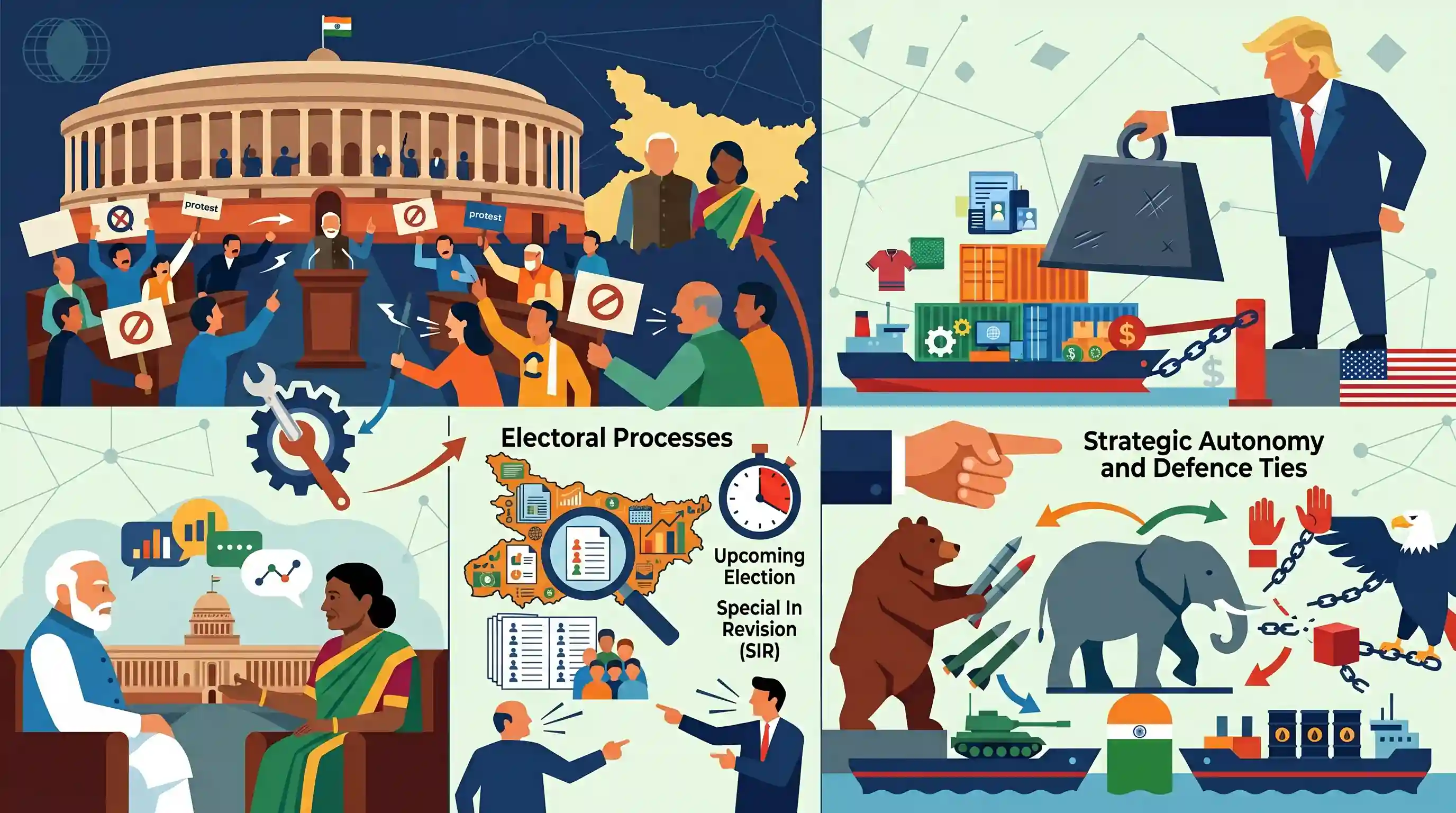
It illustrates the practical challenges of parliamentary functioning when disrupted by state-level electoral issues, while simultaneously highlighting India's delicate geopolitical balancing act amidst U.S. trade tariffs and pressure over historic defence ties with Russia.
Summary
Prime Minister Narendra Modi and Home Minister Amit Shah met with President Droupadi Murmu amidst continuous disruptions in Parliament's Monsoon session. The deadlock is rooted in the Opposition INDIA bloc's insistence on discussing the Special Intensive Revision (SIR) exercise in Bihar ahead of the state's upcoming Assembly elections, which has stalled most legislative business. Simultaneously, the meetings occurred against the backdrop of escalating international trade and diplomatic tensions, specifically U.S. President Donald Trump's recent announcement of 25% tariffs on Indian exports and penalties aimed at curbing India's procurement of Russian military equipment and oil. The developments underscore challenges in both domestic parliamentary functioning and India's strategic autonomy in global affairs.
Key Points
- PM Modi and Home Minister Amit Shah met President Droupadi Murmu at Rashtrapati Bhavan amid ongoing parliamentary disruptions.
- The Parliament logjam is primarily driven by the Opposition INDIA bloc's demand for discussions on the Special Intensive Revision (SIR) electoral exercise in Bihar ahead of Assembly elections.
- The Monsoon session has seen minimal legislative business, with only discussions on 'Operation Sindoor' making headway.
- The high-level meetings also coincide with significant international pressure, following U.S. President Donald Trump's imposition of 25% tariffs on Indian exports and penalties over India's continued purchase of Russian military equipment and oil.
Important Terms
Special Intensive Revision (SIR)

A comprehensive, house-to-house enumeration and verification exercise by the Election Commission of India (ECI) to update electoral rolls from scratch, typically preceding high-stakes elections.
UPSC context
GS Paper 2: Elections and Representation of the People Act, 1950. Relevant for voter list integrity and ECI's constitutional powers (Article 324).
Strategic Autonomy
A foreign policy doctrine enabling India to make independent decisions based on national interests while balancing relations with competing global powers, such as the U.S. and Russia.
UPSC context
GS Paper 2: International Relations. Tests understanding of India's multi-alignment strategy amid global trade wars and sanctions (e.g., CAATSA).
Operation Sindoor
The May 2025 military retaliatory airstrikes on terror camps in Pakistan/PoK following a attack in Pahalgam; it became a major nationalist narrative during the 2025 Bihar elections.
UPSC context
GS Paper 3: Internal Security and Cross-border Terrorism. Also relevant for GS Paper 2 regarding the politicization of national security.
INDIA bloc
The Indian National Developmental Inclusive Alliance; a coalition of major opposition parties formed to challenge the ruling NDA and advocate for parliamentary accountability.
UPSC context
GS Paper 2: Role of Opposition and Political Parties. Tests knowledge of coalition dynamics and executive-legislative friction in a democracy.
Monsoon Session
One of the three annual legislative sessions of the Indian Parliament, usually held between July and September, intended for passing bills and holding the government accountable.
UPSC context
GS Paper 2: Parliament—Conduct of Business. Relevant for discussing the impact of disruptions on legislative productivity and democratic functioning.
Prelims Trap
"The Special Intensive Revision (SIR) of electoral rolls is conducted under the provisions of the Representation of the People Act, 1951."
Preparation and revision of electoral rolls (like SIR) fall strictly under the Representation of the People Act, 1950. The 1951 Act deals with the actual conduct of elections.
Static Concepts Connected
What are the Prime Minister's constitutional duties under Article 78?
- Communicate decisions: To communicate to the President all decisions of the Council of Ministers relating to the administration of the Union and proposals for legislation.
- Furnish information: To furnish such information relating to administration and legislation as the President may call for.
- CoM consideration: If the President requires, to submit for consideration of the Council any matter on which a decision was taken by a Minister but not considered by the Council.
What is CAATSA and how does it affect India's foreign policy?
- Core mandate: A US federal law that imposes sanctions on countries conducting 'significant transactions' with Russian defense or intelligence sectors, Iran, and North Korea.
- Strategic friction: It directly targets India's procurement of Russian equipment (like the S-400 missile system) and discounted oil, clashing with India's policy of non-alignment and independent foreign policy.
- Waiver vs Tariffs: The US President can issue a waiver, but the imposition of unilateral trade tariffs acts as an alternative coercive tool bypassing the formal waiver process.
Cross-Topic Patterns
Trade Tariffs + Strategic Autonomy
The US linking economic tools (25% tariffs) with geopolitical penalties (CAATSA over Russian ties) highlights the merging of trade protectionism and strategic geopolitics in modern IR.
Electoral Rolls & RPA 1950
The controversy over the Special Intensive Revision (SIR) connects parliamentary stalemates to the statutory powers of the Election Commission regarding electoral roll purification.

The use of economic tariffs as coercive geopolitical tools against India's strategic autonomy (CAATSA/Russia) is a high-probability 2026 IR theme.
Linked PYQs · 5
Linked PYQs · 5
- 2021MainsGS2
To what extent, in your view, the Parliament is able to ensure accountability of the executive in India?
- 2023MainsGS2
Discuss the role of Presiding Officers of state legislatures in maintaining order and impartiality in conducting legislative work and in facilitating best democratic practices.
- 2020MainsGS2
What is the significance of Indo-US defence deals over Indo-Russian defence deals? Discuss with reference to stability in the Indo-Pacific region.
- 2017PrelimsGS1
Right to vote and to be elected in India is a
- 2024MainsGS2
Examine the need for electoral reforms as suggested by various committees with particular reference to "one nation one election" principle.
