Subhas Chandra Bose Legacy and Historical Commemoration
Source:The Hindu ↗
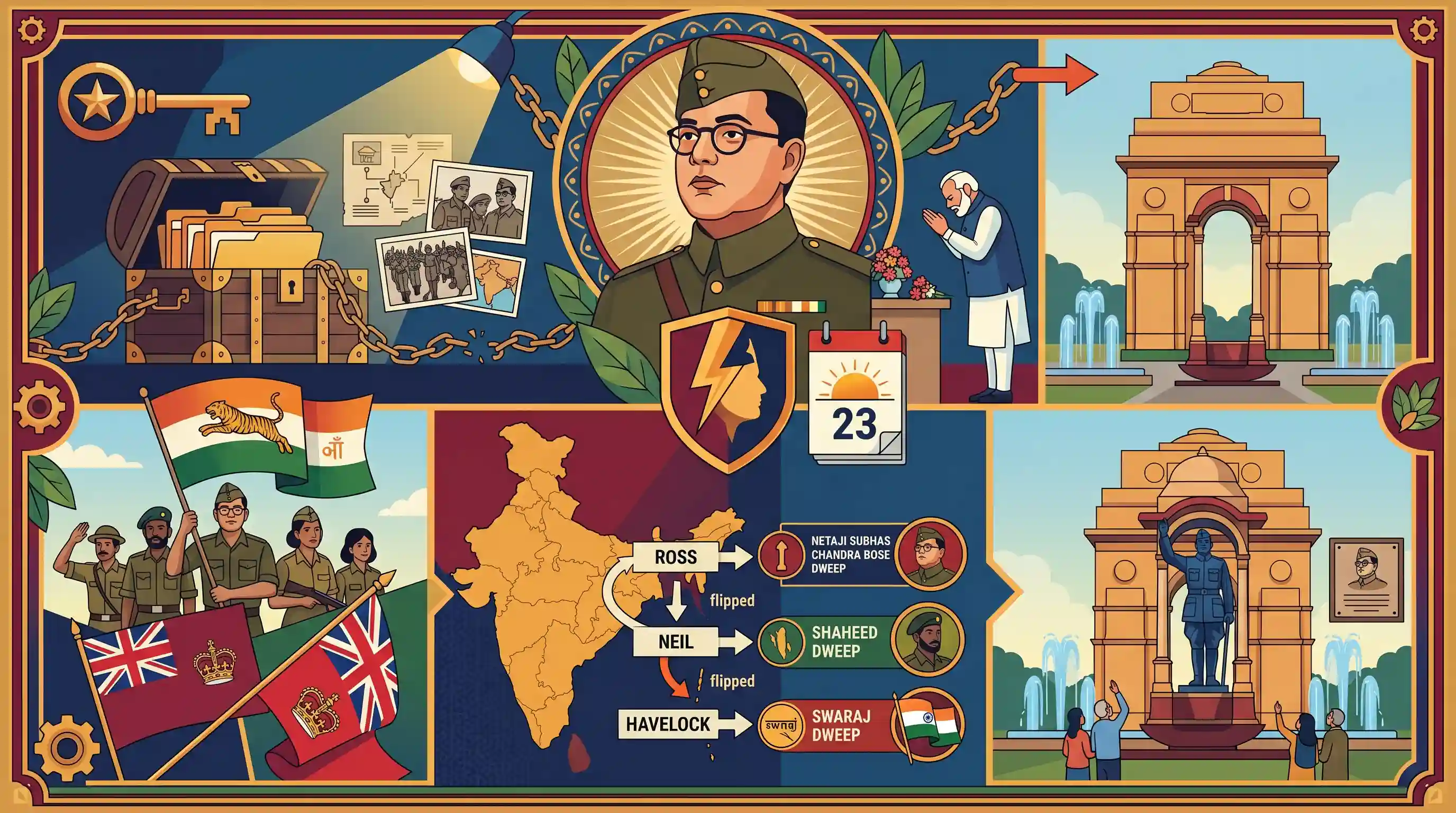
Why It Matters
Subhas Chandra Bose and the Indian National Army (INA) are staple topics in UPSC GS1. The recent government focus on Parakram Diwas, the declassification of files, and the renaming of geographical features (e.g., Ross Island) adds contemporary relevance to his historical contributions, making it highly testable in both Prelims (geography/history mapping) and Mains (evaluating his ideological differences and contributions).
Summary
Prime Minister Narendra Modi paid tribute to Netaji Subhas Chandra Bose on his birth anniversary, officially observed as Parakram Diwas. He highlighted various government initiatives designed to preserve and promote Bose's legacy, including the declassification of related files, commemorations of the Azad Hind government, the renaming of islands in the Andaman and Nicobar archipelago, and the installation of a grand statue at India Gate.
Key Points
- January 23 is celebrated as Parakram Diwas to commemorate the birth anniversary of Netaji Subhas Chandra Bose.
- The government has undertaken several initiatives to honour his legacy, including the declassification of related historical files.
- Major commemorations included the 75th anniversary of the establishment of the Azad Hind government at the Red Fort and the 75th anniversary of Bose hoisting the tricolour in Srivijayapuram.
- Three islands in the Andaman and Nicobar archipelago were renamed, with Ross Island becoming Netaji Subhas Chandra Bose Dweep.
- The 'Kranti Mandir' museum at Red Fort was established to showcase the history of Netaji and the Indian National Army (INA), alongside the installation of a grand statue of Bose near India Gate.
Important Terms
Parakram Diwas

Official national day observed on January 23 to mark the birth anniversary of Netaji Subhas Chandra Bose, commemorating his bravery and sacrifice.
UPSC context
GS Paper I: Modern History and Personalities; also relevant for Current Affairs. Tests knowledge of national commemorations and legacies.
Azad Hind Fauj
Also known as the Indian National Army (INA), it was an armed force formed by Indian nationalists in Southeast Asia in 1942 to secure India's independence from British rule with Japanese support.
UPSC context
GS Paper I: Modern History (Freedom Struggle). Tests understanding of external factors and armed movements in Indian independence.
Azad Hind government
The provisional government of Free India established by Netaji in Singapore on October 21, 1943. It issued its own currency, stamps, and was recognized by Axis powers.
UPSC context
GS Paper I: Modern History. Tests knowledge of the institutional aspects of the freedom struggle conducted from abroad.
Haripura Session (1938)
The 1938 session of the Indian National Congress where Subhas Chandra Bose was elected President, notable for his focus on industrialization and national planning.
UPSC context
GS Paper I: Modern History. Tests understanding of intra-Congress ideological shifts and Bose's leadership.
E-Gram Vishwagram Yojana
A Gujarat state government e-governance initiative launched in 2009 from Haripura to bridge the digital divide by providing ICT-enabled services in gram panchayats.
UPSC context
GS Paper II: E-governance and its applications. Mentioned by PM Modi to link rural development with Netaji's legacy.
Rani Jhansi Regiment
The women’s unit of the Azad Hind Fauj, established by Bose in 1943 and led by Captain Lakshmi Sahgal, representing one of the first female combat units in history.
UPSC context
GS Paper I: Modern History (Women in Freedom Struggle). Tests knowledge of gender participation in revolutionary movements.
Prelims Trap
"Subhas Chandra Bose originally founded the Indian National Army (INA) in Singapore to fight the British."
Captain Mohan Singh formed the first INA. Rash Behari Bose later handed leadership to Subhas Chandra Bose in 1943 in Singapore. Bose reorganized and led it, but did not found it.
Static Concepts Connected
Who were the key figures in the 1945 INA Red Fort trials?
- The Accused: Prem Sahgal, Gurbaksh Singh Dhillon, and Shah Nawaz Khan were jointly tried for treason, a move that symbolized deep communal harmony and triggered national outrage.
- Defense Lawyers: The Congress formed an INA Defense Committee that included prominent legal luminaries like Bhulabhai Desai, Tej Bahadur Sapru, Asaf Ali, and Jawaharlal Nehru.
What are the major geographical straits dividing the Andaman and Nicobar archipelago?
- Ten Degree Channel: A critical maritime passage that separates the Andaman Islands to the north from the Nicobar Islands to the south, located along the 10-degree north latitude.
- Duncan Passage: A deep strait in the Bay of Bengal that separates South Andaman (specifically Rutland Island) to the north from Little Andaman to the south.
Cross-Topic Patterns
A&N Islands: History meets Strategic Geography
Renaming colonial-era islands revives the INA's 1943 occupation history, making the Andaman archipelago a high-probability overlap area for Modern History and Indian Geography mapping questions.
Red Fort as anti-colonial continuum
UPSC frequently tests spatial continuities in history. The Red Fort links the 1857 Bahadur Shah Zafar mutiny directly to the 1945-46 INA trials, acting as a bookend for anti-colonial resistance.

Expect a multi-statement chronological question in 2026 linking Bose's Free Indian Legion, the INA handover, and the Red Fort trials.
Linked PYQs · 3
Linked PYQs · 3
- 2016MainsGS1
Highlight the differences in the approach of Subhash Chandra Bose and Mahatma Gandhi in the struggle for freedom.
- 2008PrelimsGS1
During the Indian Freedom Struggle, who of the following raised an army called ‘Free Indian Legion’?
- 2014PrelimsGS1
Which one of the following pairs of islands is separated from each other by the "Ten Degree Channel?"
