India Oman Comprehensive Economic Partnership Agreement
Source:The Hindu ↗
Why It Matters
The signing of CEPAs in the Gulf region (UAE, and now Oman) represents a major shift in India's trade policy. This development is crucial for Mains GS2 (International Relations) as an example of leveraging economic diplomacy for strategic depth and securing vital energy supply chains in West Asia.
Summary
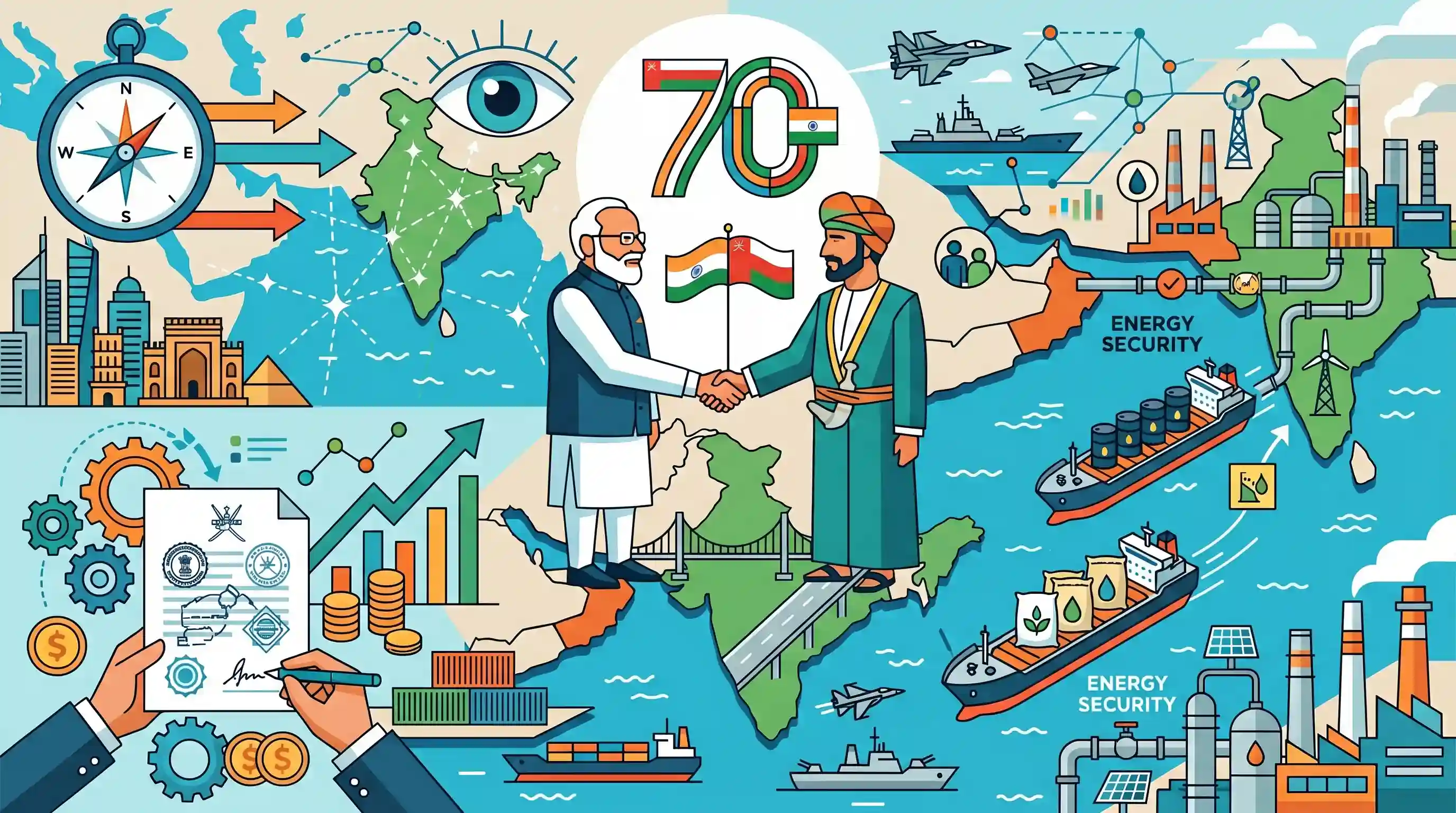
Prime Minister Narendra Modi visited Oman to mark 70 years of diplomatic relations and to conclude a Comprehensive Economic Partnership Agreement (CEPA). Building on India's Look West policy, the CEPA is set to significantly deepen bilateral economic ties. Oman, India's third-largest export destination in the GCC, plays a crucial role in India's energy security, primarily supplying petroleum products and urea. The strategic partnership involves comprehensive reviews of trade, investment, defence, and energy, further strengthening India's footprint in the Middle East.
Key Points
- PM Narendra Modi visited Oman to commemorate 70 years of bilateral diplomatic relations.
- The visit aims to finalize an ambitious Comprehensive Economic Partnership Agreement (CEPA), marking India's second such pact in the Gulf after the UAE.
- Oman is the 3rd largest export destination for India among the Gulf Cooperation Council (GCC) countries, with total bilateral trade at $10.5 billion in 2024-25.
- Energy security is a core pillar of the relationship, as India heavily imports petroleum products and urea (accounting for over 70% of imports from Oman).
- The leaders plan to review the overarching strategic partnership across trade, investment, defence, security, and technology.
Important Terms
Comprehensive Economic Partnership Agreement (CEPA)

A broad bilateral agreement covering trade in goods, services, and investments. It includes regulatory cooperation and intellectual property, going deeper than a standard free trade pact to foster economic integration.
UPSC context
Relevant for GS Paper II (International Relations) and GS III (Economy); tests knowledge of trade architecture and strategic bilateral negotiations.
Free Trade Agreement (FTA)
A treaty between two or more countries to reduce or eliminate trade barriers like tariffs and quotas on goods and services, aimed at increasing cross-border trade.
UPSC context
GS Paper III (External Sector); evaluates understanding of global trade dynamics and India's regional economic integration strategies.
Gulf Cooperation Council (GCC)
A political and economic union of six Arab nations: Saudi Arabia, UAE, Qatar, Kuwait, Oman, and Bahrain. It is India's largest trading bloc and a vital energy source.
UPSC context
GS Paper II (Bilateral and Regional Groupings); tests awareness of regional stability, diaspora welfare, and energy diplomacy in West Asia.
Look West Policy
India's strategic outreach to West Asia (the Middle East) to deepen ties in energy, security, trade, and diaspora management, paralleling the 'Act East' policy.
UPSC context
GS Paper II (Foreign Policy); crucial for discussing India's 'Extended Neighbourhood' and strategic autonomy in a multipolar world.
Energy Security
The reliable and affordable access to energy sources required for economic growth. For India, it involves diversifying imports and securing maritime trade routes in the Middle East.
UPSC context
GS Paper III (Infrastructure/Energy) and GS Paper II; tests the link between national resource needs and international diplomatic maneuvers.
Prelims Trap
Oman is India's first Comprehensive Economic Partnership Agreement (CEPA) partner in the Gulf.
The UAE was India's first CEPA partner in the Gulf region (signed in 2022). Oman is the second GCC nation India is negotiating this with.
Static Concepts Connected
What differentiates a CEPA from a standard Free Trade Agreement (FTA)?
- Standard FTA: Focuses primarily on eliminating or reducing customs duties and tariffs on the trade of goods between partner countries.
- CEPA Scope: Broader than an FTA; it encompasses trade in services, investments, competition, intellectual property rights, and regulatory cooperation.
What is the strategic geographical significance of Oman for India?
- Strait of Hormuz: Oman overlooks this critical global chokepoint, ensuring the security of vital sea lines of communication for India's energy imports.
- Port of Duqm: India secured strategic military and logistical access here, facilitating extended naval deployments in the western Indian Ocean.
Cross-Topic Patterns
Port of Duqm & Indian Ocean Security
India's access to Oman's Duqm port strategically connects to its maritime security architecture, directly countering China's naval footprint at Gwadar and Djibouti.
Urea imports & Agricultural Subsidies
Oman is a critical supplier of urea, directly linking India's Middle East diplomacy to its domestic food security and the ongoing fertilizer subsidy burden.

Expect a 2026 map prelims question pairing Western Indian Ocean ports (Duqm, Chabahar) with their strategic chokepoints.
Linked PYQs · 3
Linked PYQs · 3
- 2025MainsGS2
"Energy security constitutes the dominant kingpin of India's foreign policy, and is linked with India's overarching influence in Middle Eastern countries.” How would you integrate energy security with India's foreign policy trajectories in the coming years?
- 2017MainsGS2
The question of India's Energy Security constitutes the most important part of India's economic progress. Analyze India's energy policy cooperation with West Asian countries.
- 2011MainsGS2
Compared to the South Asian Free Trade Area (SAFTA), the Bay of Bengal Initiative for Multisectoral Technical and Economic Cooperation Free Trade Area (BIMSTEC FTA) seems to be more promising." Critically evaluate.
