Prime Minister advises alliance MPs to organize indigenous trade fairs
Source:The Hindu ↗
Why It Matters
The article highlights the intersection of electoral procedures (Vice-Presidential voting mechanisms), indirect tax administration (GST feedback loops with traders), and economic self-reliance initiatives (Swadeshi Melas), providing practical examples of legislative and executive priorities.
Summary
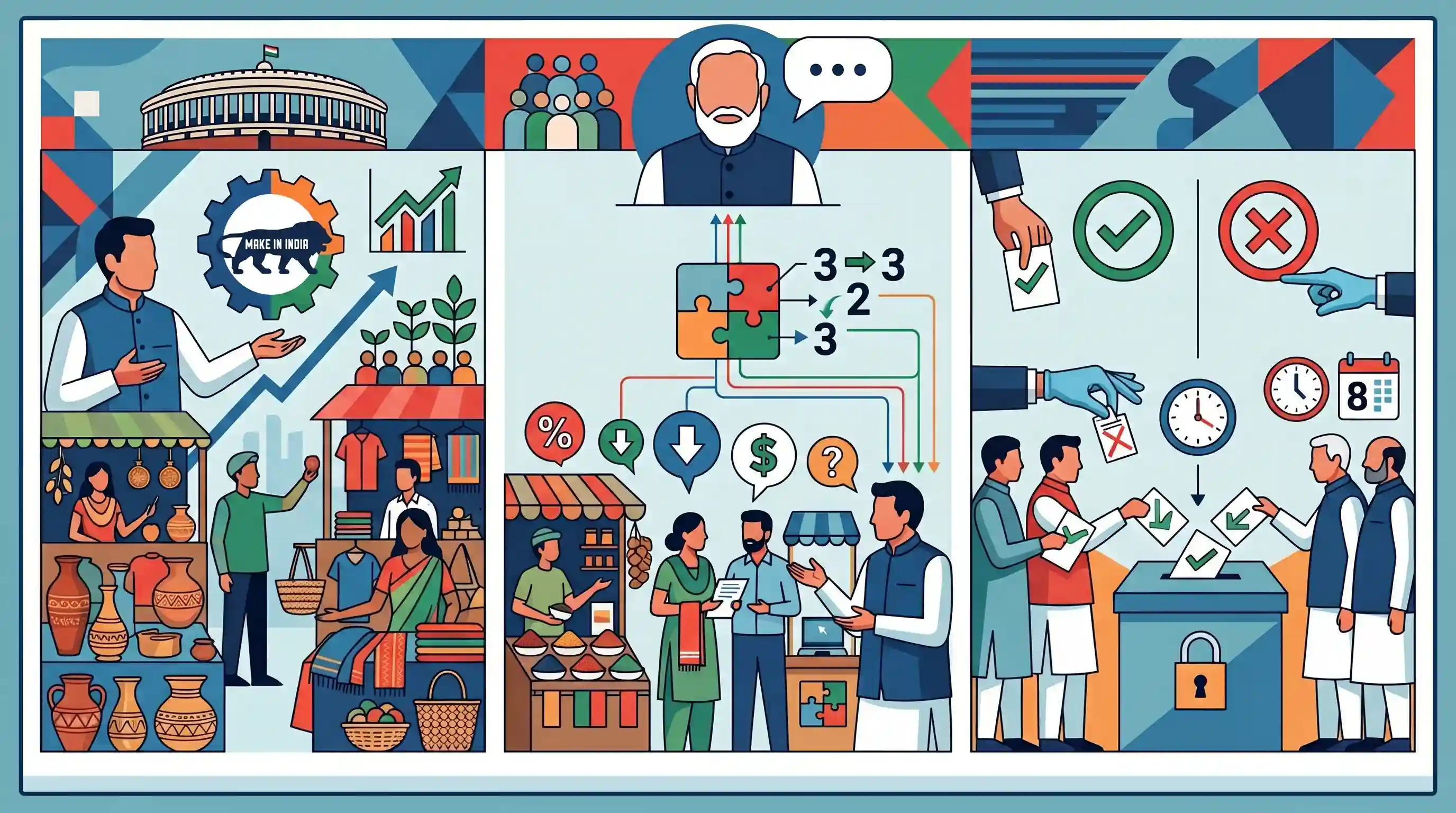
At an NDA Parliamentary Party meeting, Prime Minister Narendra Modi instructed MPs to organize 'Swadeshi Melas' in their respective constituencies to promote local products and the 'Make in India' ethos. He also asked MPs to engage with local traders to gather feedback on proposed Goods and Services Tax (GST) rate cuts. Furthermore, the Prime Minister briefed the parliamentarians on the voting protocol for the upcoming vice-presidential election on September 8 to ensure zero invalid votes.
Key Points
- Prime Minister Narendra Modi urged NDA MPs to organise 'Swadeshi Melas' to champion domestic manufacturing, aligning with the 'Vocal for Local' initiative.
- The melas are proposed to be held between September 25 (Deen Dayal Upadhyay's birth anniversary) and either October 2 (Gandhi Jayanti) or October 31 (Sardar Patel's birth anniversary).
- MPs were directed to hold interactive meetings with local traders to discuss potential GST rate reductions ahead of the upcoming GST Council meeting.
- A significant portion of the meeting was dedicated to educating MPs on the exact voting procedure for the September 8 vice-presidential elections to prevent invalid votes.
Important Terms
Make in India

A flagship government initiative launched in 2014 to transform India into a global manufacturing, design, and innovation hub by encouraging domestic and international companies to manufacture locally.
UPSC context
GS Paper III: Indian Economy; crucial for questions on industrial policy, manufacturing growth, and the 'Aatmanirbhar Bharat' vision.
GST Council
A constitutional body established under Article 279A to make recommendations to the Union and State governments on GST rates, exemptions, model laws, and administrative issues.
UPSC context
GS Paper II & III: Governance and Fiscal Federalism; tests knowledge of constitutional bodies and cooperative federalism in taxation.
Vice-Presidential Election
A constitutional process (Article 66) where the Vice-President is elected by an electoral college consisting of both elected and nominated members of both Houses of Parliament.
UPSC context
GS Paper II: Indian Constitution and Polity; focuses on the indirect election process and the composition of the electoral college.
Vocal for Local
A campaign under the 'Aatmanirbhar Bharat' vision that encourages citizens to support indigenous products and local artisans to boost MSMEs and reduce import dependency.
UPSC context
GS Paper III: Indian Economy; relevant for inclusive growth, self-reliance, and the promotion of local industrial ecosystems.
National Democratic Alliance (NDA)
A centre-right political coalition in India, founded in 1998 and led by the Bharatiya Janata Party (BJP), consisting of various national and regional parties.
UPSC context
GS Paper II: Polity; relates to the functioning of coalition governments and political alliances in India's parliamentary system.
Swadeshi
An economic strategy emphasizing the use of indigenous goods and self-sufficiency, modernized in recent policies to promote local manufacturing and cultural identity.
UPSC context
GS Paper I & III: History and Economy; links the freedom struggle's economic nationalism to contemporary self-reliance initiatives.
Prelims Trap
"State Legislative Assembly members participate in the Vice-President's electoral college."
State MLAs vote in the President's election but are entirely excluded from the Vice-President's electoral college, which only comprises Lok Sabha and Rajya Sabha MPs.
Static Concepts Connected
How does the Vice-President's electoral college differ from the President's?
- Nominated MPs: Participate in the VP election, but are excluded from the Presidential election.
- State MLAs: Elected MLAs participate in the Presidential election, but are completely excluded from the VP election.
- Voting method: Both use proportional representation by single transferable vote via a secret ballot.
How are decisions made within the GST Council?
- Constitutional basis: Created under Article 279A of the Constitution to make recommendations on taxes, cesses, and surcharges.
- Voting weightage: The Central Government holds 1/3rd of the voting weight, while all State Governments collectively hold 2/3rds.
- Majority required: Every decision requires a minimum three-fourths (75%) majority of the weighted votes of members present and voting.
Cross-Topic Patterns
Vocal for Local & ODOP linkage
The 'Swadeshi Mela' directive bridges the Atmanirbhar Bharat initiative with the One District One Product (ODOP) scheme, a frequent theme in GS-3 questions on MSME formalization and industrial policy.
GST feedback & Fiscal Federalism
MPs gathering local GST feedback ties into the broader GS-2 theme of cooperative federalism, highlighting the consultative mechanism behind GST Council rate rationalization.

Expect a 2026 Prelims multi-statement question contrasting Presidential and VP electoral colleges, particularly regarding nominated MPs.
Linked PYQs · 5
Linked PYQs · 5
- 2019MainsGS3
Enumerate the indirect taxes which have been subsumed in the Goods and Services Tax (GST) in India. Also, comment on the revenue implications of the GST introduced in India since July 2017.
- 2013MainsGS3
Discuss the rationale for introducing Goods and Services Tax (GST) in India. Bring out critically the reasons for the delay in roll out for its regime.
- 2023MainsGS3
Faster economic growth requires increased share of the manufacturing sector in GDP, particularly of MSMEs. Comment on the present policies of the Government in this regard.
- 2023PrelimsGS1
Consider the following statements in respect of election to the President of India: 1. The members nominated to either House of the Parliament or the Legislative Assemblies of States are also eligible to be included in the Electoral College. 2. Higher the number of elective Assembly seats, higher is the value of vote of each MLA of that State. 3. The value of vote of each MLA of Madhya Pradesh is greater than that of Kerala. 4. The value of vote of each MLA of Puducherry is higher than that of Arunachal Pradesh because the ratio of total population to total number of elective seats in Puducherry is greater as compared to Arunachal Pradesh. How many of the above statements are correct?
- 2017PrelimsGS1
Right to vote and to be elected in India is a
