India-Bangladesh Talks: Addressing Minorities and Border Security
Source:The Hindu ↗
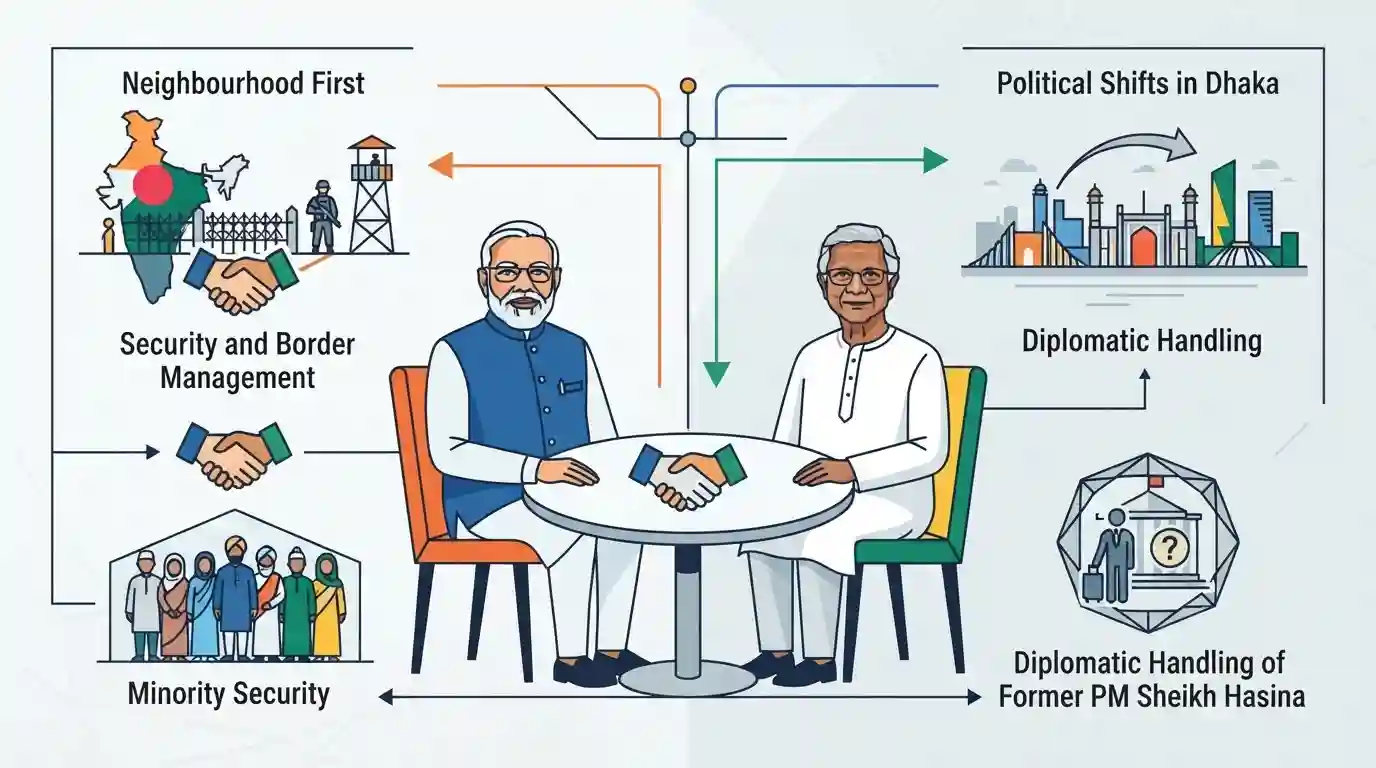
Why It Matters
The high-level engagement between Prime Minister Modi and Muhammad Yunus is crucial for India's 'Neighbourhood First' policy, addressing immediate geopolitical friction, cross-border security concerns, minority safety, and stability in South Asia.
Summary
Prime Minister Narendra Modi and Bangladesh's Chief Adviser Muhammad Yunus met to navigate bilateral tensions, focusing on minority security, boundary issues, and the diplomatic handling of former PM Sheikh Hasina, aiming to reset ties after recent political shifts in Dhaka.
Key Points
- Prime Minister Narendra Modi and Bangladesh Chief Adviser Muhammad Yunus held bilateral talks addressing key contentious issues including minority protection, border tensions, and the extradition/status of former Prime Minister Sheikh Hasina.
- The meeting marked an effort by both leaderships to manage diplomatic differences and maintain regional stability following political transitions in Bangladesh.
- Discussions emphasized mutual cooperation, security assurances, and the continuity of bilateral engagements despite recent political frictions.
Important Terms
Interim Government of Bangladesh

The temporary administration led by Nobel laureate Muhammad Yunus following the ouster of Prime Minister Sheikh Hasina in August 2024, tasked with state reforms and organizing elections.
UPSC context
UPSC Mains GS Paper II (International Relations - India's Neighborhood): Tests understanding of political transitions in neighboring states and India's diplomatic engagement strategy.
Static Concepts Connected
What are the key mechanisms and historical agreements governing the India-Bangladesh boundary?
- Legal Framework: The 4,096-km border is regulated by the Radcliffe Award (1947), Bagge Tribunal (1950), and the landmark 1974 Land Boundary Agreement (LBA) operationalized via the 100th Constitutional Amendment Act (2015).
- Enclave Exchange: The 2015 LBA resolved long-standing enclaves and adverse possessions, exchanging 111 Indian enclaves in Bangladesh and 51 Bangladesh enclaves in India, granting citizenship rights to residents.
- Border Security: Coordinated Border Management Plan (CBMP) signed in 2011 provides a structured mechanism for BSF and BGB to jointly curb trans-border crimes and illegal crossings.
Cross-Topic Patterns
Neighbourhood First vs. Strategic Autonomy
India's Neighbourhood First policy must balance sovereign non-interference in Dhaka's domestic political transitions with strategic imperatives like border security and countering external influence in the Bay of Bengal.
Border Management & Internal Security Linkages
The 4,096-km porous border requires coordinated BSF-BGB patrols, integrating smart-fencing technology with joint anti-smuggling frameworks to manage cross-border crime and refugee influxes effectively.

Expect a multi-statement prelims question on the legal instruments governing India-Bangladesh boundary demarcation or extradition frameworks.
Linked PYQs · 1
Linked PYQs · 1
- 2022MainsGS2
Do you think that BIMSTEC is a parallel organisation like the SAARC ? What are the similarities and dissimilarities between the two ? How are Indian foreign policy objectives realized by forming this new organisation?
