India Malaysia Business Ties and Renewable Energy Partnerships
Source:The Hindu ↗
Why It Matters
Showcases India's proactive economic diplomacy under the Act East Policy to attract FDI in strategic domains like green energy (green hydrogen/ammonia) and semiconductors. Understanding these ties is critical for GS-2 (Bilateral Relations) and GS-3 (Economy, S&T, and Energy Security).
Summary
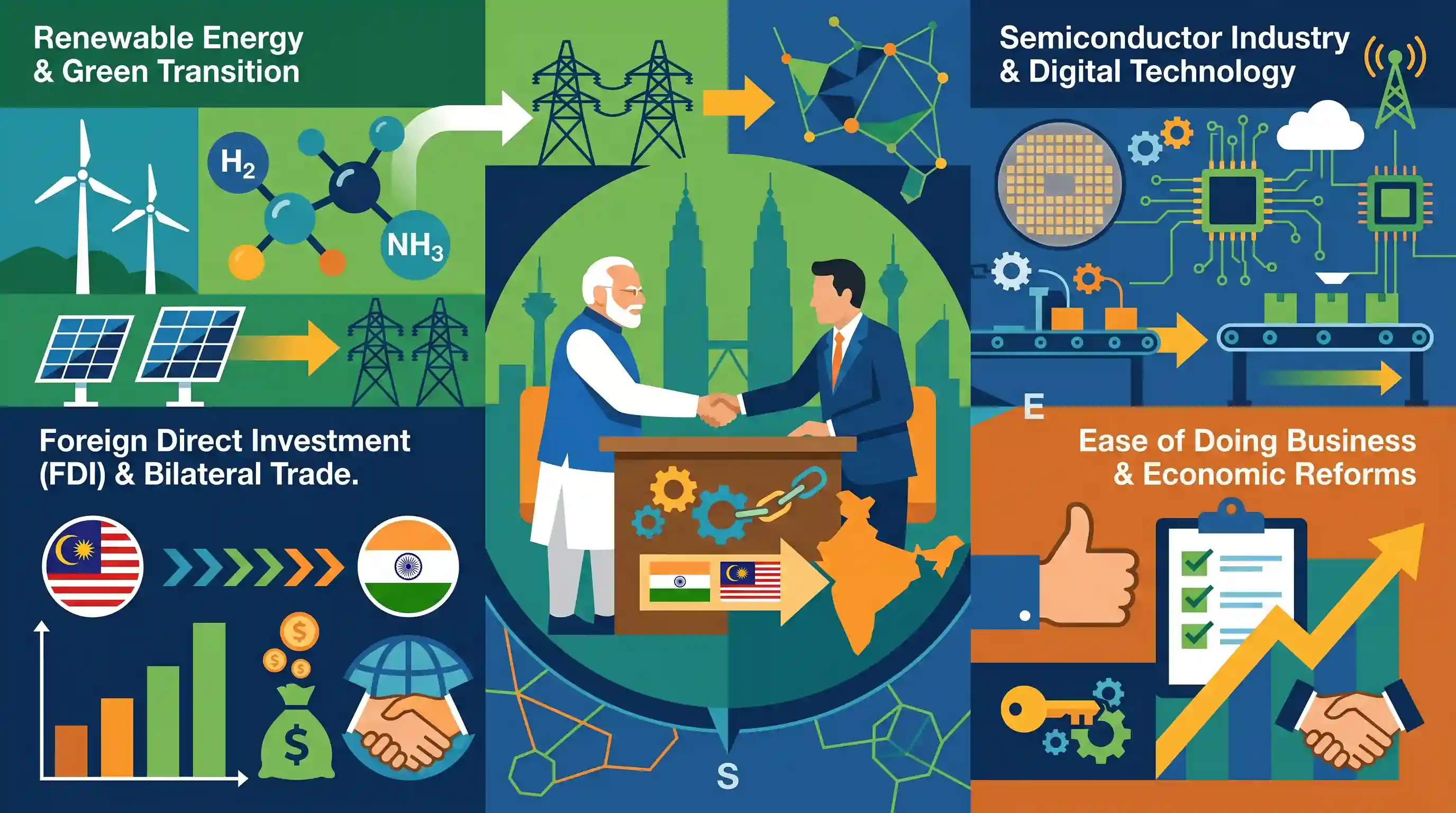
During his visit to Kuala Lumpur, Prime Minister Narendra Modi engaged with top Malaysian business leaders to promote foreign direct investment and enhance bilateral trade. The discussions spanned critical sectors of India's economy, focusing on strengthening energy partnerships through renewables like green hydrogen and green ammonia, as well as advancing the semiconductor and digital technology ecosystems. Modi underscored India's recent economic reforms aimed at ensuring ease of doing business and fostering a stable policy environment, encouraging Malaysian firms to expand their investment portfolios and explore joint ventures. The interactions, alongside the 10th India-Malaysia CEO Forum, signify a strategic push within India's Act East Policy to integrate deeply into regional value chains.
Key Points
- PM Modi held interactions with prominent Malaysian business leaders representing energy, consumer sectors, finance, and electronics during his visit to Kuala Lumpur.
- The meeting emphasized strengthening energy partnerships with a strong focus on renewable energy, green hydrogen, and green ammonia.
- Malaysian tech firms expressed a keen desire to participate in India's fast-growing innovation ecosystem, particularly the semiconductor industry.
- PM Modi highlighted recent reforms improving the ease-of-doing-business and invited investments in infrastructure, AI, digital tech, and healthcare.
- The 10th India-Malaysia CEO Forum was commended as a catalyst for opening new opportunities in bilateral trade and investment.
Important Terms
Act East Policy

India's proactive diplomatic strategy launched in 2014 to deepen economic, strategic, and cultural ties with Southeast Asia and the wider Indo-Pacific, moving beyond mere economic intent to active implementation.
UPSC context
GS2/International Relations. Core framework for India-ASEAN ties, regional security, and Indo-Pacific strategy.
India-Malaysia CEO Forum
A high-level institutional platform that brings together top business leaders from both countries to recommend policy reforms and explore strategic joint ventures in trade and investment.
UPSC context
GS2/Bilateral Relations. Tests knowledge of economic diplomacy and structured business engagement mechanisms.
PETRONAS
Malaysia's state-owned energy giant and a major investor in India's energy transition, specifically through large-scale green ammonia and renewable energy projects via its subsidiary, Gentari.
UPSC context
GS3/Energy & Investment. Relevant for India's energy security and green hydrogen partnerships.
Khazanah Nasional Berhad
The sovereign wealth fund of the Malaysian government, which manages strategic investments in Indian infrastructure, healthcare, and financial services to foster long-term bilateral capital flows.
UPSC context
GS3/Economy. Important for topics on Foreign Direct Investment (FDI) and institutional investment.
Green Hydrogen
Hydrogen produced via electrolysis powered by renewable energy; it is a key component of India’s strategy to achieve net-zero emissions and energy independence.
UPSC context
GS3/Environment & Science. Core to the National Green Hydrogen Mission and energy transition.
Look East Policy
A precursor to Act East, launched in 1991 to re-orient India's foreign policy toward Southeast Asia for economic liberalization and strategic integration with regional economies.
UPSC context
GS2/International Relations. Historical context for evolution of India’s eastward diplomatic trajectory.
Prelims Trap
"Malaysia is India's largest trading partner within the ASEAN region."
Malaysia is actually India's third-largest trading partner in ASEAN, trailing Singapore and Indonesia. Aspirants often conflate top ASEAN trade rankings.
Static Concepts Connected
What is Green Ammonia and how is it produced?
- Production process: Synthesized using green hydrogen (produced via water electrolysis powered by renewable energy) and nitrogen extracted directly from the air.
- Strategic applications: Acts as a zero-carbon fertilizer and serves as an efficient, easily liquefiable carrier for storing and transporting green hydrogen globally.
How does the Act East Policy differ from the Look East Policy?
- Strategic shift: Upgraded from a primarily economic focus (Look East) to encompass strategic, security, and defense cooperation (Act East).
- Expanded geography: Extends beyond ASEAN to encompass the broader Indo-Pacific, including Japan, South Korea, Australia, and Pacific Island nations.
Cross-Topic Patterns
Sovereign Wealth Funds driving green infra
Khazanah Nasional's presence highlights a growing trend of foreign Sovereign Wealth Funds (like UAE's ADIA and Singapore's GIC) actively funding India's long-gestation infrastructure and green energy transition projects.
Semiconductors as an Act East pillar
Engaging Malaysian electronics firms aligns with India's strategy to diversify its semiconductor supply chain across ASEAN, moving beyond a concentrated reliance on Taiwan and the US.

Expect a 2026 Prelims question linking ASEAN CECA frameworks with targeted high-tech FDI like green ammonia and semiconductors.
Linked PYQs · 4
Linked PYQs · 4
- 2016MainsGS2
Evaluate the economic and strategic dimensions of India's Look East Policy in the context of the post Cold War international scenario.
- 2016MainsGS3
Justify the need for FDI for the development of the Indian economy. Why there is gap between MOUs signed and actual FDIs? Suggest remedial steps to be taken for increasing actual FDIs in India.
- 2022MainsGS3
Do you think India will meet 50 percent of its energy needs from renewable energy by 2030 ? Justify your answer. How will the shift of subsidies from fossil fuels to renewables help achieve the above objective ? Explain.
- 2025MainsGS3
India aims to become a semiconductor manufacturing hub. What are the challenges faced by the semiconductor industry in India? Mention the salient features of the India Semiconductor Mission.
