India Brazil Bilateral Agreements on Critical Minerals and Trade
Source:The Hindu ↗
Why It Matters
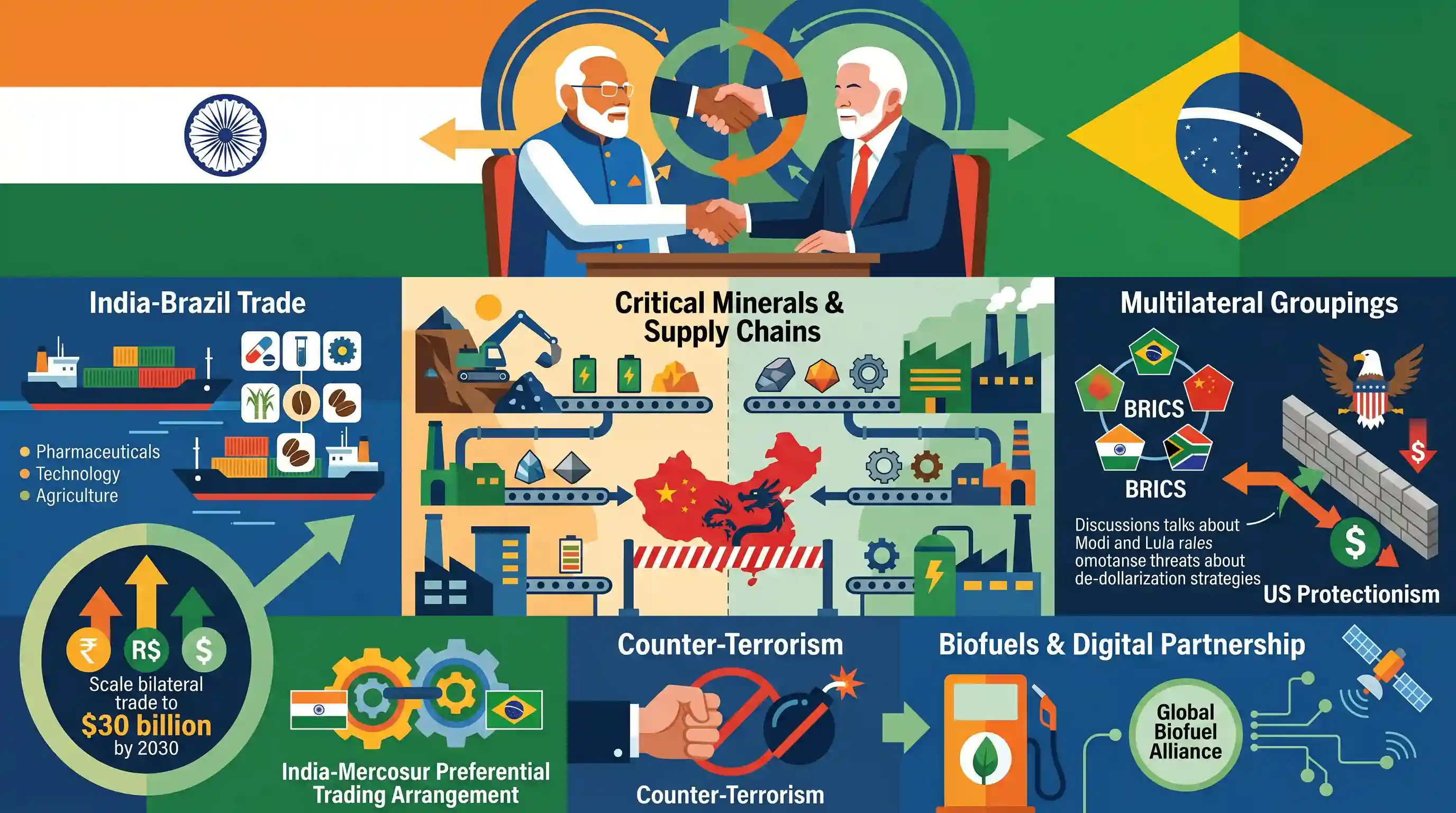
The India-Brazil relationship anchors India's outreach to Latin America and the broader Global South. Collaborative efforts on critical minerals are vital for energy transition and strategic autonomy (China+1 strategy), while jointly maneuvering protectionist threats as key BRICS members highlights shifting global economic dynamics.
Summary
PM Narendra Modi met with Brazilian President Luiz Inácio Lula da Silva, securing landmark bilateral agreements focused on critical minerals, rare earths, and steel mining to reduce supply chain dependency on China. They committed to a robust digital partnership, expanding the Global Biofuel Alliance, and scaling bilateral trade to $30 billion by 2030, anchored by an expanded India-Mercosur preferential trading arrangement. They also addressed geopolitical headwinds, particularly discussing the potential impact of Donald Trump's protectionist tariff policies and their threats against BRICS nations over de-dollarization. Furthermore, both leaders strongly condemned international terrorism, emphasizing a shared global security outlook.
Key Points
- Geoeconomic Diversification: India and Brazil signed agreements on critical minerals, rare earths, and steel mining, aiming to build resilient supply chains and reduce reliance on China.
- Trade & Economic Ties: Set an ambitious bilateral trade target of $30 billion annually by 2030 and pledged to broaden the India-Mercosur Preferential Trading Agreement.
- Emerging Tech & Energy: Decided to deepen cooperation in digital public infrastructure, artificial intelligence, and renewable energy, specifically through the Global Biofuel Alliance.
- Protectionism & Geopolitics: Addressed looming US tariff threats from the Trump administration against BRICS nations and pledged a strategic 'wait and watch' approach while reinforcing mutual support.
- Counter-Terrorism: Issued a strong joint condemnation of terrorism following the recent terror attack in Pahalgam, terming terrorists 'enemies of humanity.'
Important Terms
India-Mercosur Preferential Trading Agreement

A limited trade pact between India and the Southern Common Market (Mercosur) bloc, providing reciprocal tariff concessions on specific products to expand bilateral trade.
UPSC context
GS Paper II (International Relations); tests India's trade diversification strategy and economic engagement with Latin American regional blocs.
Mercosur
The 'Southern Common Market,' a South American trade bloc and customs union comprising Argentina, Brazil, Paraguay, Uruguay, and Bolivia, representing the world's fourth-largest integrated market.
UPSC context
GS Paper II (Regional Groupings); essential for understanding South American integration and its role as a strategic trade partner for India.
Global Biofuel Alliance
An India-led multi-stakeholder platform launched at the 2023 G20 Summit to accelerate global biofuel adoption, establish international standards, and facilitate technology transfer.
UPSC context
GS Paper III (Energy/Environment); tests India's leadership in global energy transitions and sustainable climate diplomacy.
BRICS
An intergovernmental organization (Brazil, Russia, India, China, South Africa, etc.) focused on economic cooperation, challenging Western financial dominance, and exploring alternative trade settlement mechanisms.
UPSC context
GS Paper II (Multilateral Groupings); critical for analyzing geopolitical shifts, de-dollarization trends, and responses to US protectionist policies.
Critical Minerals
Metallic or non-metallic elements (like lithium and cobalt) essential for high-tech and green industries, currently the focus of India-Brazil efforts to build resilient supply chains.
UPSC context
GS Paper III (Economy/Science); vital for topics concerning mineral security, energy transition, and reducing strategic import dependency on China.
Prelims Trap
"The Global Biofuel Alliance (GBA) is a BRICS initiative led by India and Brazil."
Although India and Brazil are prominent BRICS members championing the GBA, it was launched on the sidelines of the G20 summit and includes the USA as a core founding member.
Static Concepts Connected
What distinguishes a Preferential Trade Agreement (PTA) from an FTA?
- PTA: Operates on a 'Positive List' approach; tariffs are lowered only on specifically listed products.
- FTA: Operates on a 'Negative List' approach; tariffs are reduced/eliminated on all items except those explicitly excluded.
- India-Mercosur: Mercosur-India is currently a limited PTA, not a comprehensive FTA.
What are Rare Earth Elements (REEs) and why are they critical?
- Composition: A group of 17 metallic elements comprising 15 lanthanides plus scandium and yttrium.
- Significance: Crucial for permanent magnets, wind turbines, EV batteries, and advanced defense electronics.
- Geopolitics: China currently monopolizes global processing, making bilateral agreements (like India-Brazil) vital for supply chain resilience.
Cross-Topic Patterns
Critical Minerals Multi-alignment
India balances its membership in the US-led Minerals Security Partnership (MSP) with bilateral resource agreements with BRICS partners like Brazil, hedging against global supply shocks while countering Chinese monopolies.
Biofuels: Food vs Fuel Debate
Brazil's success with flex-fuel vehicles directly informs India's E20 (20% ethanol blending) targets, linking international climate diplomacy (GBA) to domestic agriculture and the food-vs-fuel debate.
BRICS, Vostro & De-dollarization
US tariff threats against BRICS over de-dollarization tie directly into India's recent push for Rupee-trade settlement mechanisms (Special Vostro Rupee Accounts) and the broader weaponization of global finance.

Critical minerals mapping (Brazil, Argentina, Australia) + Rare Earth processing monopolies likely form a multi-statement question in 2026.
Linked PYQs · 5
Linked PYQs · 5
- 1998PrelimsGS1
‘MERCOSUR’ consists of group of countries of
- 2020PrelimsGS1
According to India's National Policy on Biofuels, which of the following can be used as raw materials for the production of biofuels ? 1. Cassava 2. Damaged wheat grains 3. Groundnut seeds 4. Horse gram 5. Rotten potatoes 6. Sugar beet Select the correct answer using the code given below:
- 2025PrelimsGS1
Consider the following statements with regard to BRICS : I. 16th BRICS Summit was held under the Chairship of Russia in Kazan. II. Indonesia has become a full member of BRICS. III. The theme of the 16th BRICS Summit was Strengthening Multiculturalism for Just Global Development and Security. Which of the statements given above is/are correct?
- 2025MainsGS3
Mineral resources are fundamental to the country's economy and these are exploited by mining. Why is mining considered an environmental hazard? Explain the remedial measures required to reduce the environmental hazard due to mining.
- 2014PrelimsGS1
With reference to a grouping of countries known as BRICS, consider the following statements: 1. The First Summit of BRICS was held in Rio de Janeiro in 2009. 2. South Africa was the last to join the BRICS grouping. Which of the statements given above is/are correct?
