Great Nicobar Megaproject Environmental and Legal Challenges
Source:The Hindu ↗
Why It Matters
The Great Nicobar Project is a highly strategic initiative for India's maritime security and transhipment ambitions in the Indian Ocean Region, yet it is situated in an exceptionally biodiverse and ecologically fragile zone. This creates a critical UPSC debate on 'Development vs. Environmental Conservation' and carrying capacity. Understanding the legal frameworks involved (EIA, CRZ, FRA, and NGT jurisdictions) is vital for both GS Paper 2 (Governance & Tribal Rights) and GS Paper 3 (Environment & Infrastructure).
Summary
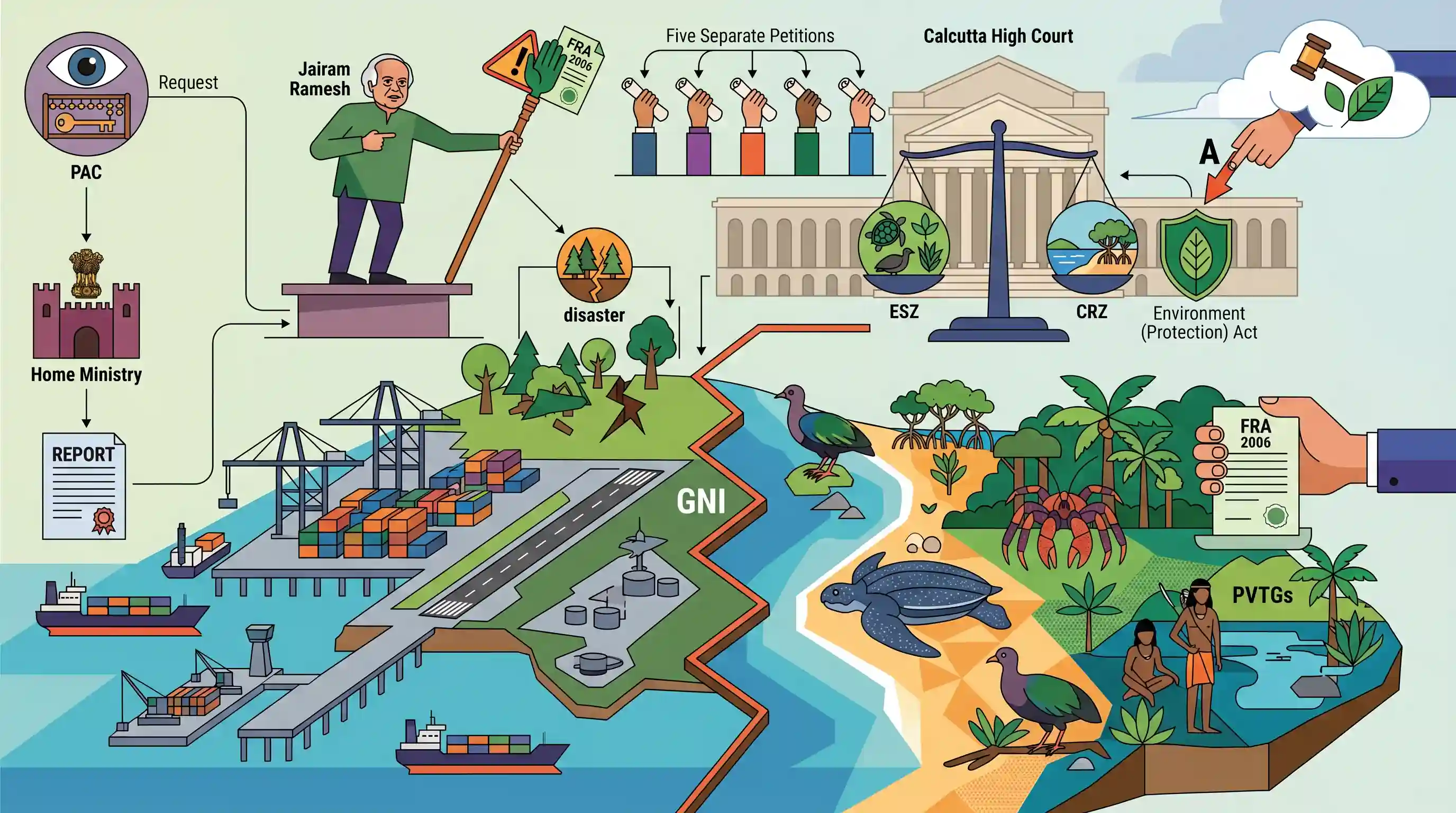
The mega-development project in Great Nicobar Island (GNI) is facing intense political, legal, and environmental scrutiny. Congress leader Jairam Ramesh has raised major concerns about the project, asserting that it risks causing an environmental disaster and violating the Forest Rights Act (FRA) of 2006. Currently, five separate petitions are in the Calcutta High Court challenging the project's compliance with Eco-Sensitive Zone (ESZ) notifications for Campbell Bay and Galathea National Parks, CRZ regulations, and the Environment (Protection) Act. Additionally, the Public Accounts Committee (PAC) has sought a report from the Home Ministry on the progress and impacts of the project, highlighting the deep administrative and ecological conflicts of the transhipment port and defense infrastructure plans.
Key Points
- The Great Nicobar Island (GNI) Project involves massive infrastructure works including a transhipment port at Galathea Bay, a power plant, dual-use airport development, and strategic military expansions like the INS Baaz runway.
- Five public interest petitions have been filed in the Calcutta High Court, challenging the project on multiple environmental and legal grounds.
- Key legal challenges include alleged violations of Eco Sensitive Zone (ESZ) notifications for Campbell Bay and Galathea National Parks, the Coastal Regulation Zone (CRZ) Notification, 2019, and the Environment (Protection) Act, 1986.
- Concerns have been raised regarding non-implementation of the Scheduled Tribes and Other Traditional Forest Dwellers (Recognition of Forest Rights) Act, 2006, in letter and spirit, threatening indigenous communities like the Shompen and Nicobarese.
- The National Green Tribunal's (NGT) order dated February 16, 2026, which granted or reviewed clearances, is also being contested, showcasing ongoing administrative and judicial friction over green clearances.
- The Parliamentary Public Accounts Committee (PAC) has actively intervened by seeking a comprehensive report on the Great Nicobar Project from the Union Home Ministry.
Important Terms
Forest Rights Act, 2006

Landmark legislation recognizing customary land, habitation, and resource rights of forest-dwelling Scheduled Tribes and traditional forest dwellers, empowering Gram Sabhas to manage forest resources.
UPSC context
GS Paper II & III: Tribal rights, forest governance, and conservation vs. livelihoods.
Environment (Protection) Act, 1986
India's umbrella environmental law enacted post-Bhopal Gas Tragedy under Article 253, granting the Central Government broad powers to regulate pollution, hazardous materials, and mandate Environmental Impact Assessments.
UPSC context
GS Paper III: Environmental legislation, governance, and pollution control standards.
Coastal Regulation Zone Notification, 2019
Rules issued under the Environment (Protection) Act, 1986 to regulate development, conserve fragile marine ecosystems, and secure livelihoods of fishing communities within 500 meters of the high tide line.
UPSC context
GS Paper III: Coastal zone management, sustainable development, and disaster-prone blue economy.
Eco Sensitive Zone Notification
Notifications issued under the Environment (Protection) Act, 1986 to declare buffer zones within 10km around Protected Areas, National Parks, and Wildlife Sanctuaries to act as "shock absorbers."
UPSC context
GS Paper III: Biodiversity conservation, wildlife protection, and development-conservation trade-offs.
Public Accounts Committee
A key parliamentary standing committee comprising 22 members that audits the revenue and expenditure of the Government of India, primarily examining the Comptroller and Auditor General's reports.
UPSC context
GS Paper II: Parliamentary financial oversight, accountability of the executive, and government spending.
National Green Tribunal
A specialized statutory body established under the National Green Tribunal Act, 2010 for the rapid, effective disposal of cases related to environmental protection and forest conservation.
UPSC context
GS Paper II & III: Environmental justice, statutory bodies, and fast-tracking ecological disputes.
Prelims Trap
The Andaman and Nicobar Islands fall under the judicial jurisdiction of the Madras High Court due to geographical proximity.
Aspirants frequently assume geographical proximity dictates judicial jurisdiction, falsely mapping the Andaman & Nicobar Islands to Madras, Andhra Pradesh, or Kerala High Courts.
Static Concepts Connected
What is the unique strategic and operational setup of the Andaman and Nicobar Command (ANC)?
- Tri-Service Integration: Established in 2001, ANC is India's first and only operational joint tri-services (Army, Navy, Air Force) theatre command.
- Southern Sentinel: INS Baaz, located at Campbell Bay on Great Nicobar, is the southernmost military air station of India, overseeing crucial maritime choke points.
- Geostrategic Control: Provides crucial surveillance over the Strait of Malacca and the Six Degree Channel to counter assertive maritime activities in the Indian Ocean.
What are the administrative and tribal safeguards for Particularly Vulnerable Tribal Groups (PVTGs) in GNI?
- Mongoloid PVTG: The Shompen are the only Mongoloid PVTG in India, distinct from the Negrito PVTGs of the Andaman Islands (e.g., Jarawas, Sentinelese).
- Nodal Authority: The Ministry of Tribal Affairs (MoTA) is the nodal national agency ensuring the implementation of the Forest Rights Act, 2006, for PVTGs.
- Consent Safeguards: Under the FRA 2006, any diversion of forest land historically inhabited by PVTGs requires the explicit consent of their local Gram Sabhas.
Cross-Topic Patterns
Defense posture vs. Ecological conservation
Environmental impact assessment laws frequently clash with strategic military outposts in ecological hotspots, forcing complex trade-offs between national security and biodiversity conservation.
Infrastructure development vs. Indigenous survival
Mega-scale infrastructure projects in isolated islands often bypass the strict spirit of the Forest Rights Act, 2006, threatening the survival of vulnerable groups like the Shompen.

Great Nicobar strategic projects, Shompen PVTG status, and Calcutta HC jurisdiction are highly likely to feature in 2026 GS-I Prelims.
Linked PYQs · 5
Linked PYQs · 5
- 2009PrelimsGS1
In which one of the following places is the Shompen tribe found?
- 2021PrelimsGS1
At the national level, which ministry is the nodal agency to ensure effective implementation of the Scheduled Tribes and Other Traditional Forest Dwellers (Recognition of Forest Rights) Act, 2006?
- 2024MainsGS3
What role do environmental NGOs and activists play in influencing Environmental Impact Assessment (EIA) outcomes for major projects in India? Cite four examples with all important details.
- 2019MainsGS3
Define the concept of carrying capacity of an ecosystem as relevant to an environment. Explain how understanding this concept is vital while planning for sustainable development of a region.
- 2018PrelimsGS1
How is the National Green Tribunal (NGT) different from the Central Pollution Control Board (CPCB)? 1. The NGT has been established by an Act whereas the CPCB has been created by an executive order of the Government. 2. The NGT provides environmental justice and helps reduce the burden of litigation in the higher courts whereas the CPCB promotes cleanliness of streams and wells, and aims to improve the quality of air in the country. Which of the statements given above is/are correct?
