Malaysian Prime Minister visit strengthens India Act East policy
Source:Indian Express ↗
Why It Matters
It highlights the evolution and practical implementation of India's Act East Policy, moving beyond cultural ties to high-tech economic integration and maritime security with a key ASEAN partner. Understanding this is crucial for Mains GS2 questions on regional geopolitics and bilateral relations.
Summary
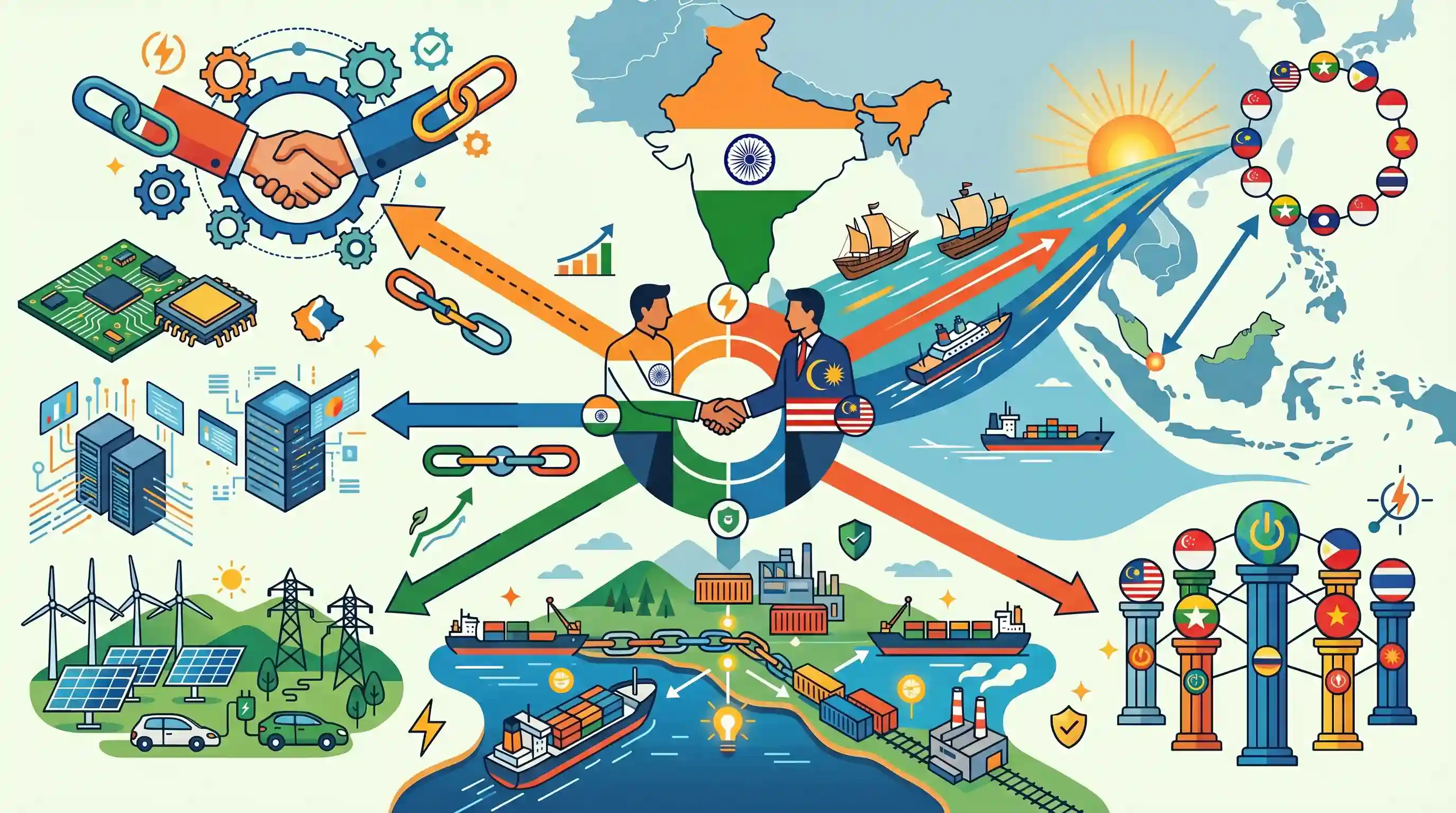
The article evaluates the strategic and economic significance of Malaysian Prime Minister Anwar Ibrahim's visit to India, emphasizing its role in revitalizing India's Act East Policy. Historically, India-Malaysia relations have experienced a disconnect between strategic intent and deep economic integration. By elevating ties to a Comprehensive Strategic Partnership, the two nations aim to bridge this gap through targeted cooperation in future-ready sectors such as semiconductors, the digital economy, and green technology. Beyond bilateral economics, the partnership is geostrategically vital for reinforcing ASEAN centrality within the broader Indo-Pacific framework and enhancing maritime security cooperation amidst major power rivalries. The visit marks a pragmatic shift toward building resilient supply chains and solidifying regional multipolarity.
Key Points
- Malaysian Prime Minister Anwar Ibrahim's visit to India signals a critical recalibration of bilateral ties, aiming to bridge the historical gap between strategic ambitions and economic realities under India's Act East Policy.
- The bilateral relationship has been elevated to a Comprehensive Strategic Partnership, focusing on modern economic drivers rather than traditional commodities like palm oil.
- Key areas of future cooperation include semiconductors, digital economy, fintech, and green technologies, aimed at building resilient regional supply chains.
- Strategically, the partnership reinforces ASEAN centrality in the Indo-Pacific, helping both nations navigate the complex geopolitical landscape shaped by US-China competition.
- Enhanced defence and maritime security cooperation forms a crucial pillar, aligning Malaysia's quest for strategic autonomy with India's regional security interests.
Important Terms
Act East Policy

Launched in 2014, this proactive diplomatic initiative upgrades the 'Look East Policy' to deepen economic, strategic, and cultural engagement with the Indo-Pacific region, emphasizing 'Commerce, Connectivity, and Culture.'
UPSC context
GS Paper II: Bilateral/Regional groupings. Essential for understanding India’s shift from economic focus to strategic and security-led engagement in Southeast Asia.
Comprehensive Strategic Partnership
An advanced diplomatic status reflecting deep mutual trust, involving multi-sectoral cooperation in high-tech areas like semiconductors, defense, and digital economy, recently accorded to India-Malaysia relations in 2024.
UPSC context
GS Paper II: India’s bilateral relations. Tests knowledge of diplomatic hierarchies and new-age strategic pillars like supply chain resilience.
ASEAN
An intergovernmental organization of ten Southeast Asian nations established in 1967 to promote regional peace and economic growth; it serves as the core of India’s 'Act East' engagement.
UPSC context
GS Paper II: International groupings. Foundational for questions on regional stability, trade (AITIGA), and India’s 'Extended Neighborhood.'
Look East Policy
The 1991 strategic shift under PM Narasimha Rao aimed at reconnecting with Southeast Asia through economic liberalization and trade, marking India's post-Cold War diplomatic reorientation.
UPSC context
GS Paper II: Evolution of India’s Foreign Policy. Important for historical comparisons and tracing the shift toward a more assertive 'Act East.'
ASEAN Centrality
A geopolitical principle positioning ASEAN at the heart of regional security and economic architectures, ensuring major powers engage through ASEAN-led forums like the East Asia Summit.
UPSC context
GS Paper II: Indo-Pacific strategy. Crucial for analyzing how India balances relations amidst US-China rivalry and maintains regional multipolarity.
Prelims Trap
India trades with Malaysia exclusively under the multilateral ASEAN-India Free Trade Agreement (AIFTA).
India and Malaysia signed a separate, bilateral Comprehensive Economic Cooperation Agreement (CECA) in 2011, which goes beyond the AIFTA tariff concessions.
Static Concepts Connected
How does India's Act East Policy differ from the Look East Policy?
- Strategic shift: Look East (1992) prioritized economic ties with ASEAN. Act East (2014) adds robust defense, maritime security, and strategic dimensions.
- Geographic expansion: Act East extends its strategic footprint beyond Southeast Asia to include East Asia, Oceania, and the wider Indo-Pacific framework.
- ASEAN Centrality: Places ASEAN at the core of Indo-Pacific institutional engagement through forums like the East Asia Summit and ADMM-Plus.
How do local currency settlement mechanisms (Rupee-Ringgit) work?
- Vostro Accounts: Malaysian banks open Special Rupee Vostro Accounts (SRVA) with authorized Indian correspondent banks to facilitate rupee-denominated transactions.
- Direct Invoicing: Exporters and importers invoice and settle trade directly in INR and MYR, bypassing third-party vehicle currencies like the US Dollar.
- Reduced Volatility: Shields bilateral trade from global dollar fluctuations while gradually advancing the internationalization of the Indian Rupee.
Cross-Topic Patterns
Digital Public Infrastructure Diplomacy
UPI-PayNet linkage mirrors digital diplomacy with Singapore (PayNow) and UAE, transforming fintech into a core pillar of India’s strategic partnerships globally.
Resilient Semiconductor Supply Chains
The India-Malaysia semiconductor alliance aligns with India’s broader Quad and domestic India Semiconductor Mission goals to de-risk critical tech reliance on China.
De-dollarization and Local Currency Trade
The Rupee-Ringgit mechanism reflects a broader trend of India establishing local currency trading frameworks, similar to the Rupee-Dirham arrangement with the UAE.

Expect a multi-statement question linking Act East expansion to digital infrastructure (UPI-PayNet) and local currency settlements.
Linked PYQs · 2
Linked PYQs · 2
- 2016MainsGS2
Evaluate the economic and strategic dimensions of India's Look East Policy in the context of the post Cold War international scenario.
- 2018PrelimsGS1
Consider the following countries: 1. Australia 2. Canada 3. China 4. India 5. Japan 6. USA Which of the above are among the 'free-trade partners' of ASEAN?
