Rashtra Prerna Sthal Inauguration and Political Ideologies in India
Source:The Hindu ↗
Why It Matters
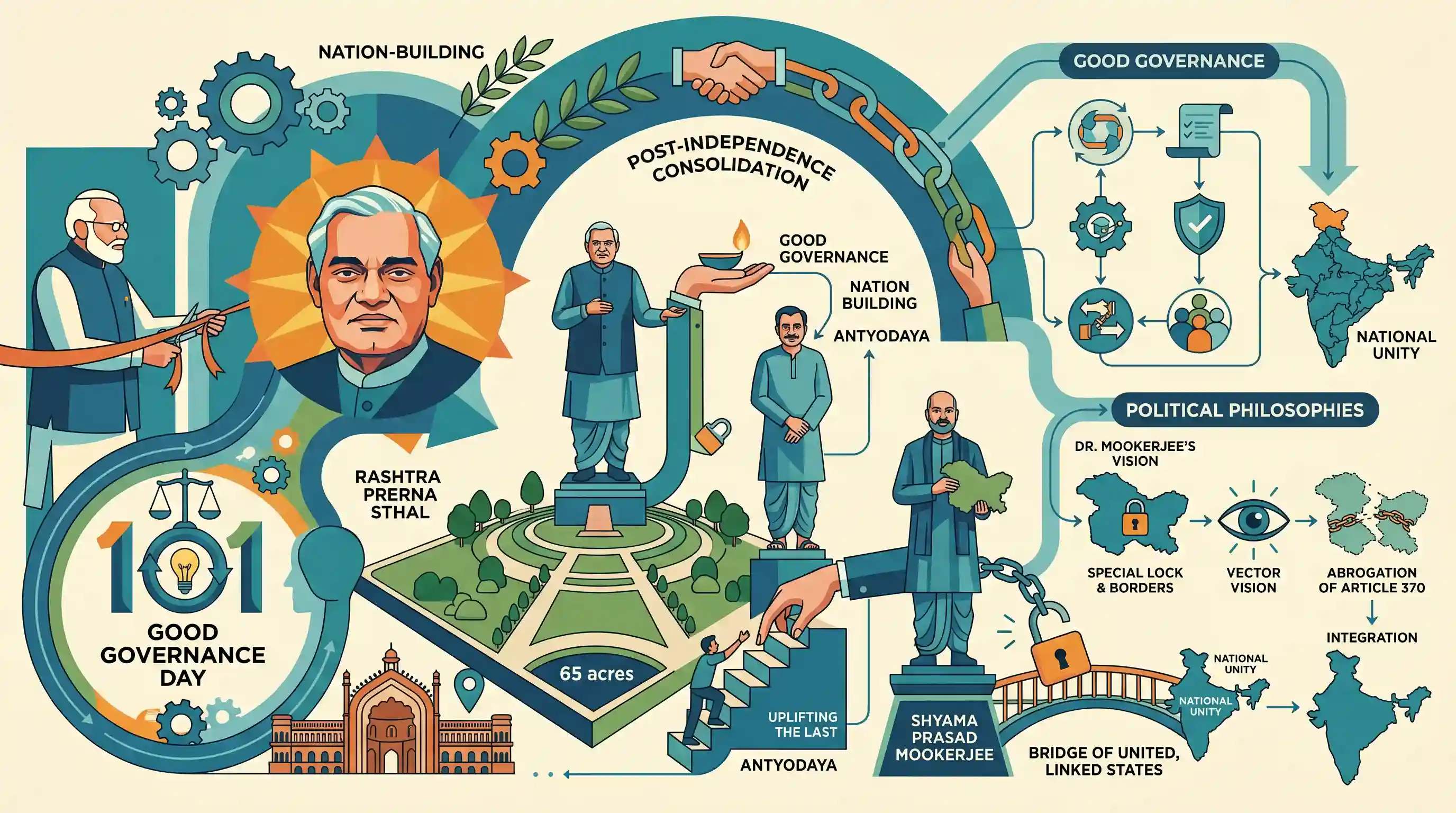
The article provides context on the ideologies of key post-independence leaders who shaped India's political landscape. Their philosophies regarding national integration (Article 370), governance (Good Governance Day), and welfare (Antyodaya) are crucial for understanding contemporary public policy and post-independence consolidation.
Summary
Prime Minister Narendra Modi inaugurated the 'Rashtra Prerna Sthal' in Lucknow on Good Governance Day, which commemorates the 101st birth anniversary of former PM Atal Bihari Vajpayee. The 65-acre memorial features statues of Vajpayee, Deen Dayal Upadhyay, and Shyama Prasad Mookerjee, celebrating their contributions to nation-building. Leaders at the event emphasized principles of good governance, 'Antyodaya', and national unity, citing the abrogation of Article 370 as a fulfillment of Dr. Mookerjee's long-standing vision for Jammu and Kashmir.
Key Points
- Prime Minister Narendra Modi inaugurated the 65-acre Rashtra Prerna Sthal in Lucknow to honour Atal Bihari Vajpayee, Deen Dayal Upadhyay, and Shyama Prasad Mookerjee.
- The inauguration coincided with Good Governance Day (December 25), marking the 101st birth anniversary of Vajpayee and Madan Mohan Malaviya.
- The lotus-shaped memorial features towering bronze statues and a museum dedicated to the leaders' lives and ideals.
- The event highlighted core governance themes, including 'Antyodaya' (uplifting the poorest) and 'Ek Bharat Shreshtha Bharat' (One India, Great India).
- Defence Minister Rajnath Singh noted that the abrogation of Article 370 in Jammu & Kashmir fulfilled Dr. Shyama Prasad Mookerjee's vision for India's unity and integrity.
Important Terms
Good Governance Day

Observed annually on December 25 to mark Atal Bihari Vajpayee's birth anniversary; it underscores the government’s commitment to transparent, accountable, and citizen-centric administration through reforms and digital tools.
UPSC context
GS Paper II (Governance) — relevant for administrative reforms, accountability, and the Good Governance Index (GGI).
Article 370
A former constitutional provision that granted special autonomous status to Jammu and Kashmir; its 2019 abrogation brought the region under the uniform legal and administrative framework of the Indian Constitution.
UPSC context
GS Paper II (Constitution) — tests historical underpinnings, federalism, and the process of territorial integration.
Antyodaya
A philosophical concept meaning 'upliftment of the last person,' prioritizing the welfare of the most marginalized; it is the cornerstone of Deendayal Upadhyaya’s 'Integral Humanism' and guides various modern social welfare schemes.
UPSC context
GS Paper IV/I (Ethics/Social Issues) — essential for understanding Indian political philosophy and inclusive development strategies.
Ek Bharat Shreshtha Bharat
An initiative launched in 2015 to enhance national integration by pairing different States and UTs for structured cultural, linguistic, and educational exchanges to celebrate India’s 'Unity in Diversity.'
UPSC context
GS Paper I/II (Social Issues/Governance) — relevant for topics on national integration and cultural preservation policies.
Rashtra Prerna Sthal
A 65-acre national memorial in Lucknow dedicated to the legacies of Atal Bihari Vajpayee, Deendayal Upadhyaya, and Syama Prasad Mookerjee; it features a lotus-shaped museum and towering bronze statues.
UPSC context
GS Paper I/II (Post-Independence History/Governance) — tests the institutionalization of leadership legacies and civic education through monuments.
Integral Humanism
An indigenous political doctrine proposed by Deendayal Upadhyaya that rejects Western materialism and advocates for a balanced development of the individual’s body, mind, intellect, and soul in harmony with society.
UPSC context
GS Paper IV/I (Ethics/Modern History) — central to Indian political thought and philosophical bases of governance.
Prelims Trap
"The concept of 'Antyodaya' was originally coined and propagated by Mahatma Gandhi during the Indian National Movement."
While conceptually similar to Gandhi's 'Sarvodaya', 'Antyodaya' (uplifting the last) as a core socio-political philosophy is fundamentally attributed to Pandit Deen Dayal Upadhyay's Ekatma Manav Darshan.
Static Concepts Connected
What were Dr. Shyama Prasad Mookerjee's key political contributions post-independence?
- First Cabinet: He served as the Minister for Industry and Supply in Jawaharlal Nehru's first interim cabinet.
- Delhi Pact Opposition: He resigned in 1950 to protest the Nehru-Liaquat Pact (Delhi Pact) regarding the protection of minority rights in India and Pakistan.
- Bharatiya Jana Sangh: He founded the Bharatiya Jana Sangh in 1951, fiercely opposing Article 370 and advocating for J&K's complete integration.
What are the key historical milestones associated with Pandit Madan Mohan Malaviya?
- Title Mahamana: He was conferred the title 'Mahamana' by Mahatma Gandhi for his monumental contributions to the nation.
- Institution Builder: He co-founded the Banaras Hindu University (BHU) in 1916 alongside Annie Besant and Sunder Lal.
- INC Presidency: He was a prominent moderate leader who served as the President of the Indian National Congress four times (1909, 1918, 1932, 1933).
Cross-Topic Patterns
Article 370 and Post-Independence Visions
The historical opposition to J&K's autonomy by early leaders connects recent constitutional actions (J&K Reorganisation Act 2019) directly to the post-1947 consolidation debates.
Integral Humanism to Modern Welfare
Deen Dayal Upadhyay's 'Antyodaya' (Integral Humanism) provides the ideological bedrock for evaluating modern governance, PDS, and welfare schemes targeting last-mile delivery.

Expect a multi-statement question in 2026 combining Malaviya's pre-independence institutions and Mookerjee's post-1947 actions.
Linked PYQs · 5
Linked PYQs · 5
- 2024MainsGS2
The Doctrine of Democratic Governance makes it necessary that the public perception of the integrity and commitment of civil servants becomes absolutely positive. Discuss.
- 2025MainsGS1
Trace India's consolidation process during early phase of independence in terms of polity, economy, education and international relations.
- 2016MainsGS2
To what extent is Article 370 of the Indian Constitution, bearing marginal note "Temporary provision with respect to the State of Jammu and Kashmir", temporary? Discuss the future prospects of this provision in the context of Indian polity.
- 2025MainsGS2
Discuss the nature of Jammu and Kashmir Legislative Assembly after the Jammu and Kashmir Reorganization Act, 2019. Briefly describe the powers and functions of the Assembly of the Union Territory of Jammu and Kashmir.
- 2015MainsGS1
Mahatma Gandhi and Dr. B.R. Ambedkar, despite having divergent approaches and strategies, had a common goal of amelioration of the downtrodden. Elucidate.
