Prime Minister Narendra Modi Upcoming State Visit to Israel
Source:Indian Express ↗
Why It Matters
The visit serves as a prime case study for India's 'de-hyphenated' foreign policy in West Asia. It is highly relevant for GS2 questions analyzing the evolution, depth, and diversity of India-Israel bilateral ties and India's strategic balancing act in a volatile Middle East.
Summary
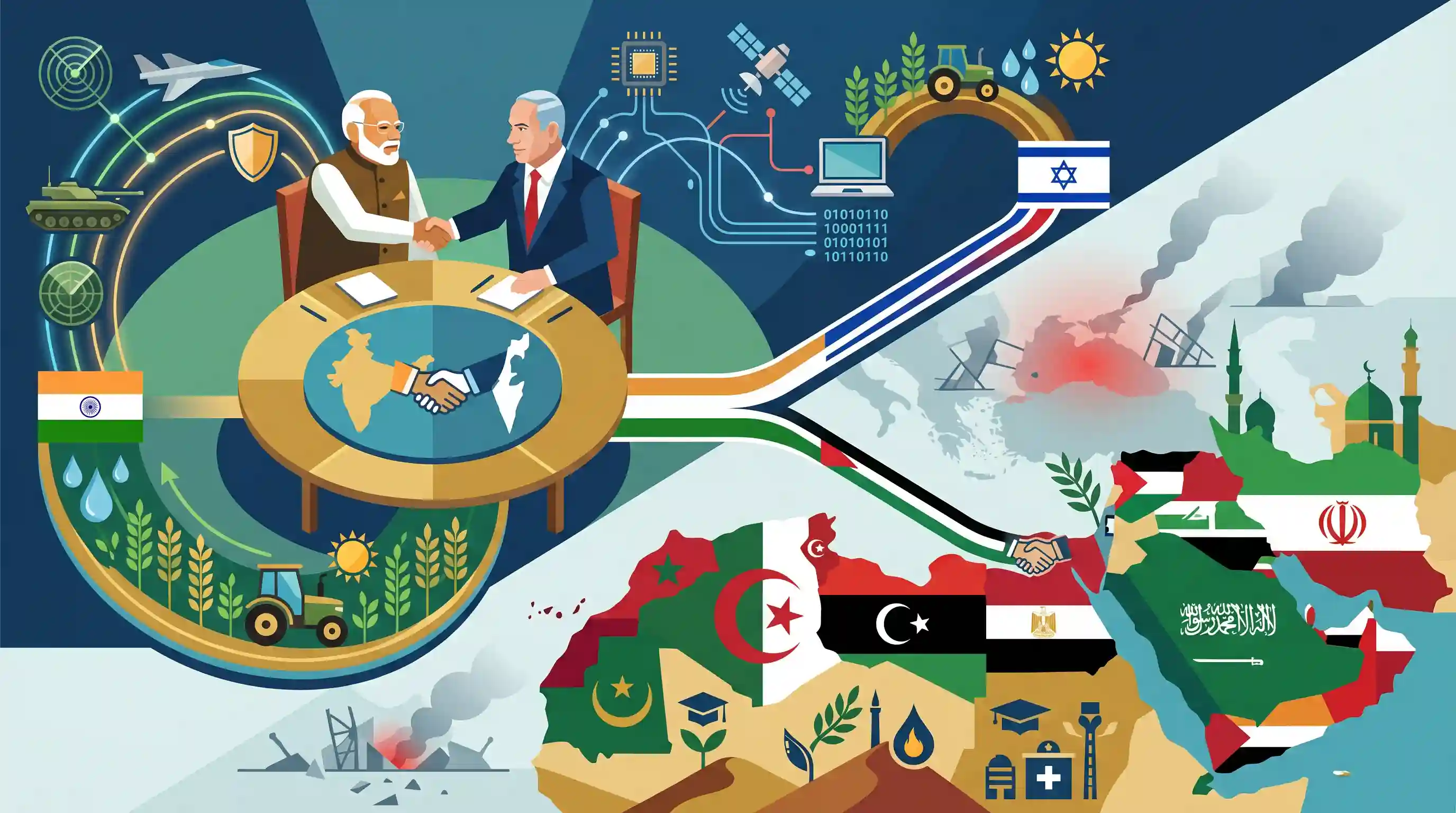
Prime Minister Narendra Modi is reportedly scheduled to visit Israel on February 25 to hold high-level bilateral talks with Israeli Prime Minister Benjamin Netanyahu. The planned visit highlights the continued strengthening of India-Israel strategic ties, which encompass key sectors such as defense, technology, and agriculture. Taking place amid ongoing conflict and regional instability in West Asia, the visit also emphasizes India's successful 'de-hyphenation' strategy in its Middle East foreign policy—balancing deep ties with Israel alongside its relationships with Arab nations and Palestine.
Key Points
- Prime Minister Narendra Modi is slated to visit Israel on February 25 to hold bilateral talks with Israeli PM Benjamin Netanyahu.
- The high-level visit underscores the strategic depth of the India-Israel partnership, which spans defense, agriculture, water management, and technology.
- The engagement reflects India's continuing 'de-hyphenation' policy, allowing it to pursue independent, robust relations with Israel while maintaining its traditional stance on Palestine.
- The visit comes against the backdrop of significant geopolitical volatility in the Middle East, highlighting India's diplomatic balancing act with both Israel and the Arab states.
Prelims Trap
India's 'de-hyphenation' policy implies it has abandoned its support for an independent Palestinian state.
De-hyphenation means treating bilateral ties with Israel and Palestine independently. It does not mean India has abandoned its historical support for the Palestinian cause or the two-state solution.
Static Concepts Connected
What is the I2U2 initiative and its core focus areas?
- Member Nations: India, Israel, USA, and UAE, forming a geo-economic minilateral grouping.
- Origin: Emerged post-Abraham Accords (2020) to capitalize on normalized Arab-Israeli relations.
- Focus Sectors: Encourages joint investments in water, energy, transportation, space, health, and food security.
How does Israeli technology aid Indian agriculture under the IIAP?
- Centres of Excellence: Establishes model farms across various Indian states for rapid tech transfer to farmers.
- Micro-irrigation: Pioneers drip and sprinkler systems suitable for dry-land farming and arid regions in India.
- Horticulture Focus: Promotes crop diversity, protected cultivation (greenhouses), and advanced canopy management to maximize yields.
Cross-Topic Patterns
I2U2 vs. Indo-Pacific Quad
Unlike the security-heavy maritime focus of the Indo-Pacific Quad, I2U2 functions primarily as a geo-economic grouping leveraging the Abraham Accords for infrastructure and food security.
Shift to defense co-development
India's ties with Israel mirror its broader defense indigenization push—moving from a buyer-seller dynamic to joint ventures like the Barak-8 (MRSAM) system.
Middle East Economic Corridor (IMEC)
Deepening ties with both Israel and Arab nations are critical to realizing the IMEC, bridging Indian ports to Europe via the UAE, Saudi Arabia, and Israel.

Expect a combined 2026 prelims question on I2U2, IMEC, and India's 'de-hyphenation' policy, testing West Asian geo-economic alignments.
Linked PYQs · 3
Linked PYQs · 3
- 2018MainsGS2
“India’s relations with Israel have, of late, acquired a depth and diversity, which cannot be rolled back.” Discuss.
- 2023PrelimsGS1
Consider the following statements: Statement-I: Israel has established diplomatic relations with some Arab States. Statement-II: The 'Arab Peace Initiative' mediated by Saudi Arabia was signed by Israel and Arab League. Which one of the following is correct in respect of the above statements?
- 2017MainsGS2
The question of India's Energy Security constitutes the most important part of India's economic progress. Analyze India's energy policy cooperation with West Asian countries.
