AP Infrastructure and Semiconductor Projects Launched by PM Modi
Source:apacnewsnetwork ↗
Why It Matters
This article is vital for aspirants tracking major capital investments, industrial corridor developments, semiconductor policies, and renewable energy targets in Andhra Pradesh, directly connecting with state economy syllabus areas for APPSC Group 1.
Summary
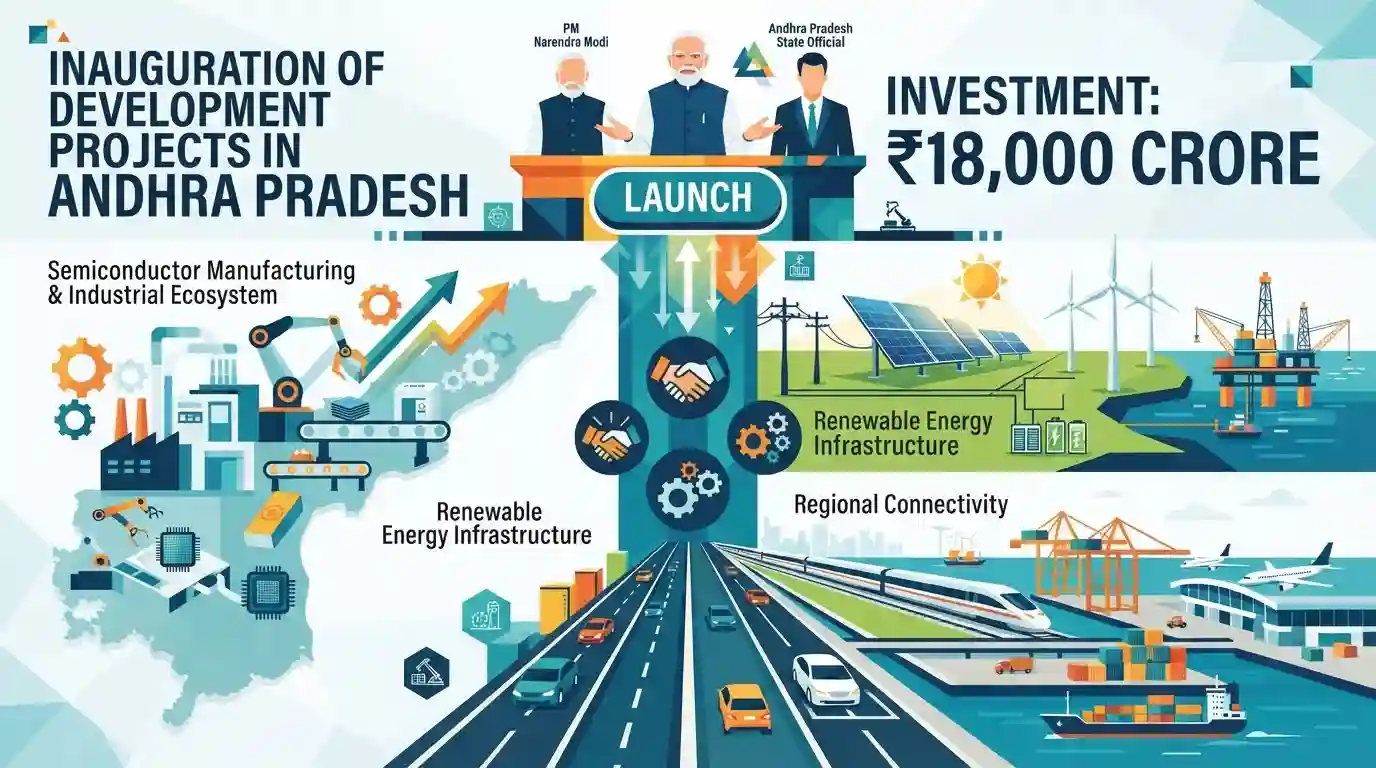
Prime Minister Narendra Modi launched key development projects worth Rs 18,000 crore in Andhra Pradesh, aimed at boosting semiconductor manufacturing, renewable energy infrastructure, and regional connectivity. The initiative highlights the central and state collaborative efforts in expanding industrial ecosystems, clean energy transition, and modern infrastructure in the region.
Key Points
- Prime Minister Narendra Modi launched development projects worth Rs 18,000 crore in Andhra Pradesh focusing on semiconductors, renewable energy, and infrastructure.
- The investments aim to bolster the industrial growth, manufacturing capabilities, and green energy transition in the state.
- Such large-scale capital investments align with Andhra Pradesh's strategic push toward industrial corridors, plug-and-play manufacturing ecosystems, and clean energy targets.
Important Terms
New and Renewable Energy Development Corporation of A.P. Ltd

A state government nodal agency in Andhra Pradesh responsible for implementing renewable energy programs, promoting green energy initiatives, and facilitating large-scale solar, wind, and green fuel projects across the state.
UPSC context
Relevant for APPSC Group papers (Economy and Infrastructure), focusing on state renewable energy policy implementation and green transition goals.
Andhra Pradesh Industrial Infrastructure Corporation
A wholly-owned state undertaking established to promote industrial growth in Andhra Pradesh by developing industrial parks, SEZs, and essential infrastructure like land, power, and water.
UPSC context
Important for APPSC Economy and Industrial Development topics, testing knowledge of state-level institutional frameworks supporting manufacturing and investments.
Andhra Pradesh Green Hydrogen and Green Ammonia Policy
A state policy framework designed to establish Andhra Pradesh as a leading hub for green hydrogen and green ammonia production, offering tax exemptions, land allotments, and fiscal incentives.
UPSC context
Vital for APPSC current affairs and Environment/Energy syllabus, testing clean energy policies and industrial decarbonization strategies in AP.
Prelims Trap
Semiconductor manufacturing and OSAT facility in Visakhapatnam is a 100% centrally funded public sector undertaking.
Aspirants might assume all semiconductor projects in India are exclusively under central PSU control, ignoring state-level nodal bodies like APIIC and private-public frameworks under the India Semiconductor Mission.
Static Concepts Connected
What are the key institutional bodies driving industrial infrastructure and semiconductor manufacturing in Andhra Pradesh?
- APIIC Mandate: APIIC role: Andhra Pradesh Industrial Infrastructure Corporation acts as the nodal agency for land acquisition, industrial park development, and infrastructure facilitation across the state.
- Semiconductor Mission: ISM framework: India Semiconductor Mission operates as a specialized business division under Digital India Corporation to fiscal support semiconductor and display fabs.
- Green Energy Agency: Renewable nodal agency: New and Renewable Energy Development Corporation of Andhra Pradesh (NREDCAP) executes solar, wind, and green hydrogen initiatives.
Cross-Topic Patterns
Semiconductors + State Industrial Policy Integration
Andhra Pradesh's semiconductor OSAT push under the India Semiconductor Mission mirrors global Fab ecosystems, testing state-level industrial policy alignment with central fiscal incentives like PLI schemes.
AP Green Energy + National Mission Targets
Green hydrogen and green ammonia policy initiatives in AP directly intersect with India's Panchamrit targets set at COP26 and National Green Hydrogen Mission.

APPSC Group-1 loves multi-statement matching questions on central-state capital investments, green energy targets, and semiconductor hubs in AP.
Linked PYQs · 3
Linked PYQs · 3
- 2024APPSC_PRELIMSGS1
In connection with transport and infrastructure in Andhra Pradesh, which of the following statement/statements is/are valid? I. Andhra Pradesh's first riverine project has been proposed between Muktayala and Madipadu on Krishna river. II. The Bhogapuram Greenfield International Airport had been started with a corpus fund that is sourced from National Investment and Infrastructure Fund (NIIF). III. Infrastructure investments in Andhra Pradesh are strictly implemented only with reference to strategic investments like ports and industrial corridors, but not with reference to community assets. IV. Rail Over Bridges (ROBs) are being developed in Andhra Pradesh under the Setu Bandhan Scheme. Select the correct answer using the codes given below :
- 2024APPSC_PRELIMSGS1
Which of the following statement/statements is/are incorrect regarding the Andhra Pradesh Industrial Policy 2023 - 27? I. To achieve a minimum contribution of 25% by industry in the State GDP II. To provide end-to-end facilitation in 2 weeks III. To envisage ten (10) priorities of accomplishment IV. To focus on becoming a 'Plug and Play State' for investments V. Ensuring land allotment by APIIC within a period of 2 weeks upon receipt of application Select the answer using the codes given below :
- 2024APPSC_PRELIMSGS1
Which of the following statements are valid in connection with Andhra Pradesh Green Hydrogen and Green Ammonia Policy (2023)? I. The objective is to target Green Energy production up to the capacity of 1 MPTA (Million Tonnes Per Annum) or Green Ammonia production up to the capacity of 2-0 MTPA in the next five years. II. New and Renewable Energy Development Corporation of A.P. Ltd (NREDCAP) shall act as a Nodal Agency under this policy. III. All the Ports in the State have infrastructure for storing liquid nitrogen which can then be utilized for storing Green Hydrogen for exporting to other countries. IV. The Policy prohibits the production of Green Hydrogen/Green Ammonia by using Renewable Energy and/or Biomass from 'Third-Party/Power exchange'. Select the correct answer using the codes given below :
