Prime Minister Visit to China for SCO Summit and Diplomacy
Source:Indian Express ↗
Why It Matters
The article is highly relevant for UPSC aspirants as it highlights India's multi-aligned diplomacy in practice. It touches upon critical issues like repairing Sino-Indian relations post-Galwan, the strategic utility of the SCO, and navigating rising US protectionist policies by strengthening economic and defence cooperation with countries like Japan, China, and Russia.
Summary
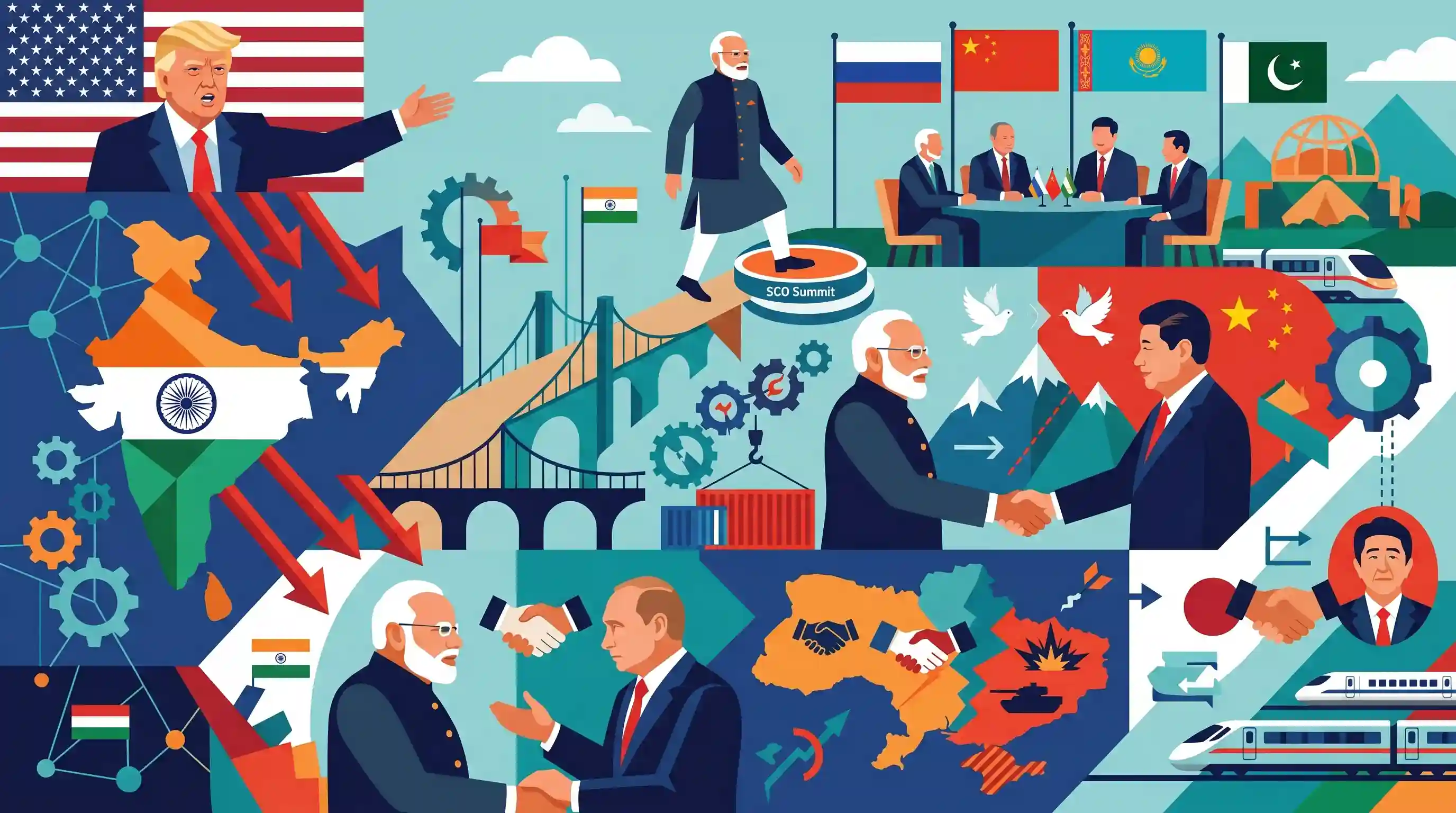
Prime Minister Narendra Modi has arrived in Tianjin, China, for the SCO Summit, marking his first trip to the country in seven years. The visit unfolds against a backdrop of global economic volatility and recent massive US tariffs imposed on India by President Donald Trump. Modi is set to hold high-stakes bilateral talks with Chinese President Xi Jinping to mend relations following the 2020 Galwan Valley clash, focusing on trade enhancement, regional stability, and border dispute settlements. Talks with Russian President Vladimir Putin regarding the US tariffs and the Ukraine conflict are also on the agenda. The China visit follows Modi's strategic trip to Japan, emphasizing India's multi-aligned foreign policy approach amid shifting global trade dynamics.
Key Points
- PM Narendra Modi arrived in Tianjin, China for the Shanghai Cooperation Organisation (SCO) Summit, his first visit to China since 2018.
- Bilateral meetings with Chinese President Xi Jinping aim to mend ties post-Galwan Valley clash, expand trade, and stabilize regional geopolitics.
- India and China plan to set up an expert group for early border settlement, alongside resuming direct flights and easing visa rules.
- In the context of the recent 50% tariffs imposed by US President Donald Trump on India, discussions with China and Russian President Vladimir Putin will focus on countering protectionism and ensuring global economic stability.
- Before visiting China, Modi held a summit in Tokyo with Japanese PM Shigeru Ishiba, securing deepening defence and tech ties and $68 billion in investments over a decade.
Important Terms
Shanghai Cooperation Organisation (SCO)

A Eurasian political, economic, and security alliance founded in 2001. India joined in 2017 to enhance connectivity with Central Asia and counterterrorism cooperation through the Regional Anti-Terrorist Structure (RATS).
UPSC context
GS Paper II (International Groupings). Tests understanding of India's role in Eurasia and balancing major powers.
Line of Actual Control (LAC)
The 3,488 km long de facto boundary separating Indian-controlled territory from Chinese-controlled territory. It is not officially demarcated, leading to frequent "differing perceptions" and border transgressions.
UPSC context
GS Paper II (India & Neighborhood). Tests knowledge of border management and historical territorial disputes.
Multi-alignment
A pragmatic foreign policy strategy where India maintains diverse, independent partnerships with various major powers simultaneously to maximize national interest and preserve strategic autonomy in a multipolar world.
UPSC context
GS Paper II (Foreign Policy). Tests evaluation of India’s strategic positioning amidst global power rivalries.
Galwan Valley Clash
A violent 2020 military standoff in Eastern Ladakh between Indian and Chinese troops. It marked a watershed moment, leading to casualties and a significant freeze in bilateral and economic relations.
UPSC context
GS Paper II (Bilateral Relations). Tests analysis of contemporary security challenges and shift in India-China ties.
Protectionism
Economic policies, such as high tariffs and quotas, used by states to restrict imports and favor domestic industries. It often triggers trade wars and disrupts global supply chains.
UPSC context
GS Paper III (Economy). Tests knowledge of global trade dynamics and their impact on India’s exports.
Prelims Trap
"SCO is an economic union that mandates free trade among its member nations."
SCO focuses on regional security, counter-terrorism (via RATS), and economic cooperation. It does not mandate a free trade area among its members.
Static Concepts Connected
What are the structural pillars and origin of the Shanghai Cooperation Organisation (SCO)?
- Origin & Expansion: Evolved from the 1996 Shanghai Five (focused on border demilitarization). Became SCO in 2001 with Uzbekistan. India and Pakistan joined as full members in 2017.
- Core Organs: The Heads of State Council is the supreme decision-making body. RATS (Regional Anti-Terrorist Structure) operates from Tashkent to combat terrorism, separatism, and extremism.
How does India's 'Multi-alignment' differ from traditional 'Non-Alignment' (NAM)?
- Issue-based Networks: Instead of remaining equidistant or passive, India actively builds concurrent, overlapping partnerships (e.g., Quad for maritime, SCO for Eurasia) to maximize strategic choices.
- Proactive Autonomy: Focuses on issue-based coalitions and de-hyphenating relationships. E.g., maintaining deep defense ties with Japan/US while simultaneously negotiating border thaws with China.
Cross-Topic Patterns
US Protectionism + Eurasian tilt
Drastic US tariffs force India to hedge its economic bets, accelerating engagement with the SCO/BRICS axis to explore alternative supply chains and local-currency trade mechanisms.
Maritime Quad vs Continental SCO
Modi's Tokyo trip (Indo-Pacific maritime security) immediately followed by Tianjin (Eurasian continental stability) perfectly illustrates India's dual-track geopolitical balancing act.

Expect a GS2 question on India's strategic hedging: balancing the US-led maritime Quad against the China-dominated continental SCO.
Linked PYQs · 5
Linked PYQs · 5
- 2021MainsGS2
Critically examine the aims and objectives of SCO. What importance does it hold for India?
- 2012MainsGS2
Do you think that China's emergence as one of the largest trading partners of India has adversely affected the settlement of the outstanding border problem?
- 2014MainsGS2
With respect to the South China sea, maritime territorial disputes and rising tension affirm the need for safeguarding maritime security to ensure freedom of navigation and over flight throughout the region. In this context, discuss the bilateral issues between India and China.
- 2019MainsGS2
‘The time has come for India and Japan to build a strong contemporary relationship, one involving global and strategic partnership that will have a great significance for Asia and the world as a whole.’ Comment.
- 2025MainsGS3
What are the challenges before the Indian economy when the world is moving away from free trade and multilateralism to protectionism and bilateralism? How can these challenges be met?
