India-Japan Strategic Partnership and Space Cooperation Roadmap
Source:The Hindu ↗
Why It Matters
The article covers crucial shifts in India's geopolitical and geoeconomic strategy. The strengthening of the India-Japan Special Strategic and Global Partnership—evidenced by investments in semiconductors, space exploration (Chandrayaan-5), and defence—acts as a cornerstone of India's Indo-Pacific strategy. Simultaneously, engaging with China at the SCO summit amidst US protectionist trade policies underscores India's commitment to strategic autonomy and multilateralism.
Summary
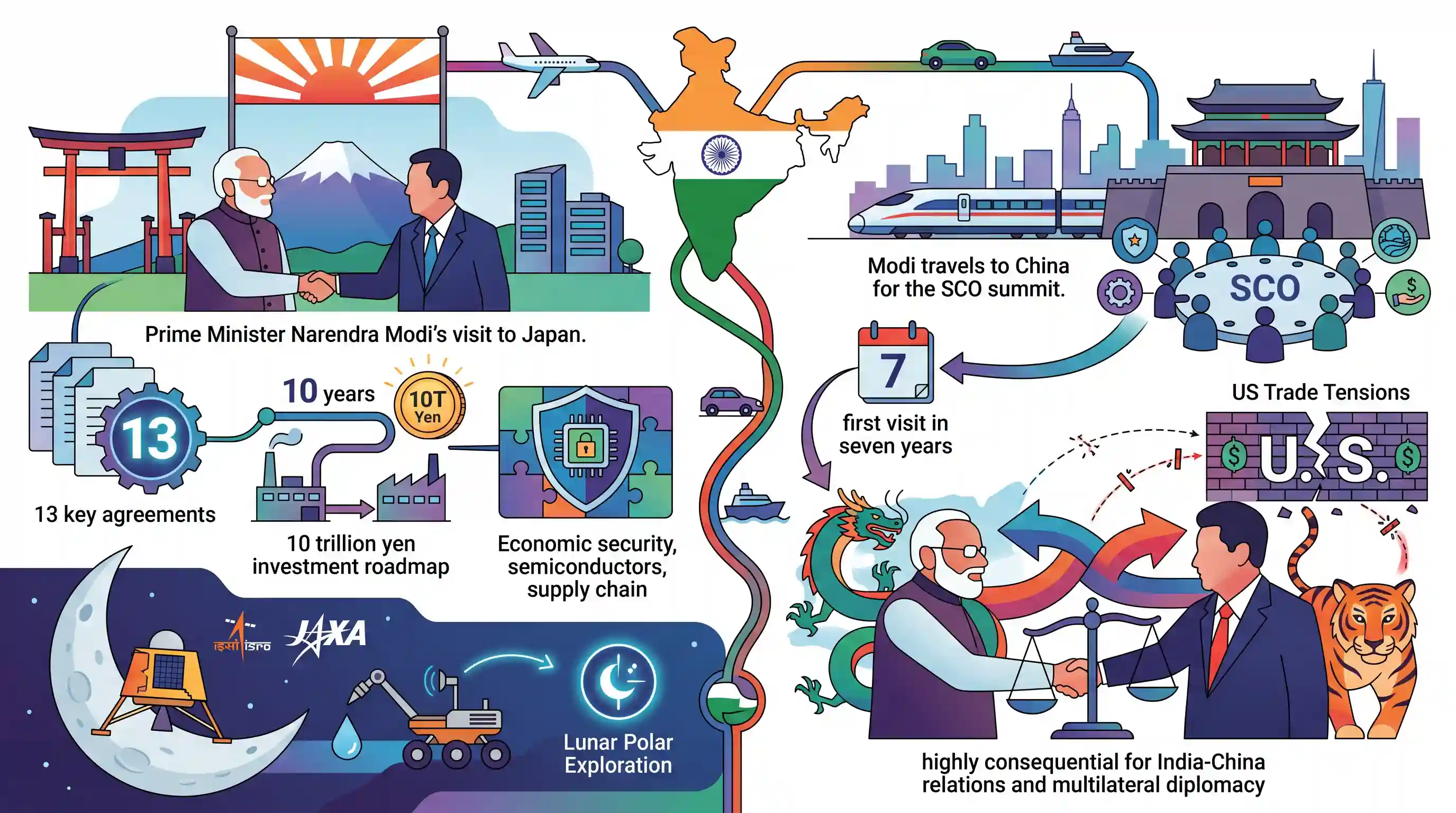
Prime Minister Narendra Modi concluded a two-day visit to Japan, securing 13 key agreements with Japanese PM Shigeru Ishiba. Outcomes included a 10-year roadmap for boosting economic partnership, an investment target of 10 trillion yen over the next decade, and an economic security architecture focusing on supply chain resilience in critical sectors like semiconductors. Notably, ISRO and JAXA signed an arrangement for the joint Chandrayaan-5 lunar polar exploration mission. Following his Japan visit, PM Modi travels to Tianjin, China, for the SCO summit. This marks his first visit to China in seven years and is viewed as highly consequential for India-China relations and multilateral diplomacy amidst recent trade tensions with the United States.
Key Points
- India and Japan signed 13 agreements, establishing a 10-year roadmap to boost their economic partnership and outlining a new framework for defence ties.
- Japan committed to an investment target of 10 trillion yen (approx. ₹60,000 crore) in India over the next decade.
- The two nations introduced an economic security architecture aimed at promoting supply chain resilience in strategic sectors like semiconductors, clean energy, and telecom.
- ISRO and JAXA signed an implementing arrangement for the Chandrayaan-5 mission to jointly explore the lunar polar region.
- Following the Japan visit, PM Modi heads to Tianjin, China, for the SCO summit—his first visit to China in seven years—taking on added significance following 50% US tariffs on Indian exports.
Important Terms
India-Japan Special Strategic and Global Partnership

The formal framework (since 2014) for bilateral ties, focusing on Indo-Pacific security, high-quality infrastructure, and deep economic cooperation, highlighted by Japan’s ¥10 trillion investment commitment.
UPSC context
GS Paper II (IR). Tests understanding of strategic alliances, maritime security (Quad), and India’s 'Act East' policy.
Chandrayaan-5 mission
Also known as LUPEX, this joint lunar mission between ISRO and JAXA aims to explore the Moon’s South Pole for water and ice using an Indian lander and Japanese rover.
UPSC context
GS Paper III (Science & Tech). Significant for international space collaboration and lunar resource exploration.
Shanghai Cooperation Organisation (SCO)
A Eurasian multilateral grouping focusing on regional security, counter-terrorism (RATS), and economic integration between member states including India, China, Russia, and Central Asian nations.
UPSC context
GS Paper II (IR). Tests knowledge of regional organizations, Central Asian outreach, and counter-terrorism diplomacy.
Economic security architecture
A strategic focus on securing critical supply chains (e.g., semiconductors) and reducing over-dependence on single markets through initiatives like the Supply Chain Resilience Initiative (SCRI).
UPSC context
GS Paper III (Economy). Tests understanding of global value chains and strategic economic autonomy.
JAXA (Japan Aerospace Exploration Agency)
Japan's national aerospace agency and ISRO's primary collaborator for the LUPEX mission; it provides the H3 launch vehicle and rover for joint lunar exploration.
UPSC context
GS Paper III (Science & Tech). Tests awareness of international technological partnerships in the space sector.
Prelims Trap
"Chandrayaan-5 (LUPEX) is a joint lunar polar exploration mission between ISRO and NASA."
LUPEX is a joint mission between India's ISRO and Japan's JAXA, not NASA. It aims to explore the lunar polar region for water resources.
Static Concepts Connected
What are the key permanent bodies of the SCO?
- SCO Secretariat: Based in Beijing, it handles the primary administrative, organizational, and executive functions for the grouping.
- RATS: Based in Tashkent, Uzbekistan, it focuses specifically on regional cooperation against terrorism, separatism, and extremism.
What is the Supply Chain Resilience Initiative (SCRI)?
- Core Members: A trilateral initiative launched by India, Japan, and Australia in 2021.
- Strategic Goal: Aims to reduce Indo-Pacific dependency on a single nation (China) by building robust, redundant, and transparent trade networks.
Cross-Topic Patterns
Hedging US Tariffs via SCO
Facing 50% US tariffs, India's active push for the SCO Development Bank and Tianjin Declaration signals classic strategic hedging, balancing Western trade friction with Eurasian economic integration.
Space Diplomacy & Indo-Pacific
The ISRO-JAXA LUPEX mission complements the Quad's critical technology working group, shifting space exploration from purely scientific endeavors to a pillar of Indo-Pacific geopolitical strategy.

Expect a multi-statement 2026 Prelims question pairing ISRO's bilateral missions (LUPEX, NISAR, TRISHNA) with their partner agencies.
Linked PYQs · 5
Linked PYQs · 5
- 2019MainsGS2
‘The time has come for India and Japan to build a strong contemporary relationship, one involving global and strategic partnership that will have a great significance for Asia and the world as a whole.’ Comment.
- 2023MainsGS3
What is the main task of India's third moon mission which could not be achieved in its earlier mission? List the countries that have achieved this task. Introduce the subsystems in the spacecraft launched and explain the role of the Virtual Launch Control Centre' at the Vikram Sarabhai Space Centre which contributed to the successful launch from Sriharikota.
- 2017MainsGS3
India has achieved remarkable successes in unmanned space missions including the Chandrayaan and Mars Orbitter Mission, but has not ventured into manned space missions. What are the main obstacles to launching a manned space mission, both in terms of technology and logistics? Examine critically.
- 2023MainsGS2
‘Virus of Conflict is affecting the functioning of the SCO’ In the light of the above statement point out the role of India in mitigating the problems.
- 2021MainsGS2
Critically examine the aims and objectives of SCO. What importance does it hold for India?
