India Japan economic partnership and Indo Pacific security framework
Source:The Hindu ↗
Why It Matters
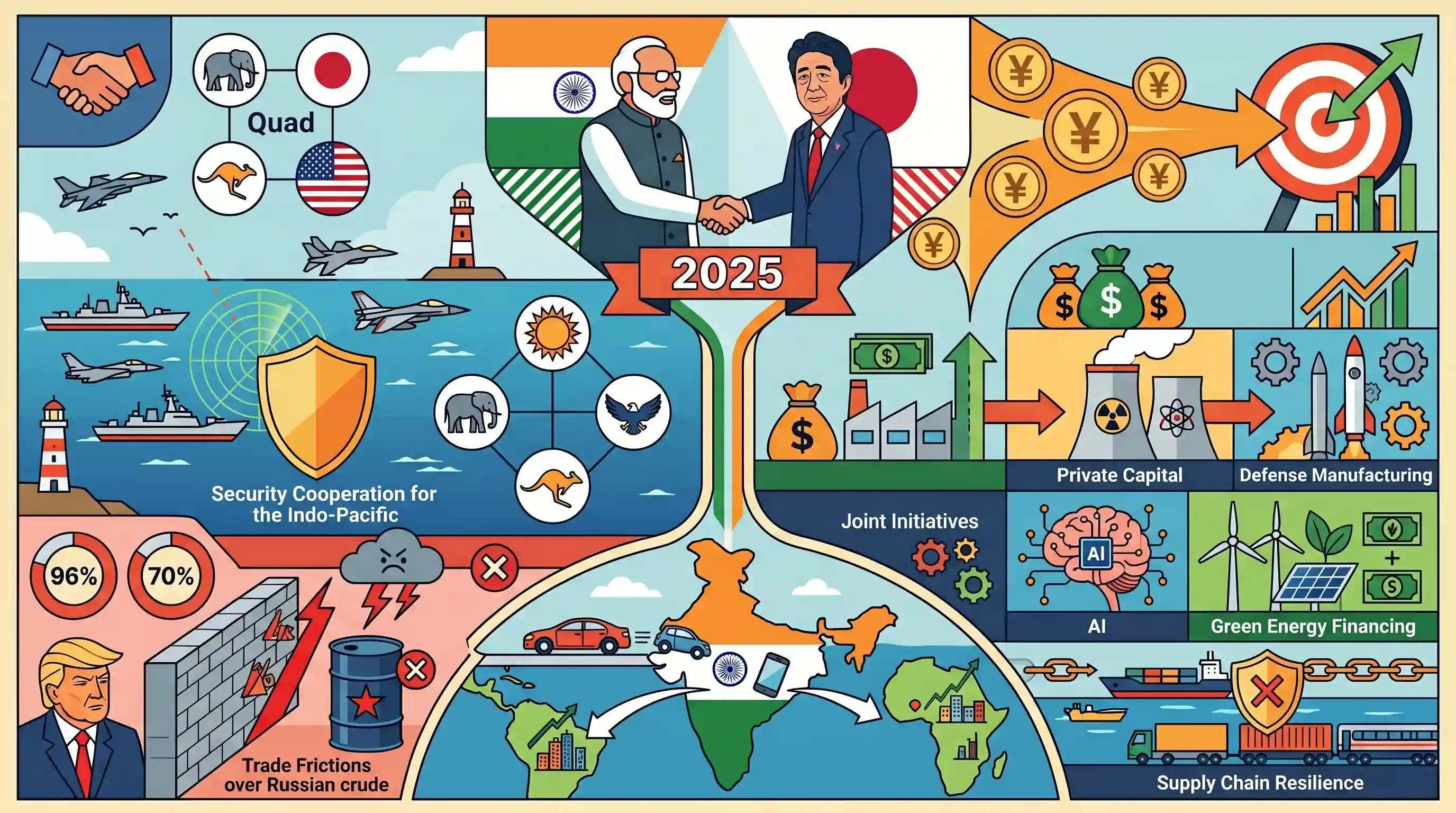
The deepening India-Japan strategic and economic partnership is crucial for India to attract large-scale foreign investment, secure critical supply chains, and balance geopolitical pressures stemming from US trade policies and Indo-Pacific volatility.
Summary
Prime Minister Narendra Modi\'s 2025 visit to Japan resulted in a massive 10 trillion yen private investment target for India and the launch of joint initiatives in artificial intelligence, supply chain resilience, and green energy financing. Amidst recent trade frictions with the US—including 50% tariffs imposed by Donald Trump over Russian crude purchases—India and Japan solidified their strategic partnership by issuing a Joint Declaration on Security Cooperation for the Indo-Pacific. The visit also highlighted India\'s opening of its nuclear and defence sectors to private capital and its positioning as a springboard for Japanese businesses to the Global South.
Key Points
- Japan announced a private investment target of 10 trillion yen for India over the next decade.
- India and Japan launched the India-Japan AI Initiative, the Economic Security Initiative for supply chain resilience, and a joint SME Forum.
- The two countries issued a Joint Declaration on Security Cooperation to promote a free, open, and coercion-free Indo-Pacific region.
- The bilateral meeting occurred against the backdrop of US President Donald Trump imposing 50% penalty tariffs on Indian imports, citing India\'s purchases of Russian crude.
- Agreements included a Joint Credit Mechanism for financing green energy and an action plan to promote a two-way exchange of 5 lakh people.
Important Terms
Joint Declaration on Security Cooperation (2025)

A 2025 bilateral framework updating the 2008 declaration to deepen defense ties, maritime security, cyber defense, and space cooperation in the Indo-Pacific.
UPSC context
GS Paper 2: International Relations; tests knowledge of evolving strategic partnerships and regional security architecture.
Economic Security Initiative
A partnership launched in 2025 to strengthen supply chain resilience and cooperation in critical sectors like semiconductors, pharmaceuticals, and essential minerals.
UPSC context
GS Paper 3: Indian Economy & S&T; tests awareness of global supply chain shifts and critical infrastructure security.
Joint Credit Mechanism (JCM)
A carbon-trading framework under Article 6.2 of the Paris Agreement, allowing Japan to invest in India's low-carbon technologies for carbon credits.
UPSC context
GS Paper 3: Environment; tests understanding of international climate finance and bilateral emissions-reduction mechanisms.
India-Japan AI Initiative
A strategic collaboration aimed at joint research, developing Large Language Models (LLMs), and building a trustworthy AI ecosystem through industry-academia exchange.
UPSC context
GS Paper 3: Science & Technology; tests knowledge of emerging tech diplomacy and bilateral digital development.
Japan Bank for International Cooperation (JBIC)
A Japanese government-owned financial institution that provides major credit and investment for India's infrastructure, green energy, and industrial corridor projects.
UPSC context
GS Paper 3: Economy; tests understanding of foreign institutional investment (FII) and bilateral infrastructure funding.
India-Japan Economic Forum
A premier bilateral business platform co-organized by trade bodies (CII and Keidanren) to facilitate private investment and industrial collaboration between the two nations.
UPSC context
GS Paper 2: International Relations; tests awareness of Track 2 diplomacy and commercial ties in bilateral relations.
Prelims Trap
"The India-Japan Joint Credit Mechanism (JCM) operates under the centralized global carbon market of Article 6.4."
The JCM is a decentralized, bilateral mechanism operating under Article 6.2 (trading ITMOs), not the UN-supervised centralized global market governed by Article 6.4.
Static Concepts Connected
What are the carbon market mechanisms under Article 6 of the Paris Agreement?
- Article 6.2: Allows countries to strike bilateral agreements to trade carbon credits, known as Internationally Transferred Mitigation Outcomes (ITMOs). Example: India-Japan JCM.
- Article 6.4: Establishes a centralized, global carbon market overseen by a UN entity, where emission reduction projects can generate tradeable credits.
- Article 6.8: Focuses on non-market approaches to emission reductions, such as technology transfer, capacity building, and climate finance cooperation.
What are the pillars of India-Japan economic and strategic cooperation?
- CEPA: Signed in 2011, this bilateral free trade agreement eliminates tariffs on over 90% of traded goods between the two nations.
- SCRI: Originally launched by India, Japan, and Australia to reduce reliance on Chinese manufacturing and ensure uninterrupted regional trade.
- Currency Swap Agreement: A $75 billion bilateral swap agreement that provides a critical backstop for India against short-term balance of payment crises.
Cross-Topic Patterns
Strategic Autonomy & Trade Wars
The US imposing 50% tariffs over Russian crude highlights the economic cost of India's multi-alignment. Closer ties with Japan offer crucial capital to offset increasing Western protectionism.
Defence FDI & Indo-Pacific Security
India opening its nuclear and defence sectors to private capital directly synergizes with Japan's Joint Declaration on Security Cooperation, building dual-use supply chains to balance China.
Bilateral Carbon Trading (JCM)
Transitioning from broad pledges to specific mechanisms like the JCM under Article 6.2 illustrates how middle-powers are independently bridging the climate finance and technology transfer gap.

Expect a complex multi-statement Prelims question merging Article 6.2 carbon trading (JCM) with Indo-Pacific supply chain initiatives.
Linked PYQs · 4
Linked PYQs · 4
- 2019MainsGS2
‘The time has come for India and Japan to build a strong contemporary relationship, one involving global and strategic partnership that will have a great significance for Asia and the world as a whole.’ Comment.
- 2024MainsGS2
‘The West is fostering India as an alternative to reduce dependence on China's supply chain and as a strategic ally to counter China's political and economic dominance.’ Explain this statement with examples.
- 2020MainsGS2
What is the significance of Indo-US defence deals over Indo-Russian defence deals? Discuss with reference to stability in the Indo-Pacific region.
- 2016MainsGS3
Justify the need for FDI for the development of the Indian economy. Why there is gap between MOUs signed and actual FDIs? Suggest remedial steps to be taken for increasing actual FDIs in India.
