The Essential Role of Universities in Cultivating Democratic Dissent
Source:Indian Express ↗
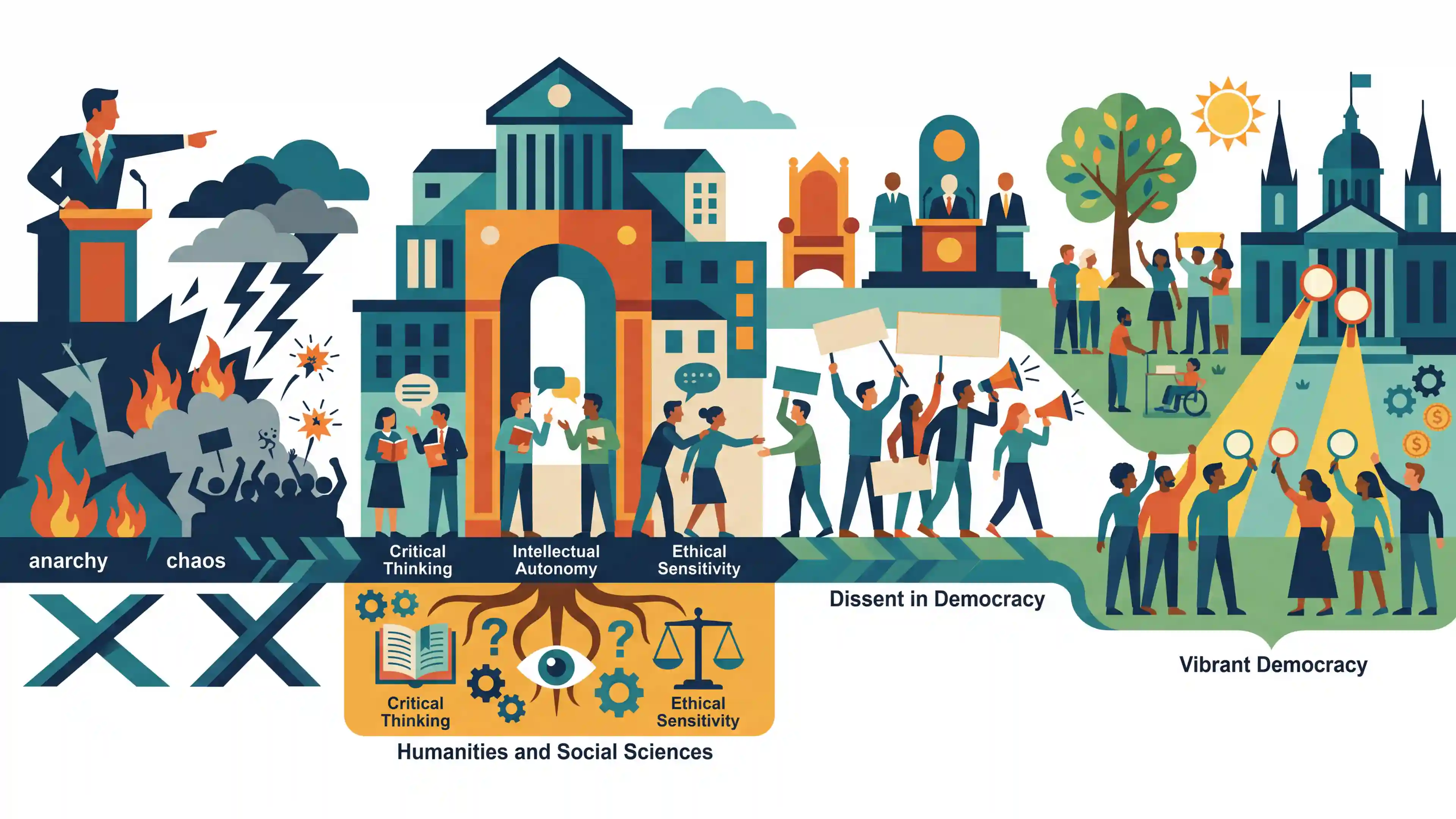
Why It Matters
Provides deep philosophical arguments suitable for Essay and Ethics papers regarding the intrinsic value of humanities, the true purpose of higher education, and the democratic necessity of dissent versus the state's demand for order and conformity.
Summary
A professor from Jadavpur University critiques the Prime Minister's remarks characterizing the institution as a space of 'anarchy' and 'chaos.' The author argues that the true purpose of a university—especially through the humanities and social sciences—is to cultivate critical thinking, intellectual autonomy, and ethical sensitivity. In this view, student dissent and the questioning of the status quo are not signs of disruption but of active, engaged minds participating in a vibrant democracy. The piece emphasizes that higher education must extend beyond mere economic utility to foster citizens capable of holding power accountable.
Key Points
- The author responds to Prime Minister Modi's recent characterization of Jadavpur University as a center of 'anarchy' and 'chaos'.
- Universities are defended as essential spaces for cultivating intellectual autonomy, critical thinking, and the questioning of established power structures.
- Humanities and social sciences are highlighted for their intrinsic value in teaching ethical uncertainty and moral nuance, countering the modern push toward purely utility-driven education.
- Student dissent and protests are framed as necessary democratic 'friction' that prevents societal complacency, rather than as acts of violence or disruption.
- The ultimate purpose of higher education is not to produce compliant subjects but informed citizens capable of holding power accountable and demanding equity.
Important Terms
Jadavpur University

A premier state-funded research university in Kolkata, originating from the 1906 Swadeshi movement. It represents the legacy of nationalist education and remains a significant center for technical and humanities research.
UPSC context
GS Paper 1 (Modern History - Swadeshi Movement) and GS Paper 2 (Education Policy/Institutions).
Right to Dissent
The democratic right to express disagreement with official policies or societal norms. It is considered a 'safety valve' of democracy, essential for accountability and progress.
UPSC context
GS Paper 2 (Polity - Fundamental Rights) and GS Paper 4 (Ethics - Dissent vs. Disobedience).
Intellectual Autonomy
The capacity to think independently and form beliefs based on reason rather than external authorities or social pressures. It is an essential intellectual virtue for objective judgment.
UPSC context
GS Paper 4 (Ethics - Foundational values for civil services; Intellectual virtues).
Freedom of Speech and Expression
A fundamental right under Article 19(1)(a) of the Indian Constitution, allowing citizens to express thoughts through various media, subject to 'reasonable restrictions' under Article 19(2).
UPSC context
GS Paper 2 (Polity - Constitution and Fundamental Rights).
Liberal Education
An educational philosophy that emphasizes broad intellectual development, critical thinking, and the humanities over narrow vocational training, aiming to cultivate well-rounded, socially responsible citizens.
UPSC context
GS Paper 2 (Social Justice - Issues relating to Education) and GS Paper 4 (Values).
Critical Thinking
The disciplined mental process of analyzing and evaluating information to reach a reasoned judgment. It is a core competency for navigating complex administrative and ethical dilemmas.
UPSC context
GS Paper 4 (Aptitude and Foundational Values for Civil Services).
Prelims Trap
The 'Right to Dissent' is an explicitly guaranteed Fundamental Right under Article 19.
The Right to Dissent is an implicit part of freedom of speech and expression under Article 19(1)(a). The word 'dissent' itself is not explicitly written in the Constitution.
Static Concepts Connected
How is the right to dissent protected under the Indian Constitution?
- Article 19(1)(a): Protects freedom of speech and expression, implicitly covering peaceful dissent and critical expression.
- Article 19(1)(b): Guarantees the right to assemble peacefully without arms, forming the constitutional basis for protests.
- Reasonable Restrictions: Dissent is balanced against public order, security, and state sovereignty under Article 19(2) and 19(3).
What is the foundational mandate for university autonomy in independent India?
- Radhakrishnan Commission: The University Education Commission (1948) established the blueprint, prioritizing university autonomy, character building, and democratic values over mere economic utility.
- Democratic Socialization: Universities were envisioned as crucibles to transition individuals from compliant colonial subjects to active, empowered democratic citizens.
- Ethical Nuance: Humanities and social sciences are deemed essential for developing the ethical nuance required to navigate complex administrative dilemmas.
Cross-Topic Patterns
Dissent vs. State Offenses in BNS
The defense of university dissent frequently intersects with the legal boundary between democratic critique and state-endangering acts defined in the Bharatiya Nyaya Sanhita (formerly Sedition).
NEP 2020's Multidisciplinary Vision
The author's plea for the humanities mirrors the National Education Policy 2020 mandate to break STEM-humanities silos, fostering ethical reasoning alongside technical skill.

Expect a GS4 or Essay prompt in 2026 contrasting utility-driven technical education with value-based humanities for ethical governance.
Linked PYQs · 4
Linked PYQs · 4
- 2023MainsEssay
Education is what remains after one has forgotten what one has learned in school.
- 2015MainsEssay
Education without values, as useful as it is, seems rather to make a man more clever devil.
- 2014MainsGS2
What do you understand by the concept "freedom of speech and expression"? Does it cover hate speech also ? Why do the films in India stand on a slightly different plane from other forms of expression ? Discuss.
- 2020MainsGS2
National Education Policy 2020 is in conformity with the Sustainable Development Goal-4 (2030). It intends to restructure and reorient education system in India. Critically examine the statement.
