India West Asia policy and de hyphenation strategy amid Gaza conflict
Source:Indian Express ↗
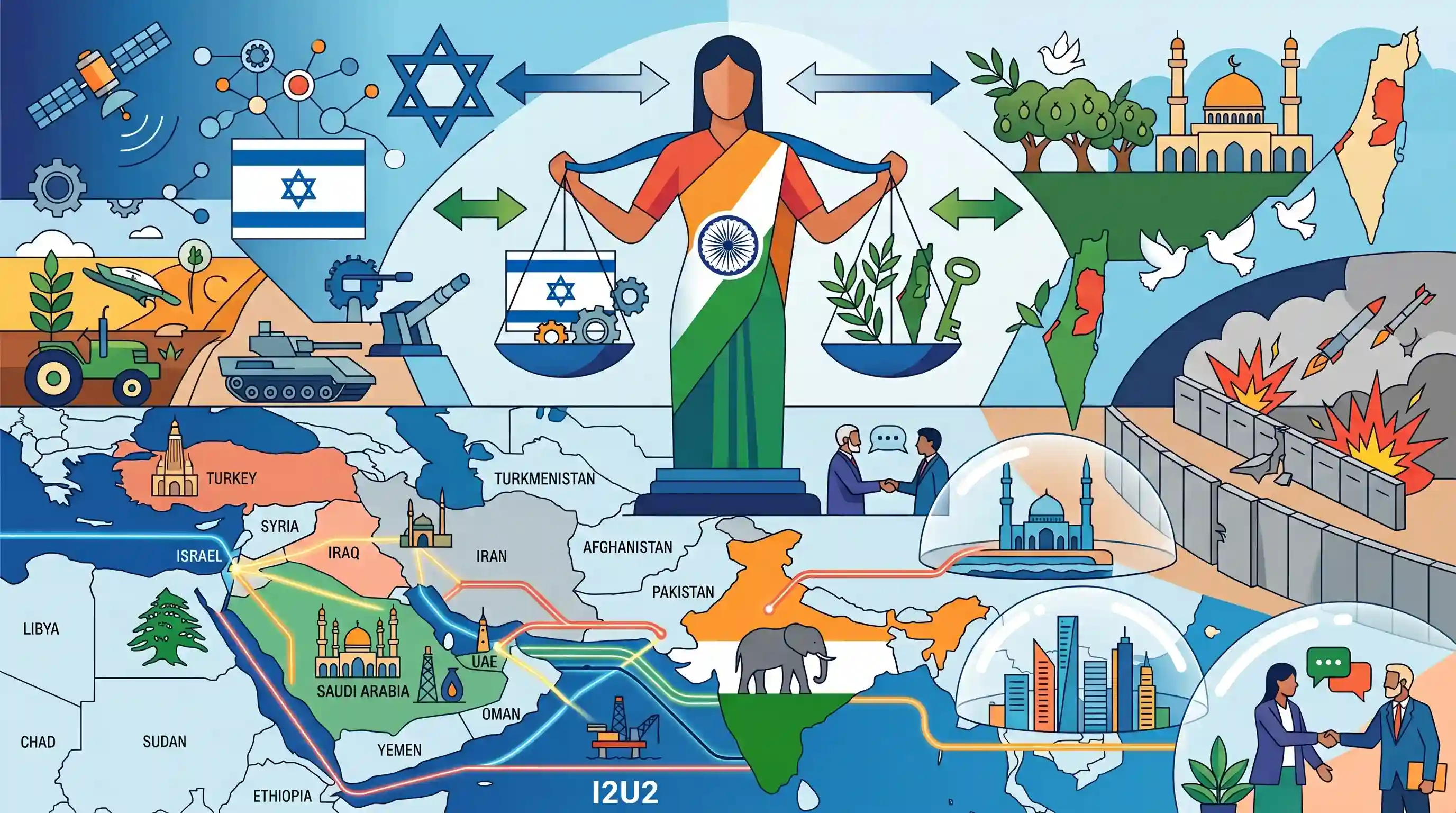
Why It Matters
West Asia is central to India's energy security, diaspora remittances, and mega-connectivity projects (like IMEC). India's ability to maintain strong ties with Israel during the Gaza crisis serves as a textbook example of 'strategic autonomy' and the 'de-hyphenation' policy, which are highly relevant for GS Paper 2 (Bilateral, regional and global groupings and agreements involving India).
Summary
Prime Minister Narendra Modi's visit to Israel amidst the ongoing Gaza conflict highlights India's strategic autonomy and evolving footprint in West Asia. It emphasizes the success of India's 'de-hyphenation' policy, allowing the nation to secure vital defense and technological partnerships with Israel without compromising its historical support for a two-state solution for Palestine. The visit also reflects New Delhi's delicate balancing act to safeguard broader geopolitical connectivity and economic interests—such as the IMEC and I2U2—ensuring relationships with Arab nations remain insulated from the ongoing Israel-Hamas hostilities.
Key Points
- India's 'de-hyphenation' policy enables New Delhi to independently pursue strategic relations with both Israel and Palestine, distinct from each other.
- The timing of PM Modi's visit to Israel underscores India's commitment to vital defense, technology, and economic ties, even amidst the sensitive Gaza conflict.
- India maintains a delicate diplomatic balance to protect its broader regional interests, including frameworks like the I2U2 and the India-Middle East-Europe Economic Corridor (IMEC), while retaining robust ties with Arab partners.
- India advocates for regional stability by simultaneously supporting the counter-terrorism narrative, pushing for an end to hostilities and the release of hostages, and endorsing the long-term two-state solution for Palestine.
Important Terms
IMEC (India-Middle East-Europe Economic Corridor)

A multimodal transport corridor (sea-and-rail) linking India, the Middle East, and Europe. Launched at the 2023 G20 Summit, it aims to boost trade and provide a strategic alternative to China's BRI.
UPSC context
GS-II (International Relations) and GS-III (Economy/Infrastructure). Tests knowledge of global connectivity and India's strategic positioning in West Asia.
I2U2 Grouping
A strategic grouping comprising India, Israel, the UAE, and the USA. Also known as the 'West Asian Quad,' it focuses on joint investments in food security, water, energy, and technology.
UPSC context
GS-II (Bilateral/Global Groupings). Tests understanding of plurilateral alliances and India's evolving 'Link West' diplomacy.
Abraham Accords
A series of 2020 agreements facilitated by the USA to normalize diplomatic relations between Israel and several Arab nations, including the UAE and Bahrain, fundamentally realigning West Asian geopolitics.
UPSC context
GS-II (Effect of Global Policies on India). Tests impact of regional normalization on India’s energy security and diaspora interests.
De-hyphenation Policy
India’s diplomatic shift to treat its relations with Israel and Palestine as independent bilateral tracks, allowing deep strategic cooperation with Israel without abandoning support for the Palestinian cause.
UPSC context
GS-II (Indian Foreign Policy). Tests ability to analyze strategic autonomy and the transition from ideological to pragmatic diplomacy.
Two-State Solution
A proposed diplomatic framework for resolving the Israel-Palestine conflict by establishing an independent State of Palestine alongside the State of Israel, based on pre-1967 borders.
UPSC context
GS-II (International Relations). Tests knowledge of historical territorial disputes and India's consistent official stance on West Asian peace.
Hamas
A Palestinian Islamist political and militant organization that governs the Gaza Strip. It is central to the ongoing conflict with Israel and is classified as a terrorist group by several nations.
UPSC context
GS-II (International Relations/Security). Tests understanding of non-state actors in geopolitics and their impact on India’s regional economic corridors.
Prelims Trap
India's de-hyphenation policy signifies the total abandonment of its historical support for the Palestinian Two-State Solution.
De-hyphenation means treating relations with Israel and Palestine independently on their own merits. India has not abandoned its historic backing for an independent, sovereign Palestinian state.
Static Concepts Connected
What is India's 'De-hyphenation' policy regarding Israel and Palestine?
- Independent Tracks: Pursuing bilateral relations with two opposing entities independently, ensuring ties with one do not dictate or constrain ties with the other.
- Structural Shift: Moving past historical constraints where India's engagement with Israel was strictly viewed through the lens of the Palestinian conflict and Arab sensitivities.
- Strategic Pragmatism: Enables India to maximize defense and technological gains with Israel while simultaneously maintaining diplomatic support and developmental aid for Palestine.
What is the I2U2 grouping and its primary mandate?
- Member Nations: Comprises India, Israel, UAE, and the USA; effectively conceptualized following the normalization of Arab-Israeli relations via the Abraham Accords.
- Economic Focus: Unlike traditional security alliances, it operates as an economic minilateral targeting joint investments in six areas: water, energy, transport, space, health, and food security.
- Resource Synergy: Synergizes the distinct strengths of its members: Israeli/American technological innovation, Emirati financial capital, and India's vast market and human resources.
Cross-Topic Patterns
Abraham Accords fueling economic minilaterals
The 2020 Arab-Israeli normalization treaties acted as the diplomatic precursor allowing India to merge its bilateral ties with the UAE and Israel into joint geopolitical economic frameworks like the I2U2 and IMEC.
Strategic balancing in 'Look West' policy
India's Middle East engagement mirrors its broader multi-alignment strategy—securing energy and diaspora interests with Arab nations while deepening defense-tech ties with Israel, akin to its delicate US-Russia balancing act.

IMEC geography + I2U2 mandates + India's de-hyphenation policy will likely form a complex, multi-statement IR question in the 2026 exam.
Linked PYQs · 4
Linked PYQs · 4
- 2018MainsGS2
“India’s relations with Israel have, of late, acquired a depth and diversity, which cannot be rolled back.” Discuss.
- 2023PrelimsGS1
Consider the following statements: Statement-I: Israel has established diplomatic relations with some Arab States. Statement-II: The 'Arab Peace Initiative' mediated by Saudi Arabia was signed by Israel and Arab League. Which one of the following is correct in respect of the above statements?
- 2022MainsGS2
How will I2U2 (India, Israel, UAE and USA) grouping transform India's position in global politics?
- 2025MainsGS2
"Energy security constitutes the dominant kingpin of India's foreign policy, and is linked with India's overarching influence in Middle Eastern countries.” How would you integrate energy security with India's foreign policy trajectories in the coming years?
