PM Modi Outlines Trade and Economic Growth Strategy
Source:The Hindu ↗
Why It Matters
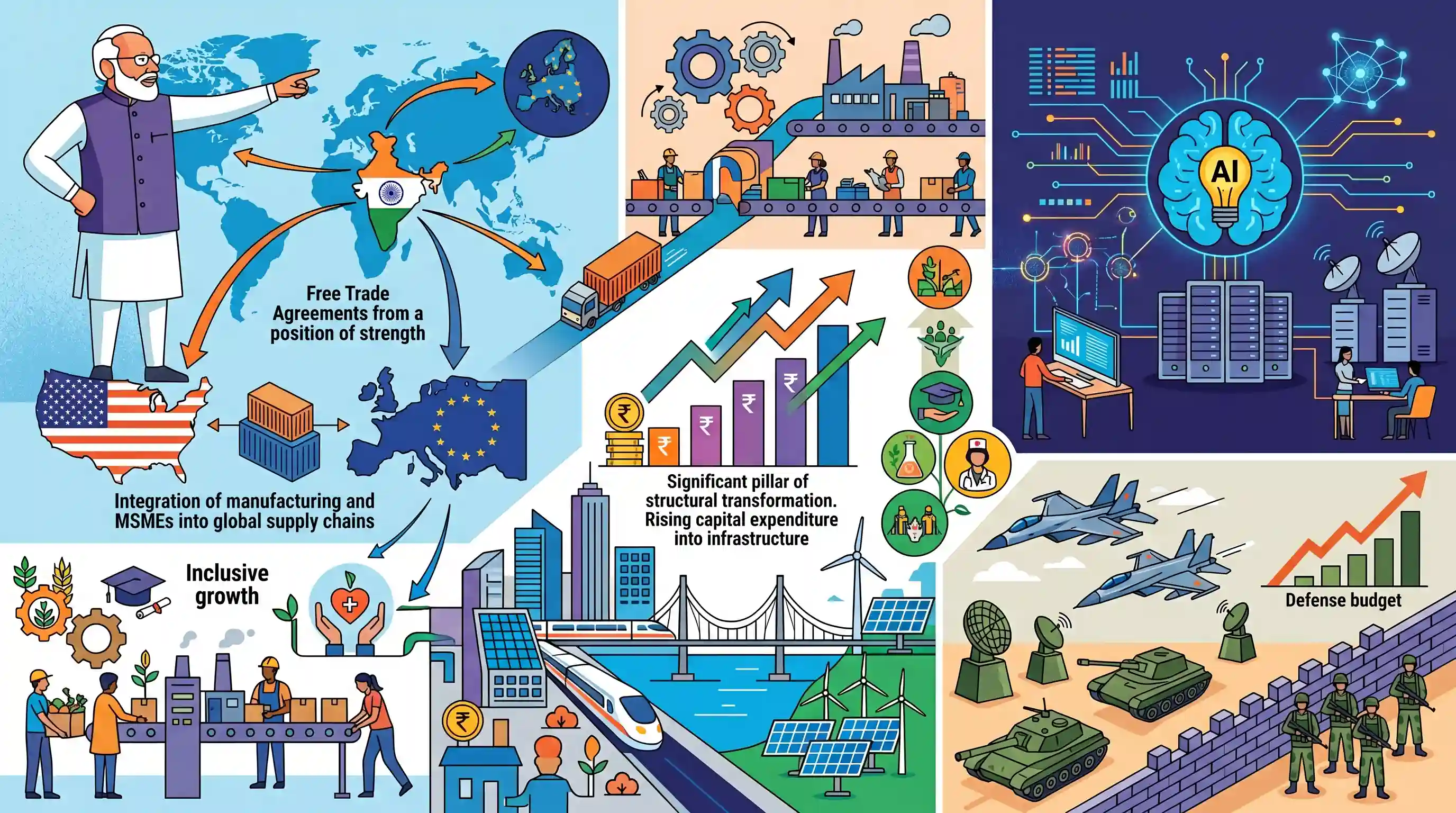
The article provides a comprehensive overview of the executive vision across multiple crucial GS-3 domains: trade policy shift, emphasis on capital expenditure, AI infrastructure push, and defense modernization imperatives following cross-border operations. This ties together economic reform and national security goals.
Summary
In an interview with PTI, Prime Minister Narendra Modi outlined the underlying strategies of the government's economic, technological, and defense policies. He emphasized that recent Free Trade Agreements with the US and EU were negotiated from a position of strength, aiming to integrate Indian manufacturing and MSMEs into global supply chains. Reflecting a broader developmental vision, the 2026-2027 Union Budget focuses on structural transformations, infrastructure capital expenditure, and fostering technological investments, particularly in Artificial Intelligence, to make India a hub for data infrastructure. Additionally, the PM underscored the importance of continuous defense modernization, citing the recent 15% budget hike following 'Operation Sindoor' along the Pakistan border.
Key Points
- Prime Minister Narendra Modi asserted that India negotiated recent trade deals with the US and EU from a position of economic strength, contrasting this with past governments' defensive postures.
- The government's trade strategy focuses on reducing non-tariff barriers and integrating Indian MSMEs into global value chains through the 'Zero Defect, Zero Effect' quality initiative.
- The Union Budget 2026-2027 represents a systemic shift prioritizing structural reforms, significant capital expenditure boosts, and innovation over incremental changes.
- A record defense allocation of ₹7.85 lakh crore (a 15% increase) was made, reflecting the necessity of continuous military modernization highlighted by recent experiences during 'Operation Sindoor' against Pakistan.
- The Budget introduced tax incentives to reduce the cost of establishing advanced AI facilities, aiming to position India competitively in data infrastructure ahead of the global AI Summit in New Delhi.
Important Terms
Free Trade Agreements (FTAs)

Pacts between two or more nations to reduce barriers to imports and exports. Recent focus includes the 2026 India-EU 'mother of all deals' and US interim trade frameworks.
UPSC context
GS Paper 2/3: International Relations and Economy. Tests knowledge of trade diplomacy, 'position of strength' negotiations, and global supply chain integration.
MSMEs
Small-scale industrial units categorized by investment and turnover. Recent government policy aims to integrate these enterprises into global markets via specific FTA provisions and the SME Growth Fund.
UPSC context
GS Paper 3: Indian Economy. Key to inclusive growth, employment, and the 'Make in India' initiative.
Operation Sindoor
A 2025 limited military action by India targeting terror infrastructure in Pakistan and PoJK. It involved precision missile strikes and drone warfare, influencing a 15% hike in the 2026-27 defense budget.
UPSC context
GS Paper 3: Internal Security and Defence. Tests awareness of cross-border counter-terror operations, 'Atmanirbhar Bharat' in defense, and border management.
Union Budget 2026-2027
The fiscal roadmap for 2026-27 focusing on 'Viksit Bharat,' structural reforms, AI (Bharat-VISTAAR), and a record ₹12.2 lakh crore public capital expenditure for infrastructure development.
UPSC context
GS Paper 3: Government Budgeting. Essential for understanding fiscal policy, capital expenditure (CAPEX), and national development priorities.
Zero Defect Zero Effect (ZED)
A certification scheme encouraging MSMEs to manufacture high-quality products (Zero Defect) with minimal environmental impact (Zero Effect), aiming to boost global competitiveness and sustainable manufacturing.
UPSC context
GS Paper 3: Manufacturing Sector/Environment. Relevant for 'Make in India' and achieving ESG standards in global trade.
Prelims Trap
The 'Zero Defect, Zero Effect' (ZED) scheme is an environmental sustainability initiative launched by the Ministry of Environment, Forest and Climate Change.
The ZED initiative is actually driven by the Ministry of MSME, targeting manufacturing quality and global supply chain integration, not the Environment Ministry.
Static Concepts Connected
What differentiates a Free Trade Agreement (FTA) from a CEPA or CECA?
- Free Trade Agreement: Focuses primarily on eliminating or reducing customs duties on a negative list of traded goods between partner countries.
- CEPA/CECA: Much broader than FTAs; they encompass trade in services, investments, competition, intellectual property rights, and regulatory harmonization.
Why does the Union Budget prioritize Capital Expenditure (CapEx) over Revenue Expenditure?
- Asset Creation: CapEx creates physical or financial assets (infrastructure, tech hubs) or reduces government liabilities, unlike Revenue Expenditure which funds day-to-day operations.
- Macroeconomic Multiplier: Infrastructure spending crowds-in private investment, yielding a significantly higher GDP multiplier (around 2.5-3.0) compared to revenue subsidies (below 1.0).
Cross-Topic Patterns
AI Infrastructure + DPI Model
Tax incentives for AI data centers extend India's Digital Public Infrastructure (DPI) strategy, bridging fiscal policy (tax breaks) with emerging tech sovereignty and data localization.
MSMEs + Global Value Chains (GVCs)
Trade agreements are now leveraging the MSME ZED certification to bypass modern non-tariff barriers (NTBs) imposed by developed nations under environmental or quality pretexts.

The MSME 'ZED' scheme and its role in bypassing non-tariff barriers in FTAs will likely form a multi-statement question in 2026.
Linked PYQs · 5
Linked PYQs · 5
- 2023MainsGS3
Faster economic growth requires increased share of the manufacturing sector in GDP, particularly of MSMEs. Comment on the present policies of the Government in this regard.
- 2017MainsGS3
Account for the failure of manufacturing sector in achieving the goal of labour-intensive exports. Suggest measures for more labour-intensive rather than capital-intensive exports.
- 2023MainsGS3
Introduce the concept of Artificial Intelligence (AI). How does Al help clinical diagnosis? Do you perceive any threat to privacy of the individual in the use of Al in healthcare?
- 2021MainsGS3
Distinguish between Capital Budget and Revenue Budget. Explain the components of both these Budgets.
- 2019MainsGS3
The public expenditure management is a challenge to the Government of India in the context of budget making during the post-liberalization period. Clarify it.
