Group Captain Shubhanshu Shukla interacts with PM Modi from ISS
Source:The Hindu ↗
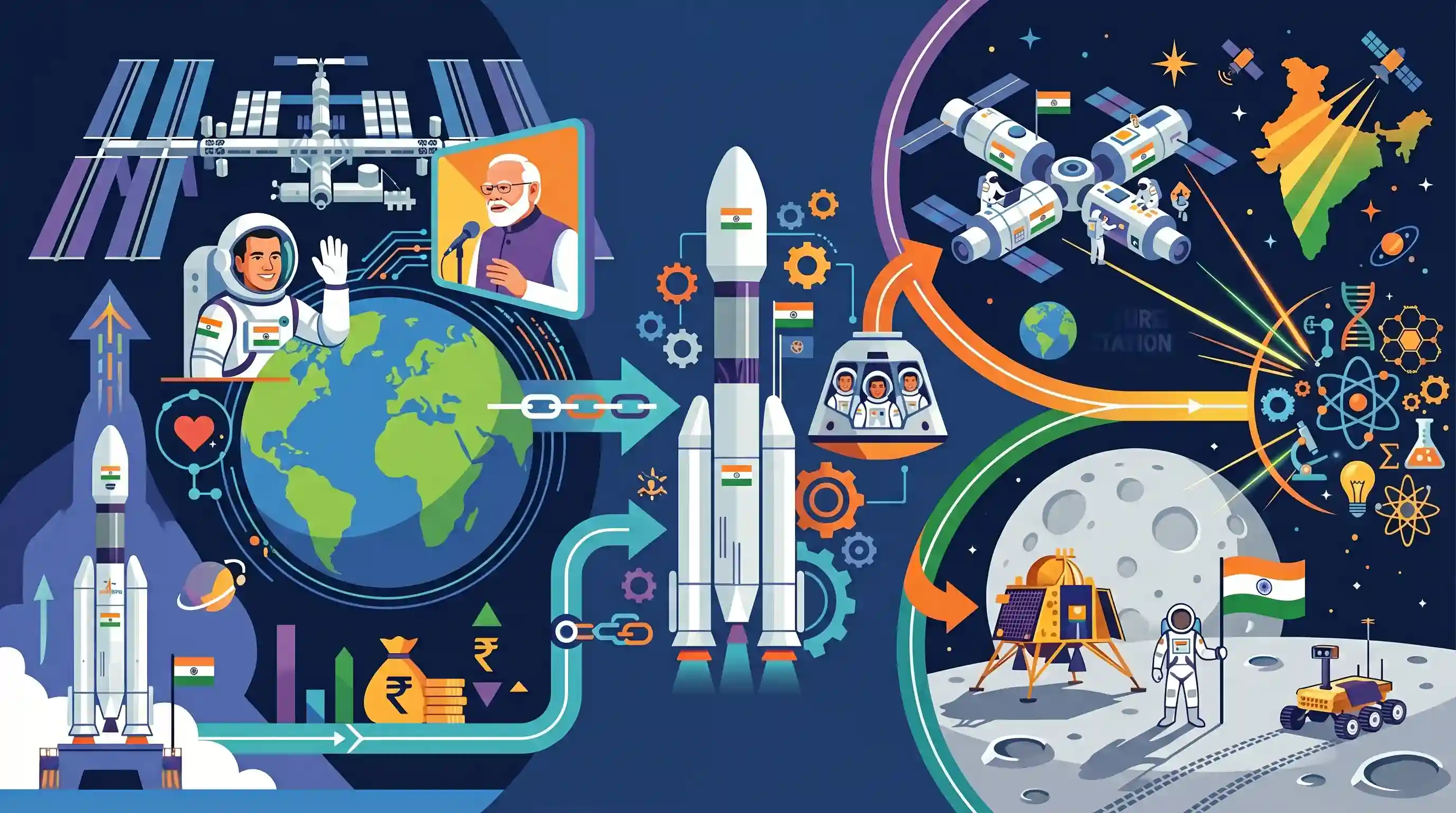
Why It Matters
Highlights a significant milestone in India's space exploration journey. It demonstrates the strategic shift towards public-private and international collaborations in space (Axiom Space) and serves as a critical stepping stone for India's upcoming human spaceflight (Mission Gaganyaan) and broader long-term space goals like the Bharatiya Antariksha Station.
Summary
Group Captain Shubhanshu Shukla, the first Indian on the International Space Station (ISS), interacted with PM Narendra Modi via video link. Shukla, part of the commercial Axiom 4 mission, highlighted his experience of a "borderless" Earth from space. The mission, for which India paid ₹548 crore, serves as a crucial precursor to India's indigenous human spaceflight project, Mission Gaganyaan, scheduled for 2027. PM Modi reiterated India's long-term space ambitions, including building an indigenous space station and landing an Indian astronaut on the Moon. Shukla's participation lays the groundwork and provides essential hands-on experience for future ISRO manned missions.
Key Points
- Group Captain Shubhanshu Shukla became the first Indian aboard the International Space Station (ISS) as part of the commercial Axiom 4 mission.
- India invested ₹548 crore in the Axiom 4 mission to gain hands-on spaceflight experience for its upcoming indigenous manned mission.
- The mission serves as a critical precursor to ISRO\'s Mission Gaganyaan, which is scheduled for launch in 2027.
- PM Narendra Modi reiterated India\'s ambitious long-term space goals, including establishing an Indian space station and landing an Indian astronaut on the Moon.
Important Terms
Mission Gaganyaan

ISRO's maiden human spaceflight mission aiming to send a three-member crew to a 400 km orbit for three days and bring them back safely to Earth.
UPSC context
GS-III: Space Technology. Tests understanding of indigenization of technology and India's position in the global space race.
Axiom-4 (Ax-4) Mission
A commercial space mission to the ISS (2025) involving Indian astronaut Shubhanshu Shukla, serving as a critical training precursor for ISRO's independent human spaceflight goals.
UPSC context
GS-III: International Relations/Space Cooperation. Tests significance of Indo-US space diplomacy and private-sector collaboration in space.
Bharatiya Antariksh Station (BAS)
India's planned indigenous modular space station, with the first module (BAS-1) slated for 2028 and full operational capability targeted for 2035.
UPSC context
GS-III: Space Infrastructure. Tests knowledge of long-term strategic scientific goals and microgravity research capabilities.
Low Earth Orbit (LEO)
The altitude range (160–2,000 km) where most Earth-observing satellites, the International Space Station, and the upcoming Gaganyaan mission are positioned.
UPSC context
GS-III: Science & Tech. Fundamental concept regarding satellite placement, space debris management, and human spaceflight logistics.
Vyommitra
An AI-enabled 'half-humanoid' female robot developed by ISRO to simulate human functions and monitor module parameters during uncrewed Gaganyaan test flights.
UPSC context
GS-III: Robotics/Space. Tests knowledge of mission safety protocols and technological innovations in robotics.
ISRO (Indian Space Research Organisation)
India’s national space agency responsible for planetary exploration, satellite operations, and the development of indigenous launch vehicles and human spaceflight programs.
UPSC context
GS-III: Scientific Institutions. Core body for all Indian space-related current affairs and technological achievements.
Prelims Trap
"Shubhanshu Shukla is the first Indian citizen to travel into space."
Rakesh Sharma was the first Indian in space (1984, Soviet Salyut 7). Shubhanshu Shukla is the first Indian to visit the International Space Station (ISS).
Static Concepts Connected
What characterizes Low Earth Orbit (LEO) where the ISS and Gaganyaan operate?
- Altitude range: Typically operates between 160 km and 1,000 km above Earth, offering low signal latency and easier access for crewed missions.
- Orbital period: Satellites and spacecraft travel at high speeds, taking roughly 90 to 120 minutes to complete a full revolution around the Earth.
- Microgravity environment: Spacecraft remain in continuous free-fall, creating a weightless (microgravity) environment critical for scientific and biological experiments.
What are the core technological components of ISRO's upcoming Mission Gaganyaan?
- Launch Vehicle: Utilizes the Human Rated LVM3 (HLVM3), a heavily modified version of the GSLV Mk III designed for maximum reliability and crew safety.
- Orbital Module: Consists of two parts: a pressurized Crew Module (housing the astronauts) and an unpressurized Service Module (providing power and propulsion).
- Crew Escape System: An autonomous, quick-acting abort system designed to safely eject and distance the crew module from the rocket in case of a launch emergency.
Cross-Topic Patterns
Commercial Spaceflight + India's Space Reforms
Axiom-4 is a private mission, reflecting a global shift toward commercial spaceflight. This parallels India's domestic space reforms (IN-SPACe, NSIL) that free ISRO to focus on strategic R&D like Gaganyaan.
ISS Retirement + Multipolar Space Stations
With the ISS slated for retirement around 2030, ISRO's goal of establishing the Bharatiya Antariksha Station by 2035 is strategically timed to ensure Indian presence in a multipolar space domain alongside China's Tiangong.

Expect a chronological-matching question in Prelims 2026: Gaganyaan (2027), Bharatiya Antariksha Station (2035), and Moon landing (2040).
Linked PYQs · 3
Linked PYQs · 3
- 2025PrelimsGS1
Consider the following space missions : I. Axiom-4 II. SpaDeX III. Gaganyaan How many of the space missions given above encourage and support micro-gravity research?
- 2017MainsGS3
India has achieved remarkable successes in unmanned space missions including the Chandrayaan and Mars Orbitter Mission, but has not ventured into manned space missions. What are the main obstacles to launching a manned space mission, both in terms of technology and logistics? Examine critically.
- 2023MainsGS3
What is the main task of India's third moon mission which could not be achieved in its earlier mission? List the countries that have achieved this task. Introduce the subsystems in the spacecraft launched and explain the role of the Virtual Launch Control Centre' at the Vikram Sarabhai Space Centre which contributed to the successful launch from Sriharikota.
