Prambanan Temple Restoration and Archaeological Diplomacy
Source:Indian Express ↗
Why It Matters
This development represents a high-profile convergence of bilateral relations, heritage preservation, and the application of cutting-edge technology in archaeology. For UPSC, it serves as an excellent case study of India's soft power diplomacy (Act East Policy / Project Mausam) and the architectural linkages between ancient Indian temple styles and those of Southeast Asian dynasties like the Mataram Kingdom.
Summary
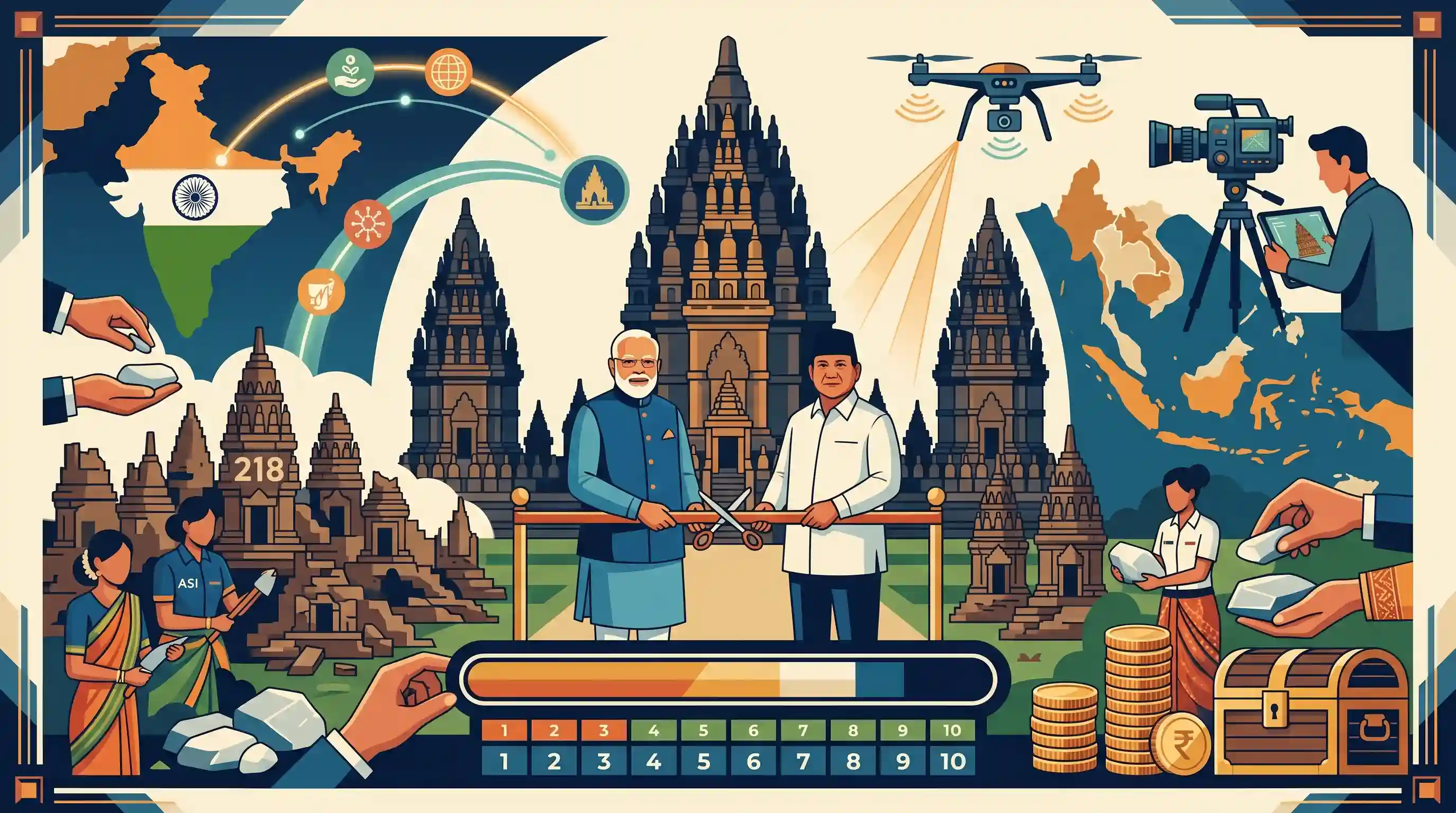
Prime Minister Narendra Modi and Indonesian President Prabowo Subianto visited the 9th-century Prambanan Temple complex in Yogyakarta, Indonesia, where they joint-launched a landmark 10-year heritage restoration project. Funded with Rs 65 crore, the conservation initiative will be carried out by the Archaeological Survey of India (ASI) to restore 218 ruined 'Pervara' (subsidiary) temples. The project highlights India's ongoing soft power outreach and cultural diplomacy in Southeast Asia, deploying high-tech solutions like LiDAR and photogrammetry for archaeological restoration.
Key Points
- PM Modi and Indonesian President Prabowo Subianto launched a 10-year joint conservation project (2026-2036) with an outlay of Rs 65 crore to restore the 9th-century Prambanan Temple compound in Yogyakarta, Indonesia.
- The Prambanan Temple Compound, inscribed as a UNESCO World Heritage Site in 1991, is the largest Hindu temple site in Indonesia and is dedicated to the Trimurti (Shiva, Vishnu, and Brahma).
- The project, led by the Archaeological Survey of India (ASI) in collaboration with the Indonesian Heritage Agency, aims to restore the 218 ruined 'Pervara' (subsidiary/guardian) temples of the 224 total arranged in concentric rows.
- Advanced tech tools, including LiDAR (Light Detection and Ranging) sensors, photogrammetry, and geotechnical and hydrological monitoring, will be deployed for scanning and rebuilding the structures.
- India has a long historical precedent of using heritage conservation as a tool for cultural diplomacy in Southeast Asia, with past projects at Borobudur (Indonesia), Angkor Wat and Ta Prohm (Cambodia), Vat Phou (Laos), My Son (Vietnam), and Thiruketeeswaram (Sri Lanka).
Important Terms
Act East Policy

India's diplomatic initiative launched in 2014 to strengthen economic, strategic, and cultural relations with Southeast and East Asia, upgrading the earlier Look East Policy.
UPSC context
GS Paper II (Bilateral & Regional Groupings), testing India’s strategic, economic, and maritime engagement with ASEAN and East Asian nations.
Project Mausam
An initiative launched by India's Ministry of Culture in 2014 to explore, document, and rebuild ancient maritime cultural linkages and trade routes across 39 Indian Ocean littoral countries.
UPSC context
GS Paper I (Art & Culture) & GS Paper II (International Relations), testing soft power projection and trans-national heritage conservation.
Archaeological Survey of India (ASI)
An Indian government agency under the Ministry of Culture, responsible for archaeological research, excavation, and the scientific preservation of historical monuments in India and abroad.
UPSC context
GS Paper I (Indian Heritage), testing institutional frameworks for heritage conservation, archaeological studies, and international cultural partnerships.
Indonesian Heritage Agency (IHA)
A public service agency under Indonesia's government established in 2023 to manage, revitalize, and preserve national cultural heritage sites, museums, and galleries across the archipelago.
UPSC context
GS Paper II (Bilateral Relations), testing cooperative frameworks and institutional counterparts for international heritage preservation projects.
UNESCO
A specialized agency of the United Nations that coordinates international cooperation in education, science, and culture, notably managing the World Heritage Site designation system.
UPSC context
GS Paper II (International Institutions), testing multilateral bodies, global heritage governance, and collaborative conservation treaties.
Ministry of Culture (India)
The Indian government ministry responsible for preserving, promoting, and documenting India’s art, culture, and heritage, while overseeing organizations like the Archaeological Survey of India.
UPSC context
GS Paper I (Indian Culture), testing administrative agencies executing national policies on monument preservation and global cultural diplomacy.
Prelims Trap
Prambanan, the largest Hindu temple complex in Indonesia, was built by the Buddhist Shailendra Dynasty.
Prambanan was constructed by the Hindu Sanjaya Dynasty of the Mataram Kingdom. Borobudur, the nearby Buddhist complex, was built by the Shailendra Dynasty.
Static Concepts Connected
What is Anastylosis in archaeological restoration?
- Core Principle: Reassembling ruined structures using original architectural fragments on their exact original foundations.
- Modern Intervention: New materials are introduced only for structural safety and must be clearly distinguishable from ancient stones.
- Global Application: Extensively used by the ASI at international sites like Angkor Wat (Cambodia) and Prambanan (Indonesia).
How did South Indian styles influence Southeast Asian temple architecture?
- Shikharas and Layout: Tall, pointed shikharas and concentric mandala layouts mirror the Pallava and Dravidian vimana designs.
- Construction Technique: Use of dry-stone interlocking masonry without mortar, adapting local volcanic/andesite stone instead of granite.
- Narrative Reliefs: Intricate bas-reliefs on exterior walls depicting the Ramayana and Bhagavata Purana, blending Indian epics with local Javanese styles.
Cross-Topic Patterns
Cultural Diplomacy + Act East
ASI's heritage restoration projects act as non-coercive soft power tools under the 'Act East' policy, reinforcing historical civilizational linkages to counter rival geopolitical influences in ASEAN.
Trade Guilds + Cultural Transmission
Ancient maritime trade guilds (like Manigramam) facilitated the transmission of Indian religious architecture, Sanskrit, and epics to the Mataram and Khmer empires.

UPSC may link ASI's overseas heritage projects (e.g., Prambanan, Vat Phou) to regional dynasties and architectural styles in a 2026 MCQ.
Linked PYQs · 3
Linked PYQs · 3
- 2015MainsGS2
Project 'Mausam' is considered a unique foreign policy initiative of the Indian Government to improve relationship with its neighbours. Does the project have a strategic dimension? Discuss.
- 2004PrelimsGS1
The Archaeological Survey of India is an attached office of the Department / Ministry of:
- 2024PrelimsGS1
Consider the following properties included in the World Heritage List released by UNESCO: 1. Shantiniketan 2. Rani-ki-Vav 3. Sacred Ensembles of the Hoysalas 4. Mahabodhi Temple Complex at Bodhgaya How many of the above properties were included in 2023 ?
