Bilateral relations and Indo Pacific maritime strategy cooperation
Source:The Hindu ↗
Why It Matters
The visit highlights India's ongoing strategic transition from passive regional balance to active maritime and diplomatic leadership in the Indo-Pacific. Combining economic, defense, and maritime objectives (via the MAHASAGAR initiative) with rich civilizational soft power diplomacy, the tour cements ties with vital ASEAN and Oceanian partners.
Summary
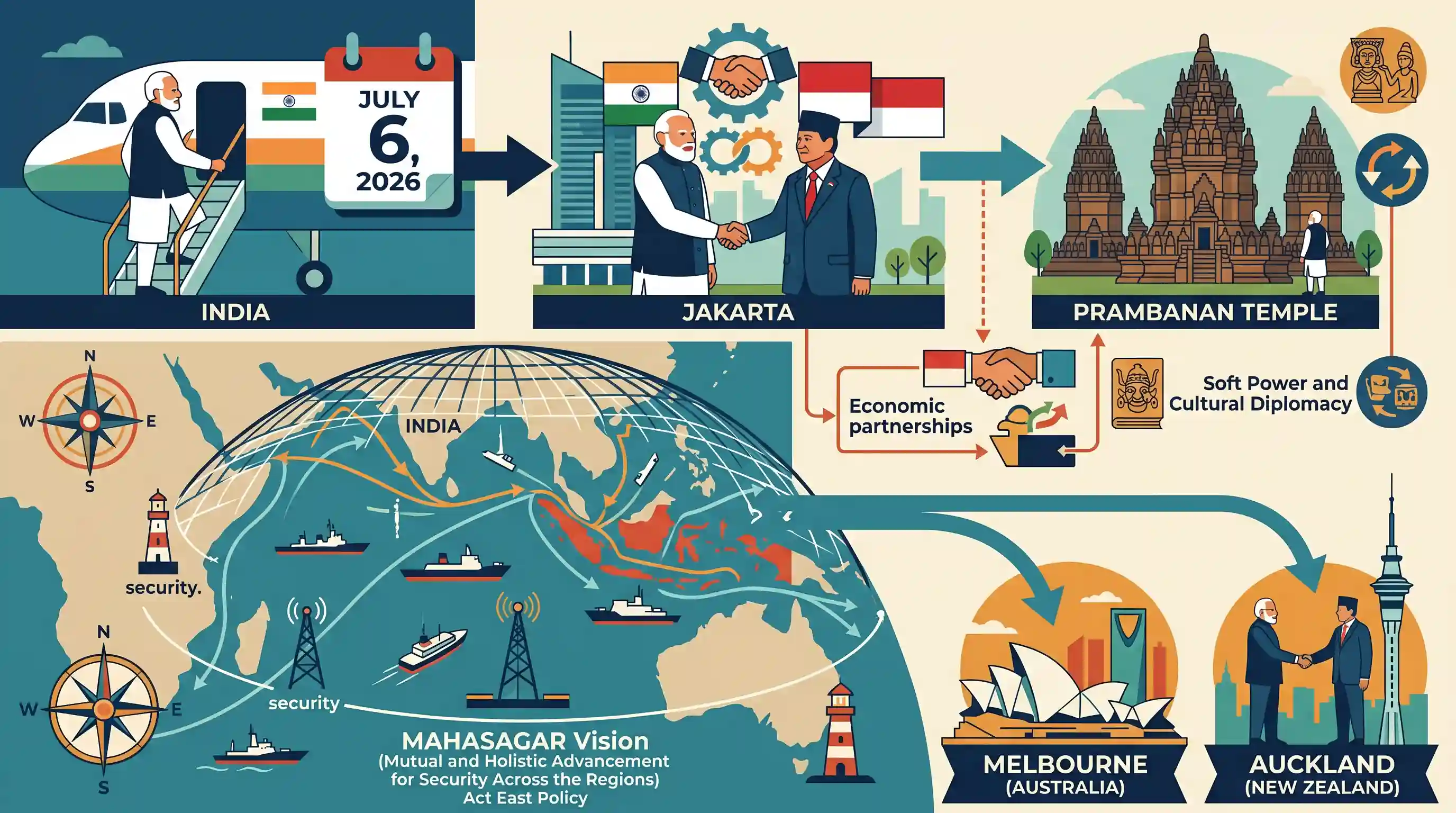
Prime Minister Narendra Modi launched a crucial three-nation tour starting in Indonesia on July 6, 2026, aimed at strengthening the Act East Policy, the MAHASAGAR Vision (Mutual and Holistic Advancement for Security Across the Regions), and India's Indo-Pacific commitment. In Jakarta, PM Modi met with President Prabowo Subianto, marking the first bilateral visit to Indonesia since the 2018 elevation of ties to a Comprehensive Strategic Partnership. The visit highlights deep civilizational links through a scheduled trip to the Prambanan Temple in Yogyakarta and sets the stage for upcoming visits to Melbourne (Australia) and Auckland (New Zealand) to deepen partnerships in the Southern Hemisphere.
Key Points
- Prime Minister Narendra Modi commenced a three-nation tour of Indonesia, Australia, and New Zealand on July 6, 2026, to strengthen India's Act East Policy, MAHASAGAR Vision, and commitment to a free, open, and inclusive Indo-Pacific.
- This marks PM Modi's first bilateral visit to Indonesia since ties were elevated to a Comprehensive Strategic Partnership in 2018, following Indonesian President Prabowo Subianto's visit to India as the Republic Day Chief Guest in January 2025.
- The MAHASAGAR Vision, standing for 'Mutual and Holistic Advancement for Security Across the Regions', represents India's collaborative framework for security and inclusive development across the maritime regions.
- Cultural soft power is highlighted by a joint visit of both leaders to the centuries-old Prambanan Temple complex in Yogyakarta, which is the largest Hindu temple in Indonesia, showcasing centuries-old civilizational linkages.
- Following Jakarta, PM Modi will visit Melbourne, Australia, at the invitation of Prime Minister Anthony Albanese, and Auckland, New Zealand, at the invitation of Prime Minister Christopher Luxon, boosting India's engagement with key Oceanian nations.
Important Terms
Act East Policy

A diplomatic initiative launched in 2014 to proactively strengthen economic, strategic, connectivity, and cultural ties with Southeast Asia and the wider Indo-Pacific, upgrading the 1991 Look East Policy.
UPSC context
GS Paper II: International Relations; tests knowledge of foreign policy evolution and Indo-Pacific engagements.
MAHASAGAR Vision
A global maritime doctrine announced in 2025 that elevates the 2015 regional SAGAR framework to focus on comprehensive global maritime partnerships, security, and economic collaboration across the Global South.
UPSC context
GS Paper II: Bilateral and Global Groupings; tests India's maritime strategy and Global South leadership.
Comprehensive Strategic Partnership (2018)
The upgraded diplomatic status established between India and Indonesia in May 2018 to significantly expand bilateral cooperation in maritime security, defence, trade, and cultural connectivity.
UPSC context
GS Paper II: Bilateral Relations; tests strategic dynamics between India and key Southeast Asian partners.
Prelims Trap
The Prambanan Temple complex was constructed by the Chola Dynasty to spread Shaivism across the Indonesian archipelago.
Prambanan is a 9th-century Hindu temple built by the Sanjaya Dynasty. Aspirants often confuse its patronage with the Cholas (due to South Indian architectural influences) or confuse it with the Buddhist Borobudur built by the Shailendras.
Static Concepts Connected
What are the architectural and historical features of the Prambanan Temple?
- Dynastic Patronage: Built in the 9th century CE by the Sanjaya Dynasty of Central Java, symbolizing a Hindu ruling class revival in a predominantly Buddhist-ruled region.
- Deity Dedication: Dedicated to the Trimurti (Shiva, Vishnu, Brahma), with the largest central 47-meter spire dedicated exclusively to Shiva the Destroyer.
- Architectural Synthesis: Combines local classical Javanese features with South Indian Pallava-style elements, visible in its stepped spires and narrative Ramayana relief carvings.
- Restoration Technique: Restored using 'anastylosis', an archaeological method of rebuilding ruined monuments using original fallen parts combined with minimal new materials.
What is the strategic significance of Sabang Port and Andaman-Aceh connectivity?
- Geographic Proximity: Sabang (Aceh, Indonesia) lies just 90 nautical miles from India's Indira Point, positioning it at the western gateway of the vital Malacca Strait.
- Chokepoint Security: Allows India to monitor and secure critical maritime sea lanes of communication (SLOCs) carrying over 60% of India's trade.
- Joint Port Development: Formalized under the 2018 'Shared Vision' to build deep-water port infrastructure, establishing India's strategic footprint outside its immediate maritime boundary.
Cross-Topic Patterns
Temple Diplomacy as Foreign Policy
Using heritage restoration (like Prambanan and Angkor Wat) as strategic soft power allows India to project non-transactional, civilizational depth in ASEAN, countering purely economic regional alignments.
Island Geopolitics and Chokepoint Security
Connecting the Andaman & Nicobar Islands to Indonesia's Sabang Port bridges internal island-territory development (GS-3) with external maritime bottleneck deterrence near the Malacca Strait (GS-2).

Prambanan's dynastic origins or Andaman-Sabang strategic connectivity likely to be paired with MAHASAGAR doctrine in 2026 maritime MCQs.
Linked PYQs · 2
Linked PYQs · 2
- 2016MainsGS2
Evaluate the economic and strategic dimensions of India's Look East Policy in the context of the post Cold War international scenario.
- 2025MainsGS3
Why is maritime security vital to protect India's sea trade? Discuss maritime and coastal security challenges and the way forward.
