Viksit Bharat Roadmap Outlined in Independence Day Policy Speech
Source:Indian Express ↗
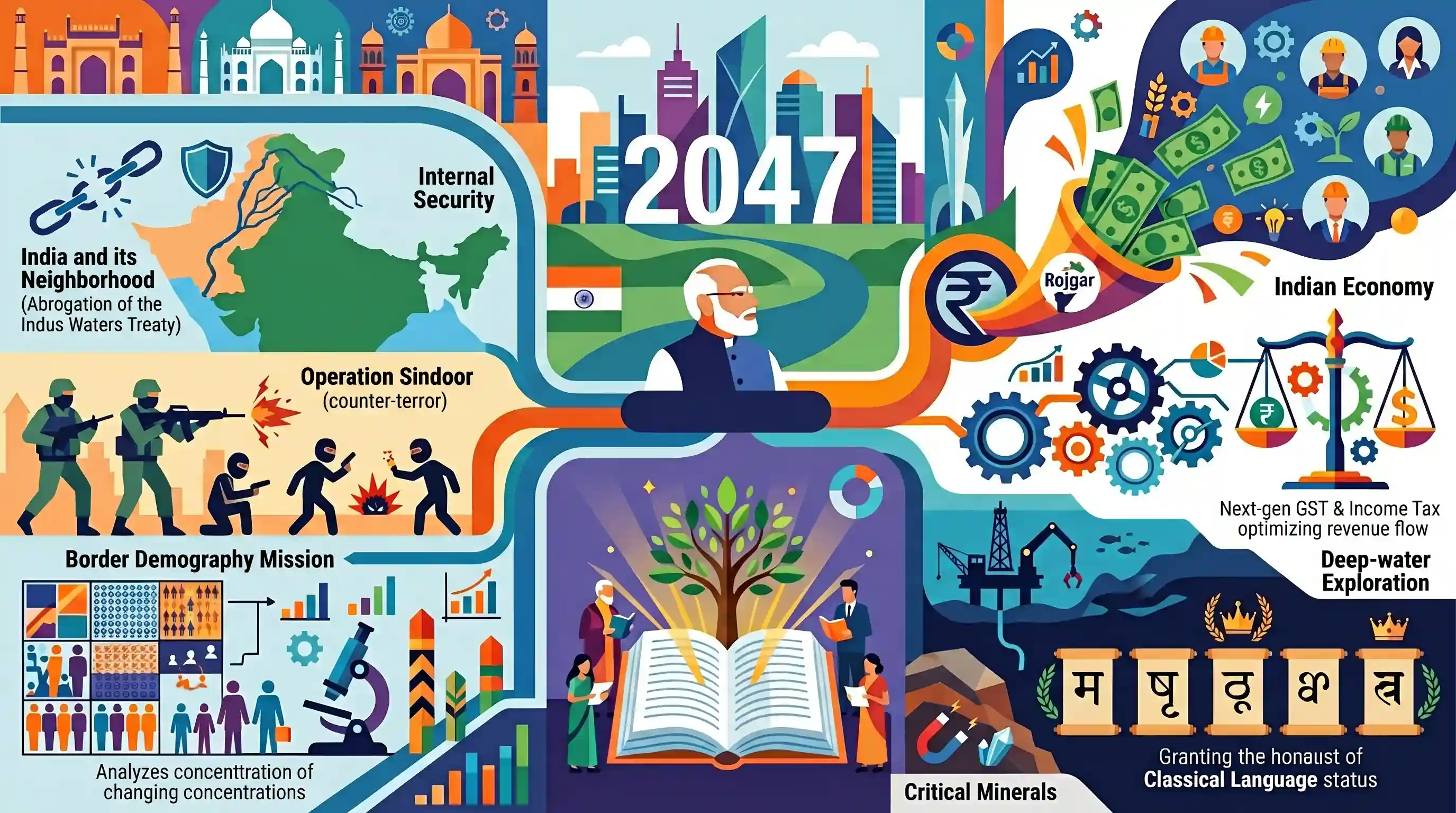
Why It Matters
The Prime Minister's Independence Day speech acts as a policy blueprint for the government, outlining critical priorities in security (abrogation of treaties, counter-terrorism), economy (tax reforms, employment generation schemes), and culture (classical languages), all of which are directly syllabus-relevant for UPSC GS1, GS2, and GS3.
Summary
Prime Minister Narendra Modi's 79th Independence Day speech laid out a comprehensive roadmap for 'Viksit Bharat' by 2047, highlighted by sweeping domestic reforms and an assertive foreign policy posture. Key announcements included the abrogation of the Indus Waters Treaty, the acknowledgement of the counter-terror 'Operation Sindoor', and the launch of a High-Power Demography Mission to address border demographic changes. On the economic front, he highlighted the Rs 1 lakh crore Pradhan Mantri Viksit Bharat Rojgar Yojana, next-generation GST and income tax reforms, and missions targeting deep-water exploration and critical minerals. Cultural initiatives included granting Classical Language status to five languages and the Gyan Bharatam Mission.
Key Points
- Foreign Policy and Security: Asserted a firm stance against terrorism with 'Operation Sindoor' and abrogated the Indus Waters Treaty to reserve river waters exclusively for India.
- Economic Reforms: Announced a task force for 'next-generation reforms' encompassing a review of GST structures and ongoing simplification of the Income Tax Act.
- Employment and Agriculture: Launched the Rs 1 lakh crore Pradhan Mantri Viksit Bharat Rojgar Yojana for youth and the PM Dhan-Dhanya Krishi Yojana targeting 100 backward agricultural districts.
- Strategic Resources: Introduced 'Samudra Manthan' for deep-water exploration and a National Critical Minerals Mission to ensure energy and mineral security.
- Internal Security: Announced a High-Power Demography Mission to counter unnatural demographic changes and infiltration in border regions.
- Cultural Heritage: Conferred 'Classical Language' status on Marathi, Assamese, Bangla, Pali, and Prakrit, and initiated the Gyan Bharatam Mission to preserve ancient manuscripts.
Important Terms
Indus Waters Treaty

A 1960 water-sharing agreement between India and Pakistan, currently held in 'abeyance' (temporary suspension) by India since April 2025 following the Pahalgam terror attack, citing state-sponsored terrorism.
UPSC context
GS II: International Relations; crucial for understanding India-Pakistan bilateral ties, transboundary water governance, and the doctrine of 'terror and water cannot coexist'.
Operation Sindoor
A precision strike operation launched on May 7, 2025, in response to the Pahalgam attack, targeting terrorist infrastructure in Pakistan-occupied territories. It signals a shift from strategic restraint to calibrated military-political response.
UPSC context
GS III: Internal Security/National Security; tests knowledge of India's defense doctrine, precision warfare, and counter-terror strategic shifts.
High-Power Demography Mission
A national mission announced in August 2025 to address illegal immigration and demographic shifts in border regions, which the government identifies as a significant threat to national security and social harmony.
UPSC context
GS III: Internal Security; focuses on border management, illegal migration (Rohingya/Bangladeshi), and their impact on local social and land rights.
National Critical Minerals Mission
A seven-year initiative (2024-2031) with a ₹16,300 crore budget to secure India's supply chain for 30 critical minerals like lithium and cobalt, essential for green energy and national security.
UPSC context
GS III: Economy/S&T; vital for understanding energy security, electric mobility, and India's transition to a 'Net Zero' economy.
Pradhan Mantri Viksit Bharat Rojgar Yojana
A ₹1 lakh crore employment-linked incentive (ELI) scheme launched in 2025 to create 3.5 crore jobs. It provides financial incentives to first-time formal sector employees and their employers via EPFO.
UPSC context
GS III: Indian Economy; relates to formalization of the workforce, youth employment, and fiscal measures for economic growth.
PM Dhan-Dhanya Krishi Yojana
An umbrella scheme approved in July 2025 that converges 36 existing agricultural programs into a single framework across 100 underperforming districts to boost productivity, irrigation, and farmer credit.
UPSC context
GS II: Governance; GS III: Agriculture; tests understanding of administrative convergence, decentralised planning, and sustainable farming interventions.
Gyan Bharatam Mission
A national initiative under the Ministry of Culture to identify, digitize, and preserve over five million ancient manuscripts using modern technologies like AI, OCR, and blockchain to reclaim India's knowledge heritage.
UPSC context
GS I: Indian Culture; GS III: S&T; tests the integration of traditional knowledge systems with modern technological preservation methods.
Samudra Manthan
A component of the National Deep Water Exploration Mission (2025) focused on accelerating the exploration and production of oil and gas reserves from India's deepwater and ultra-deepwater offshore blocks.
UPSC context
GS III: Energy; S&T; Economy; focuses on blue economy, energy self-reliance, and deep-sea mineral/hydrocarbon exploration.
Prelims Trap
The Indus Waters Treaty contains a specific exit clause allowing either nation to unilaterally withdraw.
The 1960 IWT has no exit or abrogation provision. India's unilateral withdrawal relies on customary international law principles, not a built-in treaty mechanism.
Static Concepts Connected
What are the core mechanisms and allocations of the 1960 Indus Waters Treaty?
- River Allocation: Eastern rivers (Ravi, Beas, Sutlej) allocated to India. Western rivers (Indus, Jhelum, Chenab) to Pakistan, with limited consumptive use permitted for India.
- Permanent Indus Commission: A bilateral commission composed of Indian and Pakistani commissioners, originally mandated to meet at least once a year to resolve issues cooperatively.
- Role of World Bank: Acted as a signatory and broker, not a guarantor. It facilitates dispute resolution by appointing Neutral Experts or setting up Courts of Arbitration.
What are the criteria for according 'Classical Language' status in India?
- High Antiquity: Early texts or recorded history must have a high antiquity stretching back 1500–2000 years.
- Valuable Heritage: A body of ancient literature or texts that is considered a valuable heritage by generations of speakers.
- Original Tradition: The literary tradition must be original and not borrowed from another speech community.
Cross-Topic Patterns
IWT Abrogation + Vienna Convention
The absence of an exit clause in the IWT forces reliance on the Vienna Convention's 'rebus sic stantibus' (fundamental change of circumstances), linking hydro-diplomacy with international treaty law.
Critical Minerals + UNCLOS (Seabed Mining)
The National Critical Minerals Mission couples with 'Samudra Manthan', connecting terrestrial domestic supply chains to deep-sea exploration and International Seabed Authority (ISA) allocations under UNCLOS.
Border Demography + Article 355 Security
The High-Power Demography Mission shifts border management from mere physical guarding to active socio-demographic monitoring, tying directly into historic NRC debates and the mandate under Article 355.

2026 prelims will heavily test the newly expanded Classical Languages list, alongside the geopolitical legality of unilateral IWT abrogation.
Linked PYQs · 4
Linked PYQs · 4
- 2012MainsGS2
The situation today is far different to that prevalent fifty years back when the Indus Water Treaty was signed." Highlight the complexity of the current challenges on both sides of the border in this regard. Do you think that a review of the Treaty is in India's best interests?
- 2019MainsGS3
Enumerate the indirect taxes which have been subsumed in the Goods and Services Tax (GST) in India. Also, comment on the revenue implications of the GST introduced in India since July 2017.
- 2015PrelimsGS1
Which one of the following was given classical language status recently?
- 2014PrelimsGS1
Consider the following languages: 1. Gujarati 2. Kannada 3. Telugu Which of the above has/have been declared as 'Classical Language/Languages' by the Government?
