SJVN Bikaner Solar Project Launched for Clean Energy
Source:egov.eletsonline ↗
Why It Matters
Rajasthan leads the nation in solar potential, making its mega renewable energy infrastructure projects highly relevant for RPSC RAS examinations. Questions frequently assess state solar policies, solar parks (like Bhadla), and administrative executing bodies.
Summary
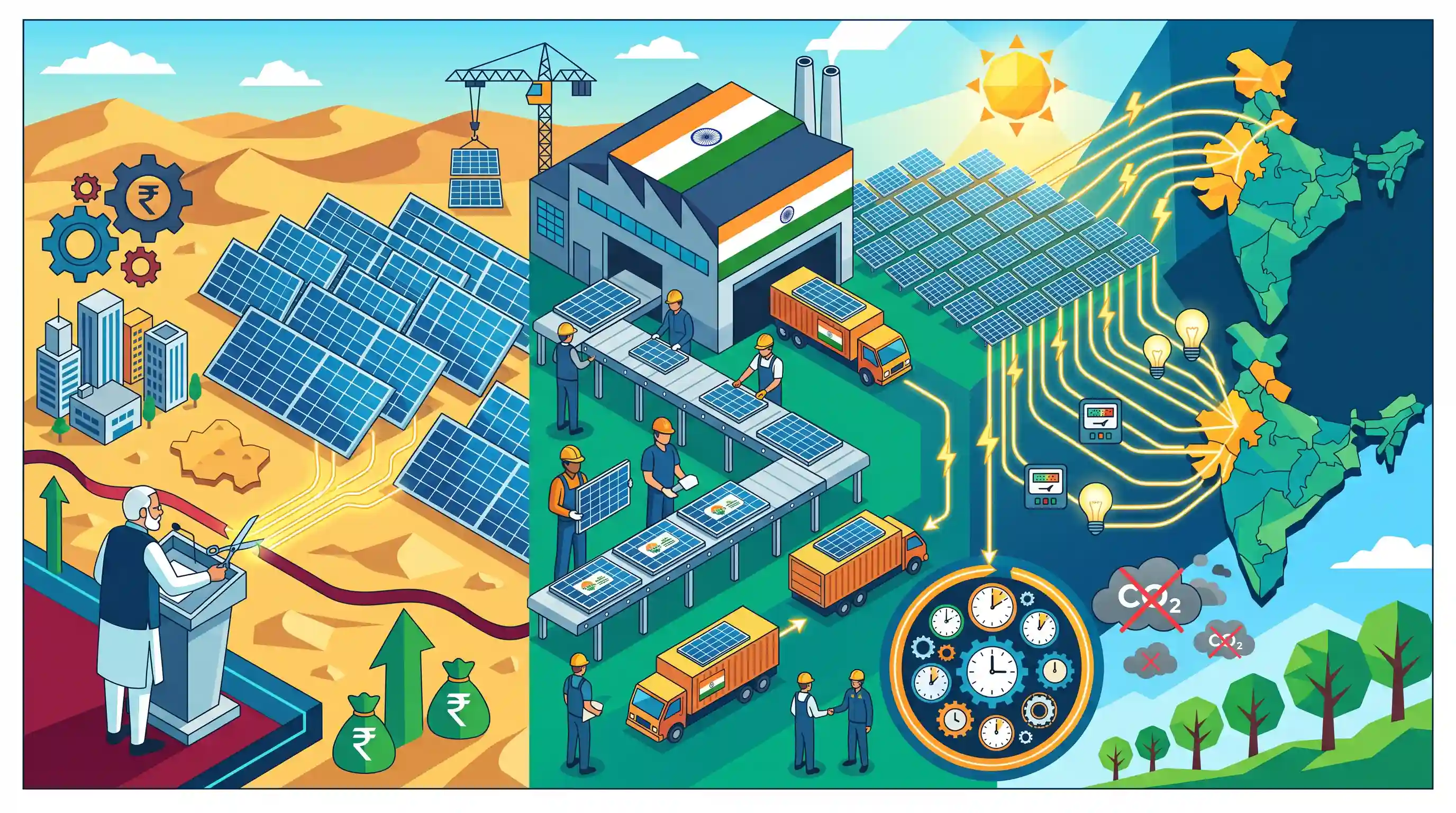
Prime Minister Narendra Modi inaugurated the 1,000 MW Bikaner Solar Power Project in Rajasthan, developed by SJVN Green Energy Limited (SGEL) with an investment of ₹5,492 crore. Spanning 5,000 acres, it is the largest single-location EPC solar project in India under the Domestic Content Requirement (DCR) framework. Over its 25-year operational lifecycle, it is projected to produce over 56,482 million units of clean energy and reduce carbon emissions by 2.79 billion kg. The power generated is allocated to Rajasthan, Uttarakhand, and Jammu & Kashmir, boosting local energy security and promoting indigenous solar module manufacturing.
Key Points
- Prime Minister Narendra Modi inaugurated SJVN's 1,000 MW Bikaner Solar Power Project, developed by SJVN Green Energy Limited (SGEL) at an estimated cost of ₹5,492 crore.
- The project is spread across 5,000 acres in Bikaner and represents India's largest single-location Engineering, Procurement, and Construction (EPC) solar project under the Domestic Content Requirement (DCR) category.
- It features a total power output allocation of 500 MW to Rajasthan, 200 MW to Uttarakhand, and 300 MW to Jammu & Kashmir.
- Expected first-year generation is 2,454.84 million units (MU), and over its 25-year lifespan, it is projected to generate 56,482.14 MU of clean electricity, reducing CO2 emissions by 2.79 billion kg.
- Aligned with the 'Make in India' and 'Atmanirbhar Bharat' initiatives, the project utilizes approximately 24.22 lakh domestically manufactured DCR solar modules and 175 crore indigenous solar cells.
Important Terms
Domestic Content Requirement (DCR)

A policy mandate requiring developers to use locally manufactured solar components (cells and modules) to qualify for government-funded schemes, subsidies, or benefits, promoting self-reliance and boosting domestic manufacturing.
UPSC context
GS Paper III (Infrastructure, Energy, Economy); tested in Prelims 2017 regarding its role in India's solar mission and WTO compliance.
Atmanirbhar Bharat
A national vision launched in 2020 aiming to make India self-reliant across key sectors, including manufacturing, energy, and technology, by promoting domestic production and reducing import dependence.
UPSC context
GS Paper III (Indian Economy, Industrial Growth, Infrastructure); crucial for understanding development strategies, import substitution, and manufacturing policies.
Make in India
A major government initiative launched in 2014 designed to facilitate investment, foster innovation, enhance skill development, protect intellectual property, and build best-in-class manufacturing infrastructure in India.
UPSC context
GS Paper III (Growth, Development, and Employment); tests policies targeting industrialization, export promotion, and the manufacturing sector's GDP share.
SJVN Limited
A Navratna Central Public Sector Enterprise under the Ministry of Power, established in 1988 as a joint venture between the Government of India and the Government of Himachal Pradesh, focusing on power generation.
UPSC context
GS Paper III (Infrastructure, Energy); relevant for evaluating the role of public sector undertakings in India’s renewable energy and hydroelectric growth.
SJVN Green Energy Limited (SGEL)
A wholly owned subsidiary of SJVN Limited incorporated in 2022 to spearhead capacity additions in new and renewable energy sources, including solar, wind, hybrid, and energy storage solutions.
UPSC context
GS Paper III (Infrastructure, Energy); tests institutional structures for green transition and public sector-led implementation of renewable energy projects.
Rajasthan Renewable Energy Corporation Limited (RRECL)
The state nodal agency formed in 2002 to promote and develop non-conventional energy sources and enforce energy conservation measures, facilitating major renewable infrastructure projects in Rajasthan.
UPSC context
GS Paper III (Infrastructure: Energy); tests institutional frameworks at the state level that support national renewable energy targets and climate goals.
Rajasthan Solar Energy Policy
A policy framework designed to leverage Rajasthan's high solar insolation, promoting large-scale solar parks, setting ambitious capacity generation targets, and facilitating land and transmission infrastructure for developers.
UPSC context
GS Paper III (Energy, Infrastructure, Environment); highlights state-specific climate strategies, decentralized solar projects, and local contribution to national green targets.
Prelims Trap
Domestic Content Requirement (DCR) in India's solar sector was completely banned and abolished after the 2016 WTO ruling.
DCR was only struck down for commercial solar projects. India still legally implements DCR for public sector/CPSU projects using the GATT Article III:8(a) government procurement exception.
Static Concepts Connected
What is the GATT National Treatment principle and its exception in India's solar disputes?
- National Treatment: GATT Article III:4 requires imported goods to be treated no less favorably than domestic goods, preventing discrimination.
- WTO Solar Ruling: WTO ruled India's early solar DCR inconsistent because it forced commercial developers to buy domestic solar components.
- GATT Article III:8(a): Provides a government procurement exception, allowing India to mandate DCR only for state-owned enterprises producing power for government use.
What are the criteria and financial powers of Navratna CPSEs in India?
- Eligibility: Must be Miniratna Category-I, Schedule A, with excellent/very good MoU ratings and score 60+ on six performance indicators.
- Financial Autonomy: Can invest up to ₹1,000 crore or 15% of their net worth in a single project without central government approval.
Cross-Topic Patterns
Solar expansion vs WTO National Treatment
Balancing domestic manufacturing push with international trade commitments requires strategic use of GATT exceptions, shaping India's trade diplomacy.
Inter-state power allocation & federal grids
Allocating Rajasthan-generated solar energy to J&K and Uttarakhand highlights how cooperative resource-sharing drives India's national grid decarbonization.

The legal distinction between commercial DCR and the GATT Art III:8(a) government procurement exception is a high-probability 2026 prelims target.
Linked PYQs · 3
Linked PYQs · 3
- 2012RPSC_PRELIMSGS1
Where will the first solar park (solar park) be set up in Rajasthan?
- 2021RPSC_PRELIMSGS1
In which year was the Rajasthan Solar Energy Policy announced?
- 2023RPSC_PRELIMSGS1
Which agency has been given the responsibility of implementing the PM-KUSUM scheme (Component A) in Rajasthan, which involves the establishment of solar power plants with a capacity of 0.5 MW to 2 MW?
