Sindhu Hospital in Hyderabad and Tech Integration in Healthcare
Source:The Hindu ↗
Why It Matters
The inauguration highlights the ongoing governmental push for resilient healthcare infrastructure and the integration of modern technology in medical services, which are critical themes under governance and public health for UPSC.
Summary
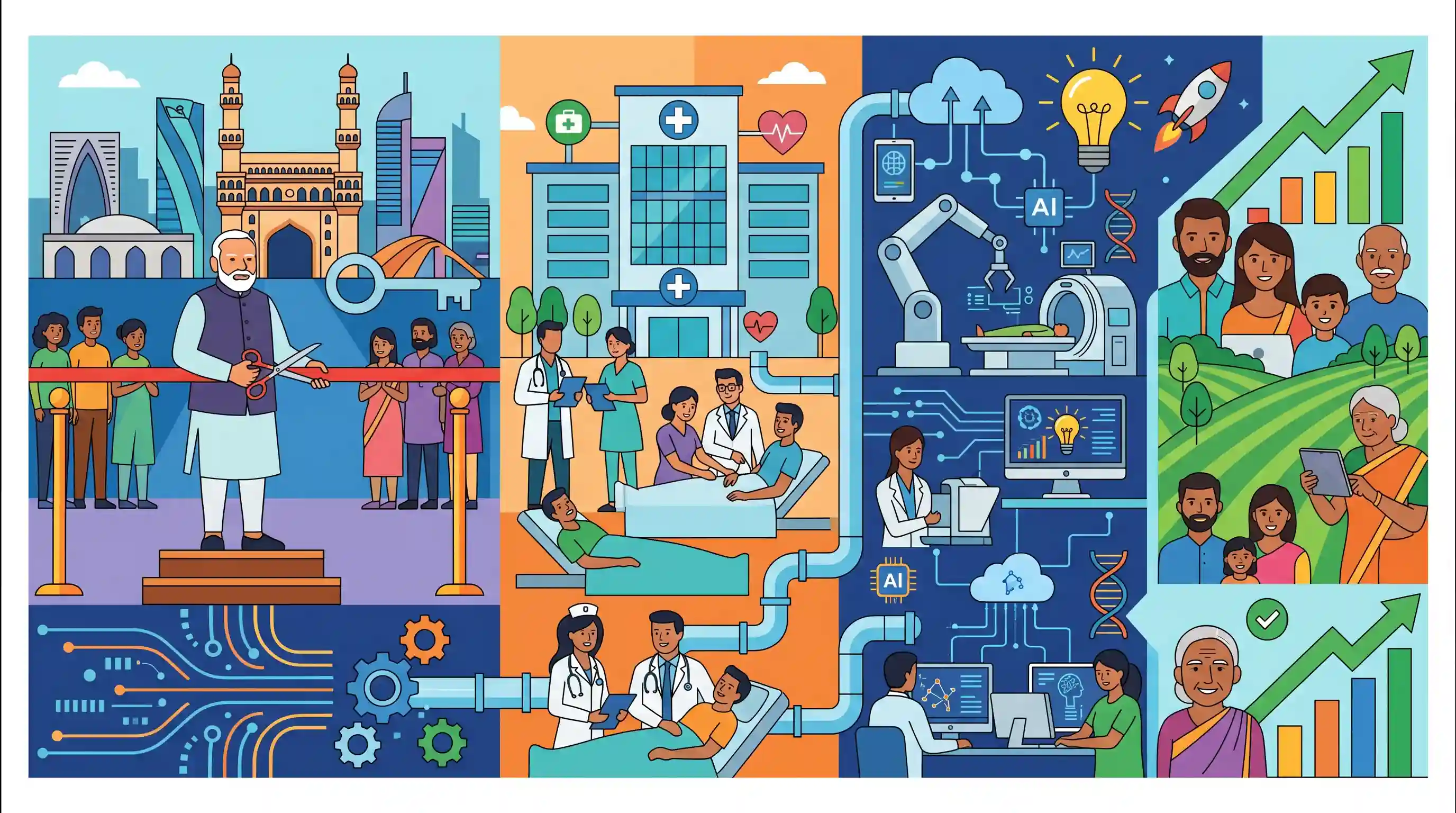
Prime Minister Narendra Modi inaugurated Sindhu Hospital in Hyderabad, emphasizing its contribution to strengthening the region's healthcare infrastructure. He lauded the hospital's focus on integrating advanced technology and innovative practices to improve medical care and healthcare access.
Key Points
- Prime Minister Narendra Modi inaugurated Sindhu Hospital in Hyderabad, Telangana.
- The facility aims to strengthen the healthcare infrastructure and improve access to medical services in the region.
- The Prime Minister praised the hospital management's emphasis on integrating advanced technology and innovation into medical care.
Important Terms
Sindhu Hospital

A 1,500-bed, cancer-focused, quaternary care not-for-profit institution in Hyderabad. It integrates advanced technology and 33+ super-specialties to enhance regional medical access.
UPSC context
GS Paper 2 (Social Justice/Health); tests knowledge of major healthcare infrastructure and social-sector initiatives.
Quaternary Care
An extremely specialized level of medical care involving advanced diagnostic and surgical procedures, often experimental, typically provided in research-oriented multi-specialty hospitals.
UPSC context
GS Paper 2 (Health Infrastructure); tests understanding of the healthcare delivery hierarchy and advanced medical services.
Viksit Bharat @2047
The government's roadmap to transform India into a developed nation by its centenary of independence in 2047 through infrastructure, economic, and social reforms.
UPSC context
GS Paper 2 (Governance), GS Paper 3 (Economy); tests awareness of long-term national developmental goals and strategic vision.
Not-for-profit Healthcare
Healthcare institutions where surplus revenue is reinvested into medical services and facilities rather than distributed as profit, aiming to provide affordable, high-quality care.
UPSC context
GS Paper 2 (Social Justice/Health); relevant to discussions on Universal Health Coverage and social welfare models.
PM MITRA Scheme
A scheme to establish large-scale, integrated textile parks with world-class infrastructure, following the '5F' vision (Farm to Fibre to Factory to Fashion to Foreign).
UPSC context
GS Paper 3 (Economy/Industry); tests knowledge of industrial policy, textile sector reforms, and export-oriented infrastructure.
Prelims Trap
"Participation in the Ayushman Bharat Digital Mission (ABDM) is mandatory for all private multi-specialty hospitals."
ABDM participation is entirely voluntary for citizens, healthcare professionals, and facilities. It acts as a digital public good framework, not a coercive mandate.
Static Concepts Connected
What are the core components of the Ayushman Bharat Digital Mission (ABDM)?
- ABHA Number: A 14-digit voluntary health ID for citizens to securely store, access, and share health records digitally with consent.
- HPR & HFR: Comprehensive repositories containing verified digital identities of all healthcare professionals (HPR) and medical facilities (HFR) across both modern and traditional medicine.
- Unified Health Interface: An open, interoperable IT protocol enabling seamless exchange of data and digital health services (like teleconsultation) across diverse platforms, akin to UPI.
How is healthcare delivery classified from Primary to Quaternary care?
- Primary Care: The first point of contact (PHCs, Ayushman Arogya Mandirs) focusing on basic maternal, child, and preventive health services.
- Secondary & Tertiary: Advanced medical investigation and management provided by district hospitals and super-specialty institutes (e.g., AIIMS) for complex diseases.
- Quaternary Care: An extension of tertiary care involving highly specialized, experimental, or uncommon medical procedures, such as advanced neuro-oncology or complex organ transplants.
Cross-Topic Patterns
Health Tech & DPDP Act 2023
The integration of AI and digital health records (like ABDM) intersects directly with the DPDP Act 2023, demanding strict consent-manager protocols for processing sensitive personal health data.
Marketisation vs. Primary Health Welfare
The skew of private charitable investment toward urban quaternary care highlights the ongoing structural debate in GS2: balancing high-end medical marketisation with the state's duty to fund rural primary care.

Expect a 2026 GS3 Mains question on the role of DPIs (like ABDM) and AI in bridging healthcare access gaps vs. data privacy risks.
Linked PYQs · 4
Linked PYQs · 4
- 2024MainsGS2
In a crucial domain like the public healthcare system the Indian State should play a vital role to contain the adverse impact of marketisation of the system. Suggest some measures through which the State can enhance the reach of public healthcare at the grassroots level.
- 2021MainsGS2
“Besides being a moral imperative of a Welfare State, primary health structure is a necessary precondition for sustainable development.” Analyze.
- 2023MainsGS3
Introduce the concept of Artificial Intelligence (AI). How does Al help clinical diagnosis? Do you perceive any threat to privacy of the individual in the use of Al in healthcare?
- 2020MainsGS3
What do you understand by nanotechnology and how is it helping in health sector?
