Prime Minister inaugurates Samrat Samprati Museum in Gandhinagar
Source:Indian Express ↗
Why It Matters
For UPSC aspirants, this highlights an important cultural institution tied to the Mauryan dynasty and Jainism, both crucial topics in GS1 History and Art & Culture. The focus on preserving ancient manuscripts and artifacts also connects with the broader GS1 theme of safeguarding Indian art heritage.
Summary
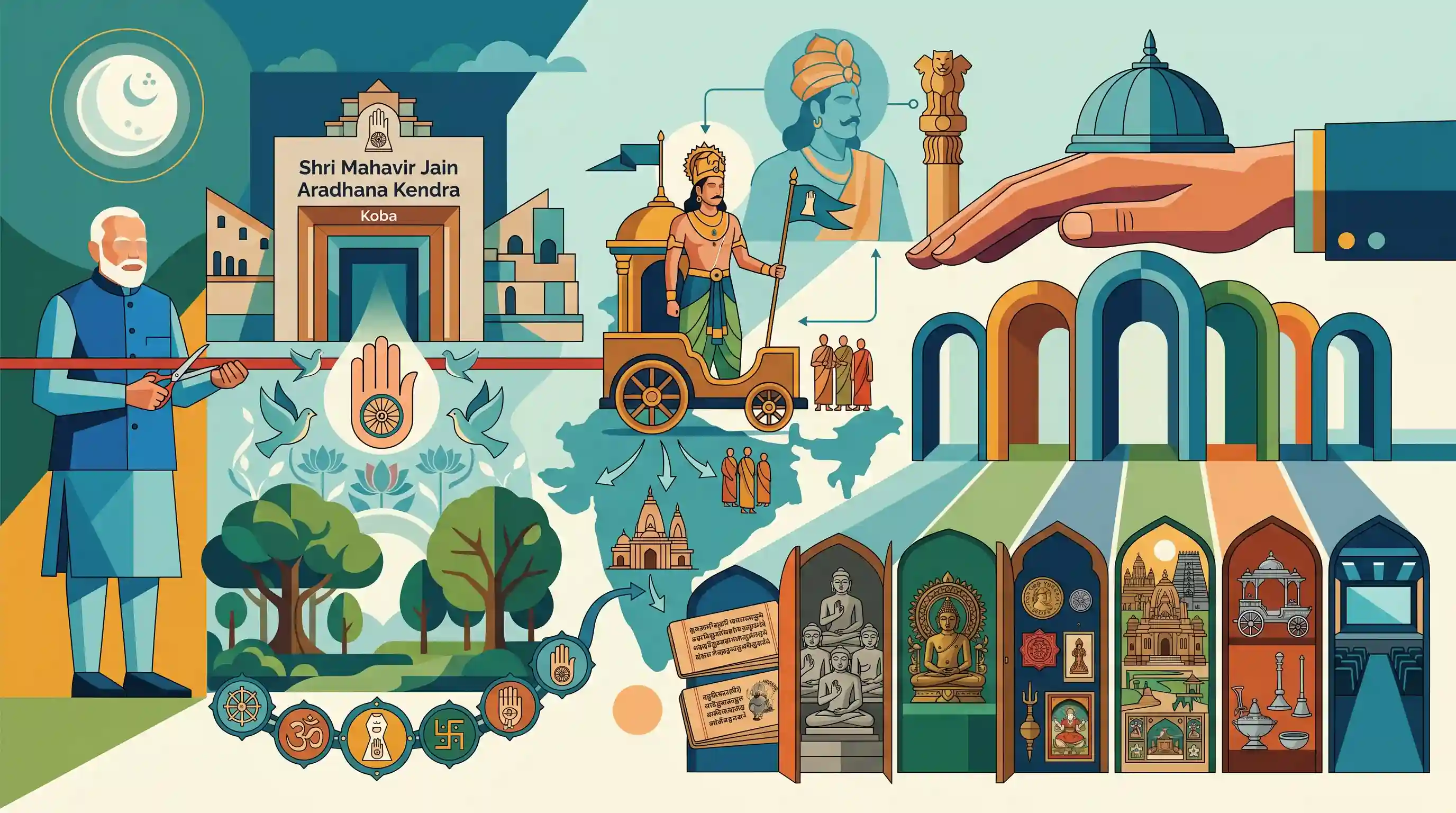
Prime Minister Narendra Modi inaugurated the Samrat Samprati Museum in Gandhinagar on Mahavir Jayanti. Located at the Shri Mahavir Jain Aradhana Kendra in Koba, the museum celebrates Jain heritage and the core principle of Ahimsa. It honors Samrat Samprati, the grandson of Mauryan emperor Ashoka, who played a key role in spreading Jainism. The museum safeguards India's cultural and art heritage by showcasing an extensive collection of ancient manuscripts, sculptures, metal idols, and rare artefacts across seven galleries.
Key Points
- Prime Minister Narendra Modi inaugurated the newly built Samrat Samprati Museum at Koba village in Gandhinagar, Gujarat, on the occasion of Mahavir Jayanti.
- The museum is dedicated to preserving Jain heritage and promoting the principle of 'Ahimsa' (non-violence).
- It is named after Mauryan emperor Samrat Samprati, the grandson of Samrat Ashoka, recognized for his significant role in propagating Jainism and non-violence.
- The museum features seven galleries displaying rare artefacts, ancient manuscripts, sculptures, stone and metal idols, miniature paintings, coins, and silver chariots.
Important Terms
Samrat Samprati

Mauryan emperor (reigned c. 224–215 BCE) and grandson of Ashoka. Known as the 'Jain Ashoka,' he converted to Jainism and extensively promoted the faith through temples and missions.
UPSC context
GS Paper 1: Ancient History. Important for Mauryan dynasty studies and religious patronage shifts in post-Ashokan India.
Samrat Samprati Museum
A newly inaugurated repository in Gandhinagar featuring seven thematic galleries. It houses over 2,000 rare artifacts, including ancient manuscripts and idols, to showcase Jainism’s historical and cultural evolution.
UPSC context
GS Paper 1: Art and Culture. Relevant for current developments in cultural heritage preservation and museum infrastructure.
Shri Mahavir Jain Aradhana Kendra
A major Jain research and spiritual center in Koba, Gandhinagar. It is globally significant for housing over 300,000 ancient manuscripts and preserving Jain and Indological literary heritage.
UPSC context
GS Paper 1: Indian Heritage. Key for understanding the preservation of ancient literature and Indological research centers.
Mahavir Jayanti
The birth anniversary of Lord Mahavira, the 24th Tirthankara. It is the most significant Jain festival, celebrating the principles of non-violence, truth, and spiritual liberation.
UPSC context
GS Paper 1: Indian Festivals and Culture. Tests knowledge of Jain philosophy and its historical founders.
Ahimsa
The central Jain vow of non-violence. It mandates complete non-injury to any living being through thought, word, or deed and is considered the highest ethical duty (Dharma).
UPSC context
GS Paper 1 (Culture) and GS Paper 4 (Ethics). Core philosophical concept in Indian religious and ethical systems.
Jain Manuscripts
Handwritten historical documents (hastaprats) recorded on palm leaves or paper. They preserve the Agamas (scriptures), philosophy, and historical records of Jainism in languages like Prakrit and Sanskrit.
UPSC context
GS Paper 1: Indian Literature and Art. Important for the study of ancient scripts and intellectual history.
Prelims Trap
Mauryan ruler Samrat Samprati patronized the Digambara sect of Jainism under the guidance of Bhadrabahu.
Samprati patronized the Shvetambara sect under the monk Suhastisuri. Chandragupta Maurya was the Mauryan ruler guided by Bhadrabahu (Digambara tradition).
Static Concepts Connected
Which major ancient Indian dynasties and rulers patronized Jainism?
- Mauryan Empire: Chandragupta Maurya (embraced Jainism late in life) and his grandson Samprati (the "Jain Ashoka").
- Chedi Dynasty: King Kharavela was a massive patron of Jainism, famously commissioning the Hathigumpha inscription.
- Rashtrakutas & South Indian Dynasties: Amoghavarsha I was a great patron and authored Kavirajamarga; many Kadamba and Ganga rulers also supported Jainism.
What are the core differences between the Shvetambara and Digambara sects?
- Monastic code: Shvetambaras (white-clad) wear white clothing, while Digambaras (sky-clad) practice complete nudity as a sign of renunciation.
- Women's liberation: Shvetambaras believe women can achieve Moksha (Malli was female). Digambaras believe women must be reborn as men first.
- Canonical texts: Shvetambaras accept the canonical texts (Agamas). Digambaras reject them, believing the original teachings of Mahavira were lost.
Cross-Topic Patterns
Jain temple architecture & royal patronage
Samprati commissioned numerous Derasars. UPSC often links state patronage of Jainism to specific temple architectures (e.g., Maru-Gurjara) and prominent pilgrimage sites like Palitana or Mount Abu.
Institutionalizing cultural heritage preservation
The Koba museum's focus on manuscripts aligns with ongoing central initiatives (like the National Mission for Manuscripts) to digitize and preserve fragile ancient texts against deterioration.

Expect a chronological or comparative question on Mauryan successors' religious patronage (Dasharatha's Ajivikas vs. Samprati's Jainism).
Linked PYQs · 3
Linked PYQs · 3
- 2023PrelimsGS1
"Souls are not only the property of animal and plant life, but also of rocks, running water and many other natural objects not looked on as living by other religious sects." The above statement reflects one of the core beliefs of which one of the following religious sects of ancient India?
- 2020PrelimsGS1
Who among the following rulers advised his subjects through this inscription ? "Whosoever praises his religious sect or blames other sects out of excessive devotion to his own sect, with the view of glorifying his own sect, he rather injures his own sect very severely."
- 2018MainsGS1
Safeguarding the Indian art heritage is the need of the moment. Discuss.
