Climate Inequality and Historical Responsibility at NGT Forum
Source:The Hindu ↗
આ શા માટે મહત્વનું છે
This article directly addresses India's official stance on international climate negotiations, equity, historical responsibility, and the fulfillment of Paris Agreement targets, which are core themes in GS3 Environment.
સારાંશ
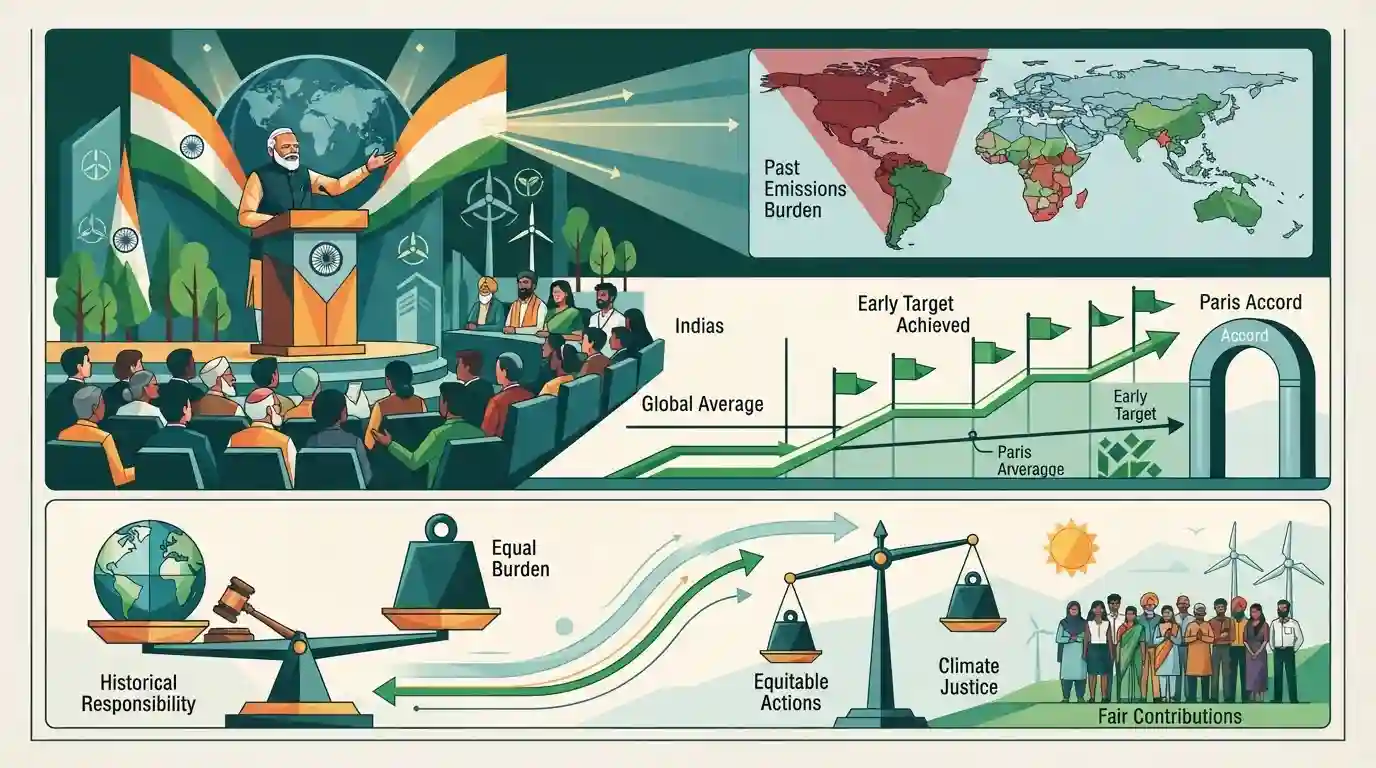
Prime Minister Narendra Modi inaugurated the National Green Tribunal's climate conference, addressing issues of climate inequality and asserting that developing countries face unfair blame for global emissions. He highlighted India's track record of meeting its Paris Agreement pledges early and advocated for climate justice based on historical responsibilities.
મુખ્ય મુદ્દા
- Prime Minister Narendra Modi highlighted 'climate inequality' at the National Green Tribunal's climate conference, stating that developing nations are wrongly blamed for carbon emissions.
- He asserted that India has fulfilled all its commitments under the Paris Agreement ahead of schedule, setting an example for global climate action.
- Emphasized the principle of climate justice, noting that historical emissions of developed nations disproportionately impact developing countries.
મહત્વપૂર્ણ શબ્દો
Paris Agreement

A legally binding international treaty adopted in 2015 at COP21, aiming to limit global temperature rise to well below 2°C through nationally determined contributions (NDCs) and climate finance.
UPSC context
GS Paper III (Environment & Ecology, Climate Change Policy). Tests international climate negotiations, equity, and India's NDCs.
National Green Tribunal (NGT)
A specialized statutory body established in India under the 2010 Act for the expeditious disposal of cases relating to environmental protection and forest conservation.
UPSC context
GS Paper II (Statutory Bodies) and GS Paper III (Environment). Tests judicial activism, environmental governance, and institutional mechanisms in India.
પ્રિલિમ્સ ટ્રેપ
India fulfilled all its legally binding international reduction targets under the Paris Agreement ahead of schedule.
Aspirants may think India's Paris Agreement NDCs are legally binding under international law, but individual NDCs under the Paris framework are voluntary commitments without top-down enforcement penalties.
સંલગ્ન સ્થિર ખ્યાલો
What are the core principles of international climate law established under the UNFCCC?
- CBDR-RC Principle: CBDR-RC acknowledges that developed countries historically contributed most to global greenhouse gas emissions and possess greater financial/technological resources.
- Common Responsibility: States have common obligations to protect the global environment, but differentiated responsibilities based on historical contribution and economic capability.
- Financial Assistance: Developed nations committed to providing financial resources and transferring clean technologies to assist developing countries in mitigation and adaptation.
આંતર-વિષય પેટર્ન
Climate Equity vs Carbon Border Taxes
India's push for climate justice and early NDC fulfillment intersects with UNFCCC negotiations on climate finance (NCQG) and CBAM disputes at the WTO.

Expect a multi-statement prelims question on historical responsibility vs NDCs, or Mains GS3 on climate justice vs per capita equity.
સંલગ્ન PYQ · 2
સંલગ્ન PYQ · 2
- 2025MainsGS3
Write a review on India's climate commitments under the Paris Agreement (2015) and mention how these have been further strengthened in COP26 (2021). In this direction, how has the first Nationally Determined Contribution intended by India been updated in 2022?
- 2020MainsGS3
Explain intra-generational and inter-generational issues of equity from the perspective of inclusive growth and sustainable development.
