Amrit Bharat Scheme Progresses with Eight Rajasthan Stations
Source:ommcom-news ↗
Why It Matters
The article bridges central infrastructure schemes (Amrit Bharat Station Scheme) with Rajasthan's cultural heritage. Questions in RPSC RAS Prelims frequently test knowledge of specific state districts benefiting from central schemes, as well as the integration of historical architecture into modern development.
Summary
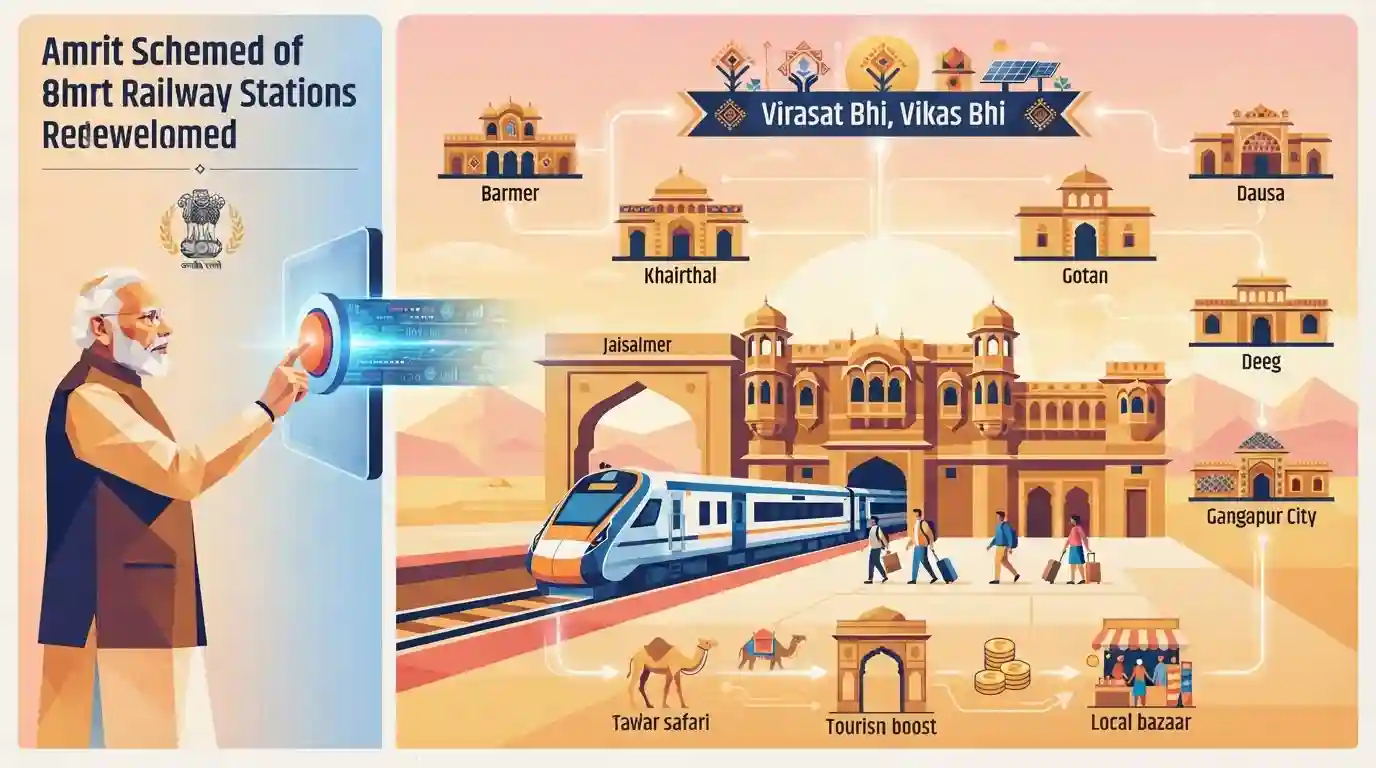
Prime Minister Narendra Modi virtually inaugurated the redevelopment of eight railway stations across Rajasthan as part of the Amrit Bharat Station Scheme. The stations being modernized include Jaisalmer, Barmer, Dausa, Khairthal, Gotan, Somesar, Deeg, and Gangapur City. Highlighting the 'Virasat Bhi, Vikas Bhi' philosophy, the redevelopment blends world-class passenger amenities with local cultural heritage. Notably, the Jaisalmer railway station will be redesigned to mirror the architectural grandeur of the city's iconic Sonar Fort, serving as a gateway to Rajasthan's rich heritage and aiming to significantly boost local tourism and economic activity.
Key Points
- PM Modi inaugurated the redevelopment of 8 railway stations in Rajasthan under the Amrit Bharat Station Scheme.
- The targeted stations are Jaisalmer, Barmer, Dausa, Khairthal, Gotan, Somesar, Deeg, and Gangapur City.
- The project embodies the 'Virasat Bhi, Vikas Bhi' (Heritage as well as Development) vision, integrating modern passenger facilities with the state's traditional architecture.
- The Jaisalmer station will specifically be modeled after the historic Sonar Fort, featuring local murals and cultural designs to boost tourism.
Important Terms
Amrit Bharat Station Scheme

A Ministry of Railways initiative to continually modernize over 1,300 stations. It upgrades passenger amenities, ensures multimodal connectivity, integrates local culture, and promotes green building standards.
UPSC context
Important for GS-3 Infrastructure. Tests knowledge of public transport modernization, accessibility, and integrating local economies through transit hubs.
Virasat Bhi, Vikas Bhi
A governance philosophy emphasizing the parallel pursuit of cultural heritage preservation alongside modern economic progress, ensuring infrastructure development reflects and respects India's ancient traditions.
UPSC context
Relevant for GS-1 (Culture) and Essays. Tests the government's approach to harmonizing heritage conservation with modern infrastructural development.
Sonar Fort
A 12th-century massive yellow sandstone fort built by Rawal Jaisal in Rajasthan. Often called the Golden Fort, it is a UNESCO World Heritage Site and one of the world's few fully preserved living forts.
UPSC context
Crucial for GS-1 Art and Culture. Tests knowledge of UNESCO World Heritage Sites, Rajput architecture, and India's historical fortifications.
One Station One Product (OSOP)
An Indian Railways scheme promoting the 'Vocal for Local' vision by providing dedicated kiosks at railway stations to showcase and sell indigenous, locally crafted goods.
UPSC context
Important for GS-2 (Schemes) and GS-3 (Economy). Tests knowledge of MSME promotion, local economic empowerment, and marginalized community support.
Prelims Trap
All prominent medieval forts of Rajasthan, including Jodhpur's Mehrangarh Fort, are part of the UNESCO 'Hill Forts of Rajasthan' serial site.
Only six specific forts are part of the UNESCO serial site. Mehrangarh (Jodhpur) and Junagarh (Bikaner) are frequently used as trap choices but are not inscribed.
Static Concepts Connected
What is the significance of the UNESCO 'Hill Forts of Rajasthan' inscription?
- Six Serial Sites: Comprises Chittorgarh, Kumbhalgarh, Ranthambore, Gagron, Amer, and Jaisalmer forts, illustrating the peak of Rajput military and defensive architecture between the 8th and 18th centuries.
- Terrain Adaptation: Gagron is situated on a river cliff (Water Fort / Jal Durg), whereas Jaisalmer is a desert-protected fort (Giri/Dhanvan Durg).
- Living Fort Status: Jaisalmer is a rare 'living fort' where a significant portion of the local community still resides within the historic fortified walls.
What are the design and operational objectives of the Amrit Bharat Station Scheme?
- Master Plan Approach: Shifts from ad-hoc renovations to long-term Master Plans, continuously upgrading amenities like access, waiting areas, and local transport integration.
- Local Heritage Synergy: Ensures station facades and public spaces reflect local art, history, and cultural heritage, avoiding homogenized infrastructural designs.
- OSOP Integration: Mandates dedicated retail space at stations to sell indigenous, local, and artisanal crafts under the 'One Station One Product' (OSOP) scheme.
Cross-Topic Patterns
Cultural Heritage and Transit-Oriented Development
Blending regional architectural heritage (like Jaisalmer's yellow sandstone style) with modern transit infrastructure aligns cultural preservation with national Transit-Oriented Development (TOD) frameworks.
GI Tags and Railway-Driven Micro-Economies
Integrating the 'One Station One Product' initiative with railway hubs leverages national logistics infrastructure to market GI-tagged goods and bolster rural MSME economic survival.

Expect UPSC to link railway modernization (ABSS) with UNESCO tangible heritage assets, testing living fort architecture or GI products.
Linked PYQs · 3
Linked PYQs · 3
- 2024RPSC_PRELIMSGS1
Which of the following group of districts/cities of Rajasthan are arranged in ascending order as per their distance from the border with Pakistan?
- 2023RPSC_PRELIMSGS1
In the year 2022-23, what sub-sector contributed the most to the Gross State Value Added (GSVA) of the service sector in Rajasthan, based on current values?
- 2025RPSC_PRELIMSGS1
The correct order of decreasing contribution of different sectors in Rajasthan’s Gross Fixed Capital Formation is
