Meerut Transit Launch and Regional Rapid Transport System Expansion
Source:The Hindu ↗
Why It Matters
The article provides examples of recent infrastructure developments (RRTS/Namo Bharat) and reflects the increasing mainstream political and economic focus on Artificial Intelligence and Free Trade Agreements (FTAs) — all key themes in the GS-2 and GS-3 syllabi.
Summary
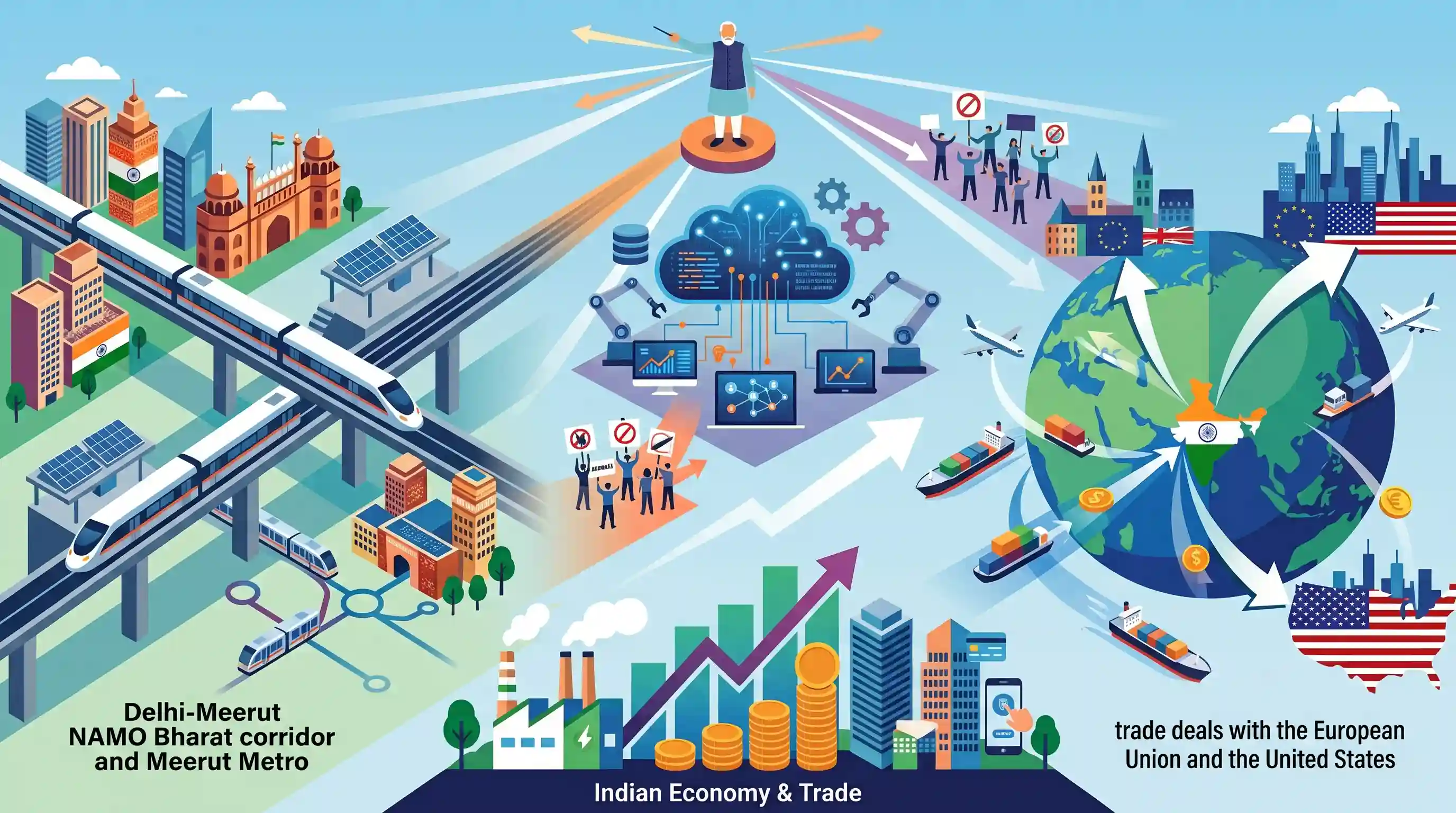
Prime Minister Narendra Modi launched the final leg of the Delhi-Meerut NAMO Bharat corridor and the Meerut Metro, highlighting India's expanding Regional Rapid Transit System (RRTS). During a rally in Meerut, he criticized opposition protests at the recent "AI Impact Summit" in New Delhi, advocating for the adoption of Artificial Intelligence and emerging technologies. He also emphasized India's growing global economic footprint, referencing impending trade deals with the European Union and the United States.
Key Points
- Launch of the final leg of the Delhi-Meerut NAMO Bharat corridor and Meerut Metro, underscoring the government's push for modern urban transit systems (RRTS).
- PM Modi highlighted the "AI Impact Summit" in New Delhi, emphasizing the importance of adopting emerging technologies like Artificial Intelligence for national progress.
- The Prime Minister noted expanding global economic ties, specifically mentioning upcoming trade deals and FTAs with the European Union and the United States.
- The political discourse framed advanced infrastructure and technological adoption as the twin pillars of India's 21st-century growth strategy.
Important Terms
Regional Rapid Transit System (RRTS)

A semi-high-speed, high-frequency commuter rail network (180 kmph design) connecting regional hubs. It provides high-capacity, point-to-point travel, bridging the gap between intra-city metros and inter-city conventional railways.
UPSC context
GS-III (Infrastructure). Tests knowledge of regional connectivity models, urban transport efficiency, and National Capital Region (NCR) planning.
NAMO Bharat
The official brand name for India’s first RRTS trains. These indigenous semi-high-speed trainsets (160 kmph operational speed) were launched on the 82-km Delhi-Ghaziabad-Meerut corridor to revolutionize regional commuting.
UPSC context
GS-III (Railways). Focuses on "Make in India" and indigenization of high-tech infrastructure.
India AI Impact Summit 2026
A landmark 2026 global summit in New Delhi centered on "human-centric AI." It introduced the M.A.N.A.V. vision—promoting Moral, Accountable, National sovereignty-based, Accessible, and Valid AI for the Global South.
UPSC context
GS-III (Science & Technology). Relevant for AI ethics, digital public infrastructure, and India’s global tech leadership.
India-EU Free Trade Agreement (FTA)
A comprehensive "future-ready" economic partnership aimed at lowering trade barriers, enhancing market access for Indian goods, and securing mobility rights for professionals across the 27 EU member states.
UPSC context
GS-II (International Relations). Tests understanding of bilateral diplomacy, trade blocks, and economic strategic partnerships.
Meerut Metro
India’s fastest urban metro system (120 kmph) which uniquely shares track and signaling infrastructure with the RRTS. It provides localized transit within Meerut while integrated into the broader regional network.
UPSC context
GS-III (Infrastructure). Relevant for urban planning, transit-oriented development, and multi-modal integration.
Prelims Trap
"RRTS is a centrally funded intra-city metro project."
RRTS is specifically designed for inter-city regional travel (not intra-city), and NCRTC is a joint venture of the Centre and 4 states, not solely central.
Static Concepts Connected
How does RRTS differ from conventional Metro systems?
- Speed and Scope: Semi-high-speed (up to 160 kmph) designed specifically for longer-distance, regional inter-city travel, unlike slower intra-city metros.
- Stop Frequency: Features fewer stops to maintain high average speeds for rapid point-to-point regional transit.
- Implementation Entity: Implemented by NCRTC, a joint venture between the Centre and four NCR states, highlighting a shared funding model.
What is the Broad-based Trade and Investment Agreement (BTIA)?
- Origin: Initiated in 2007, it is the proposed comprehensive Free Trade Agreement between India and the European Union.
- Sticking Points: Historical negotiations stalled over EU demands for tariff cuts on autos/dairy and India's demands for easier movement of professionals (Mode 4).
Cross-Topic Patterns
NCRTC as Cooperative Federalism
The JV model of NCRTC (Centre + Delhi, Haryana, Rajasthan, UP) reflects institutionalized cooperative federalism for regional urban decongestion, bridging GS2 (Polity) and GS3 (Infrastructure).
AI Safety vs AI for Development
India is shifting the AI governance narrative from Western-led 'AI Safety' to 'AI for Development', aligning with its broader G20 Global South leadership strategy.

Multi-statement Prelims Q in 2026 likely contrasting RRTS, Metro, and Vande Bharat specifications alongside NCRTC's funding model.
Linked PYQs · 2
Linked PYQs · 2
- 2022MainsGS3
Why is Public Private Partnership (PPP) required in infrastructural projects ? Examine the role of PPP model in the redevelopment of Railway Stations in India.
- 2023MainsGS3
Introduce the concept of Artificial Intelligence (AI). How does Al help clinical diagnosis? Do you perceive any threat to privacy of the individual in the use of Al in healthcare?
